In 2012, Tim Duncan went offshore. Much of the American oil industry was occupied with the shale boom on land. Duncan and his partners formed Talos Energy around a different proposition: the Gulf of Mexico still had things to offer an engineer willing to look again. The attraction included a pleasantly unfashionable business advantage. When competitors leave a neighborhood, there may be more room to work.
Duncan had spent years evaluating reservoirs and building businesses in those waters. He could see a use for better seismic imaging, faster computing and infrastructure already standing offshore. An older oil field was an invitation to ask another question. The industry had drilled there before. Had it understood everything beneath it?
That question runs through his career, from the private companies that preceded Talos to a Mexican discovery, a New York stock listing and, now, a London-listed venture called 1947 Oil & Gas. His job titles have changed. His interest in the Gulf has proved rather harder to shift.
An Amoco childhood, a Mississippi education
Duncan was born in New Orleans in 1973. His father worked for Amoco, and the family moved through assignments that included Texas and Egypt. Offshore projects were part of the world he grew up looking at. Before petroleum engineering became his profession, the oil business had already supplied an unusually expansive childhood geography.
He studied petroleum engineering at Mississippi State, graduating in 1995, and later earned an MBA at the University of Houston. The combination would become useful: one discipline asks what is underground; the other asks what a company can afford to do about it. Duncan's career repeatedly placed him between those questions.
His early work included reservoir engineering and portfolio evaluation at Pennzoil, Zilkha Energy and Amerada Hess. Around 2000, he joined Gryphon Exploration, managing reservoir engineering and evaluations. Gryphon was sold to Woodside in 2005. He then helped found Phoenix Exploration in 2006, becoming senior vice president of business development. An Apache-led group bought Phoenix in 2011.
By the time Talos arrived, he had experience of the entire sequence: assess the rock, assemble the opportunity, build the business, negotiate the exit. Several colleagues had worked together before. A newly incorporated company could therefore contain a considerable amount of shared history.
The unfashionable address
Talos began with backing from Apollo Global Management and Riverstone Holdings, with initial private equity commitments of up to $600 million. That funding gave the team a starting point for acquisitions and exploration. It also came with the obligation every engineer eventually encounters when someone else supplies the money: explain why this particular idea deserves it.
The company's early scale was modest in human terms. Its original team numbered five employees. Its ambitions required persuading people to join a young business and investors to support an offshore strategy while onshore opportunities commanded attention. Duncan later described the challenge of getting prospective capital providers to take that reinvestment story seriously.
He framed acquisitions as a way to obtain producing assets and cash flow that could support exploration. The approach connected a relatively immediate source of revenue with a much less certain search for future production. It was an exercise in managing the interval between paying for a well and learning whether it would reward the expense.
Offshore infrastructure mattered to that arithmetic. Talos could pursue opportunities near platforms and other facilities rather than assume every discovery needed an entirely new development system. Duncan's enthusiasm for improving technology sat alongside an appreciation for expensive equipment that somebody had already built. Even an explorer can enjoy a useful hand-me-down.
“We're a throwback.”
Tim Duncan, 2023
Then Mexico opened a door
In 2015, Talos and its partners won two blocks in Mexico's first Round One lease sale. The opportunity extended a familiar geological interest into a newly accessible business setting. The consortium included Sierra Oil and Gas and Premier Oil, with Talos operating the exploration effort.
In July 2017, Zama-1 found oil. The well sat in approximately 166 meters of water, about 60 kilometers from the Port of Dos Bocas. Mexico's hydrocarbons regulator confirmed that the drilling had established a discovery in a structure with no previously recorded exploration well. Reprocessed three-dimensional seismic data and subsurface studies had helped define where to drill.
The initial oil-in-place estimate was roughly 1.4 billion to 2 billion barrels. That phrase needs its full name. Oil in place measures the resource estimated underground; it does not promise that every barrel can be recovered or sold. Even with that distinction, Zama gave the young company a discovery large enough to alter the conversation around it.
Estimated oil in place across the discovery. Not a recoverable-reserves figure or Talos's ownership share.
water depth60 km
from Dos Bocas
Duncan's explanation for the result began with confidence in the team and its evaluation process. That is less cinematic than a lucky drill bit, but it fits the professional habits behind his companies. A prospect has to survive interpretation, financial scrutiny and the decision to commit real capital before it has a chance to become a discovery.
Zama also brought an education in the distance between discovering a field and controlling its future. Mexico later assigned operatorship of the shared development to Pemex. In 2023, Talos sold 49.9 percent of its Mexican subsidiary to Grupo Carso. Duncan's offshore thesis had produced a significant find; the subsequent business involved partners, government decisions and ownership negotiations as well as geology.
A stock ticker changes the room
On May 10, 2018, Talos completed its combination with Stone Energy and began trading on the New York Stock Exchange as TALO. Houston remained headquarters. For Duncan, who continued as chief executive, the transaction carried the company from private equity ownership into the daily visibility of a public market.
The deal also broadened its offshore footprint. Talos's existing deepwater emphasis included Green Canyon; Stone brought a core position in Mississippi Canyon. The names sound like neighboring stops on an adventurous itinerary. For the business, they meant a wider set of facilities, producing assets and prospects across which to consider the next dollar of investment.
Recognition followed the company-building work. Duncan received the Gulf Coast EY Entrepreneur of the Year award for the Energy & Energy Services sector in 2016. His university named him a Distinguished Fellow of its engineering college in 2012. He also served as chair and vice chair of the National Ocean Industries Association, moving from company decisions into the industry's broader discussions.
Growth continued through acquisitions, including QuarterNorth in March 2024. By that August, Talos was guiding to third-quarter production of 92,000 to 97,000 barrels of oil equivalent per day. Those numbers describe a company well beyond its five-person beginning, with a larger operating base and correspondingly larger demands on management.
Another use for knowing the subsurface
During Duncan's tenure, Talos also developed a carbon capture and storage business. The work extended its subsurface expertise toward storing industrial carbon dioxide underground. Robin Fielder joined the leadership of that effort, and the company built relationships around Gulf Coast projects, including Bayou Bend.
The venture provides a useful complication to a career often described simply as offshore oil exploration. Familiar technical skills could support a different commercial activity. In a 2022 podcast conversation, Duncan and Fielder discussed carbon storage as an emerging business alongside Talos's existing production operations.
In March 2024, Talos sold its Low Carbon Solutions subsidiary to TotalEnergies. The buyer acquired interests in three Gulf Coast projects. Talos's announcement put the purchase price at $125 million before reimbursements, adjustments and retained cash. The company used the transaction to reduce credit-facility borrowings. A new line of business had become an asset another operator wanted to own.
The engineer who talks about belonging
People feature prominently in Duncan's account of building companies. He has described pride in seeing projects succeed for employees who took the risk of leaving comfortable jobs to join a startup. The career achievements make more sense with that obligation in view: asking someone to share a vision creates a rather personal interest in making it work.
In 2022, his routine included monthly meetings with a dozen employees drawn from across Talos to hear ideas. Board member Paula Glover described his emphasis on a culture of belonging. Fielder characterized his working pace as entrepreneurial and fast. These accounts add something that production statistics cannot: a glimpse of how colleagues experienced the organization around him.
Outside work, his attachments include Mississippi State and Starkville, where he and his wife attended college. His university involvement has included its engineering advisory council and foundation board. Asked for an unexpected personal fact in 2017, he offered a compact sporting assessment: “I'm unbeatable at table tennis.” Offshore prospects, apparently, receive more qualifications than his backhand.
Back to the Gulf, by way of London
Duncan stepped down as Talos's president and CEO effective August 29, 2024. His subsequent work included a board seat at Expand Energy, continuing service that began at Chesapeake in 2021. By 2026, another operating chapter had emerged: executive chairman of 1947 Oil & Gas.
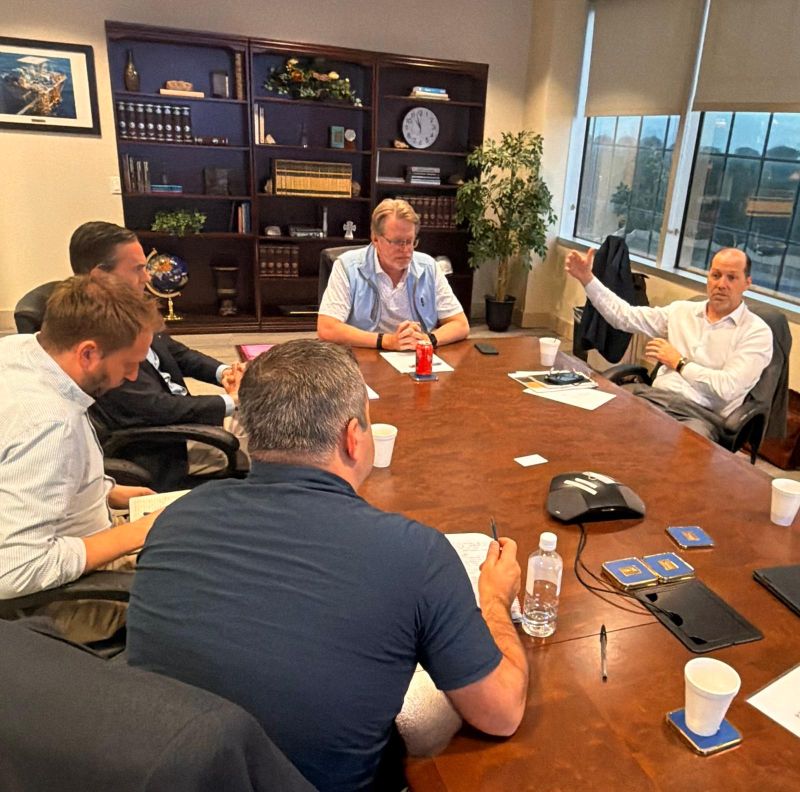
The new company's name reaches back to the year of the Kermac No. 16 well, an early offshore milestone beyond sight of land. Its stated strategy is to acquire producing assets, improve operations and develop additional opportunities. Jeff Currie, formerly Goldman Sachs's commodities research chief, and resource-company builder Ivan Murphy are part of the leadership group.
On September 28, 2026, 1947 began trading on London's AIM market, alongside completion of its Renaissance Offshore acquisition. The acquired business supplied interests in 11 mature shallow-water fields. Duncan again had an operating base from which to pursue further deals. The setting is familiar; the company and stock exchange are new.
After more than three decades in the industry, his career still returns to the same practical curiosity: what can a capable team do with assets that invite a second look? The Gulf has supplied several answers already. At 1947, Duncan has arranged to keep asking.
Keep following the current
Conversations, company updates and the next chapter.
1947 Oil & Gas leadership ↗Timothy S. Duncan on LinkedIn ↗Expand Energy board biography ↗The Talos Energy profile ↗The 2017 Energy Council conversation ↗Duncan on Zama and engineering careers ↗Listen: the carbon storage conversation ↗Watch: 1947 Oil & Gas lists on AIM ↗Watch: 1947's producing-assets strategy ↗Read: the September 2026 London listing ↗