The useful thing about a 185-foot boat is that it makes vague strategy impossible. A founder can waffle about vision in a pitch deck. Steel is less accommodating. It needs a design, a shipyard, crews, maintenance, fuel and enough paying work to justify every foot. In 2017, C-Dive put that sort of commitment into the Gulf of Mexico with DSV 217, a new saturation dive support vessel delivered while much of the offshore market was retrenching.
The timing looked backward. Oil prices had fallen. Support vessels were being cold-stacked. Older diving companies were fighting the cost of capital equipment. C-Dive, founded in Houma, Louisiana, in 2008 by commercial diver Robert "Robbie" Champagne III, chose the moment to add new capacity. Not a discounted conversion, but a vessel designed around the work.
That distinction is the story. C-Dive was not making a heroic bet that oil would immediately roar back. It was betting that customers would still have pipelines to inspect, leaks to repair, platforms to remove and wells to plug - and that a newer, task-specific vessel could win that work against an aging fleet.
A diving company, not a scuba shop
Commercial diving is closer to underwater industrial construction than recreation. C-Dive's people inspect platforms, cut and weld pipe, install anodes, clear debris, repair risers and help remove infrastructure that has reached the end of its life. The customer is an energy producer, pipeline owner or marine contractor whose problem happens to sit below the waterline - often in poor visibility, around heavy equipment and under a thick layer of regulation.
The company sells project execution, not tickets on a boat. A job can combine a dive crew, vessel, crane, decompression chambers, remotely operated vehicle, inspection equipment and project management. Surface diving handles work where a diver can return between shifts. Mixed gas extends the range. Saturation diving keeps crews under pressure for multi-day assignments, reducing the repeated decompression that would otherwise consume the schedule.
One company, three pressure regimes
BELL
Around that core, C-Dive accumulated adjacent tools: pipe-lay and recovery barges, jet sleds for burying or uncovering pipeline, hydraulic shears and grapples, nondestructive testing, underwater video and photography, and ROV inspection. The business model is project-based and enterprise-facing. Its edge is the ability to package expensive parts that customers would otherwise coordinate across separate vendors.
Customers buy fewer handoffs
An offshore operator does not wake up wanting 12 hours of saturation diving. It wants a pipeline back in service, an old platform removed or a regulated site cleared without an incident. Depth is a technical input. The commercial product is a completed scope with fewer points of failure between the vessel owner, dive contractor, inspection crew, crane operator and project manager.
That explains where C-Dive fits in the market. At one end are labor-only specialists that can supply qualified people but depend on somebody else's vessel and equipment. At the other are large offshore contractors with global fleets and balance sheets sized for major developments. C-Dive occupied the middle: regional enough to mobilize from Houma, yet integrated enough to own key vessels, yards, cranes and dive systems. Its customers ranged from upstream producers and midstream pipeline owners to marine contractors managing larger packages.
The difference becomes more valuable as offshore assets age. New construction rewards reach and installation capacity. Late-life work arrives as a messy list: inspect the structure, isolate the line, cut and recover pipe, plug the well, remove the platform and document the cleared site. A contractor that can carry more of that sequence reduces interfaces and schedule risk. C-Dive's expansion into decommissioning was therefore not a fashionable climate detour. It followed the physical life cycle of the same steel its divers already knew.
The first thing to fail was the old fleet logic
For years, the Gulf's four-point saturation vessels were typically offshore supply boats converted for diving. That saved the cost of a new hull, but the original layout imposed compromises. Machinery moved into spaces once intended for tankage. Working decks inherited somebody else's dimensions. Crew accommodations and dive systems had to negotiate with a boat designed for a different job.
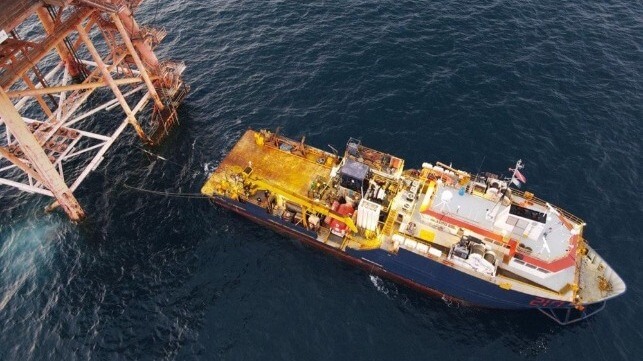
Champagne and local marine architects Tommy Parfait and Dan Duplantis reversed the sequence: start with the diving mission, then draw the vessel. A&B Industries built the result in Amelia, Louisiana. DSV 217 came out 185 feet long and 44 feet wide, with a 65-by-44-foot clear aft deck, a 12-foot moon pool, a six-person saturation system, a hyperbaric rescue chamber and a 30-ton telescoping crane. Its staterooms sat on the main deck rather than being tucked into a conversion's leftover geometry.
“By constructing a newbuild, we were able to design the DSV to fit its purpose.”Robert Champagne, founder and CEO, 2018
The quote explains what changed the company's mind about the conventional route. The operating fleet was old, client expectations around safety and cost were rising, and a conversion preserved too many compromises. A purpose-built boat could be the physical answer to all three objections.
The known cost was broader than a purchase price. C-Dive accepted construction risk, financing exposure, crew requirements and the burden of keeping a specialist vessel busy in a weak market. The vessel price was not published. A later public property record offers one concrete glimpse of the wider expansion: in 2023, C-Dive paid $950,000 for 1.214 acres of light-industrial property on Dunn Street in Houma.
The accident that belongs in the story
Industrial profiles get dishonest when every hard edge is sanded away. In August 2015, while the DSV Ms. Kerci was working on a Gulf South pipeline plug-and-abandonment job, a gas release caused an explosion and injured workers. The resulting federal litigation examined the contracts and insurance obligations around the project. It is a reminder that in this market, “execution risk” is not a spreadsheet euphemism.
C-Dive's public culture places safety first, followed by quality and customer satisfaction. Its divers carry commercial qualifications, and the company says its workforce follows client, association and government rules. Those systems matter because the conditions do not forgive improvisation. Safety is both an ethical obligation and part of the product being sold.
From a sharp wedge to the whole job
The company says it began with three people working out of a marsh. By the 2020s it reported more than 100 divers and tenders, three Intracoastal Canal locations and roughly 1,900 feet of combined waterfront. The fleet grew to include surface and saturation vessels and the 260-foot Speedy lay-and-recovery barge. A 2019 Louisiana small-business award marked the local expansion.
Then the name stopped fitting. In 2023, C-Dive became Champagne Energy and Environmental Solutions, or CEES, as it pushed beyond diving into marine construction, decommissioning, environmental remediation and renewable-energy work. This was less a pivot than a zoom-out. The diver remained the wedge; the addressable job became everything required to inspect, maintain and eventually remove an offshore asset.
Three people and a marsh.
C-Dive starts in Houma.
First vessel.
Ms. Kerci adds owned surface-diving capacity.
The contrarian build.
Purpose-built DSV 217 enters service.
The name widens.
C-Dive becomes CEES.
The platform integrates.
CEES joins the Chouest Group.
In March 2026, the Chouest Group acquired the business, now called Champagne Energy Solutions. The terms stayed private. The industrial logic did not: Chouest brought marine logistics, engineering and subsea robotics; Champagne brought diving, pipeline and decommissioning execution. Existing leadership and staff remained. C-Dive's journey had moved from one specialist service toward an integrated late-life-asset platform.
The part founders can steal
“Buy when everyone is scared” is catchy and mostly useless. C-Dive offers a more disciplined version. First, find an expensive constraint the customer already understands. Second, design the asset around that constraint. Third, pair the hardware with scarce operating expertise. Fourth, expand into adjacent steps only when the same crew, vessel or customer relationship gives you an advantage.
Converted vessels forced diving work into layouts built for another mission.
Deck, beam, moon pool, chambers and crew spaces followed the workflow.
Divers, vessels, inspection, pipe work and project management traveled together.
Without utilization, financing and specialist labor, the moat becomes overhead.
The strategy does not travel everywhere. It fails when demand is merely cyclical hope, when a general-purpose asset can do the job almost as well, when debt matures before the market returns, or when trained labor cannot be recruited and retained. It also fails if one customer controls the schedule. Purpose-built equipment has low tolerance for idle time.
That is why DSV 217 is more interesting than a generic tale about courage. C-Dive had founder-market fit in the literal sense: Champagne had spent decades as a diver, supervisor and project manager. The company had existing relationships, an operating base and work that could feed the vessel. The new boat amplified a system already in motion.
Eighteen years after its founding, C-Dive's lasting lesson is precise. Small companies can win asset-heavy markets when they know exactly which compromise to remove. The trick is not to own more steel. It is to own the steel that makes the customer's difficult job measurably easier.