A billion-dollar sale makes a tidy ending. Randolph Newcomer appears to prefer a working sequel. In August 2022, Riverbend Energy Group completed the sale of three non-operated oil and gas portfolios for $1.8 billion. By June of the following year, his firm was announcing an acquisition in the Williston Basin and rebuilding its non-operated strategy. The closing table had scarcely become a historical landmark before there was more business to put on it.
That sequence offers a useful way into Newcomer’s career. Known professionally as Randy Newcomer, Jr., he founded Riverbend in 2003 and remains its managing partner and chief executive. His work involves assembling interests in energy assets, managing them and finding an eventual buyer. Then comes the less photogenic part of the story: doing the assembly all over again.
Energy investment lends itself to grand declarations about the future. Newcomer’s record is easier to understand through particular transactions, particular basins and the practical business of assessing what lies beneath a piece of ground. The route to his present job began with petroleum engineering. Along the way, he added finance, boardrooms and a business that has expanded into technologies far removed from the conventional image of an oil well.
The reservoir came first
Newcomer was born in Houma, Louisiana, and raised in Houston. He earned a bachelor’s degree in petroleum engineering from Texas A&M University and an Executive MBA from the University of Houston. The combination reads almost like a map of his later career: first the physical asset, then the business built around it.
He began at Amoco Production Company in 1989. His assignments covered production and reservoir engineering, business development, and acquisitions and divestitures, all associated with the Permian Basin. These were different views of the same underlying problem. An asset has to work underground, at the surface and on the balance sheet. A persuasive presentation cannot negotiate with a reservoir.
In 1997 he moved to EnCap Investments, where he served as a vice president until 2003. There he evaluated financings involving mezzanine debt and equity. The vocabulary changed, but the subject remained energy: how projects are financed, how claims on their proceeds are arranged and how investors decide what risks they will accept.
Seen together, those jobs explain the breadth of the founder’s preparation without requiring an invented moment of revelation. At Amoco, Newcomer worked with engineering and transactions. At EnCap, he worked with capital. Riverbend brought those strands into a company of his own. He had spent years on both sides of the question that accompanies every acquisition: what can this asset produce, and what is it worth paying for?
- 1989Amoco
Permian engineering and transactions - 1997EnCap
Energy debt and equity - 2003Riverbend
Founder and chief executive - 2026Another exit
Mineral and royalty sale to Viper
Buying a share of the work
Riverbend’s business includes operated assets, non-operated working interests, and minerals and royalties. Those categories describe distinct relationships with energy production. An operator manages the work. A non-operated investor holds an interest alongside the operator. Mineral and royalty ownership gives another form of participation in the underlying resource. The distinctions matter because the responsibilities, costs and decisions differ.
For Newcomer, that range has meant building a firm with several ways to enter the same industry. It also makes a simple description such as “oil company” incomplete. Riverbend invests in energy, and its structure allows it to buy and manage different kinds of exposure to the business rather than treating every opportunity as a drilling assignment.
The 2022 sale made the scale tangible. The divested interests extended across the Bakken/Three Forks, Utica, Fayetteville and Haynesville. At the transaction’s effective date, the properties produced approximately 47,000 barrels of oil equivalent per day from more than 11,000 wells. These were non-operated interests spread across a substantial asset base, rather than one conspicuous piece of equipment with a price tag attached.
The attraction of such a story is the final number. The work precedes it: assembling holdings, evaluating production and managing the interests until a sale becomes possible. An exit compresses years of separate decisions into a single announcement. For an engineer turned investment manager, that compression is a reminder that the headline and the process run on very different clocks.
Three Riverbend non-operated portfolios sold.
More than 11,000 wells in the underlying asset base.
By June 2023, Riverbend was buying again. Its new Williston position, alongside other recent transactions, gave it a non-operated asset base in the Williston and Permian basins. Newcomer described the next phase in terms of “prudent underwriting and active asset management.” It is a fairly restrained phrase for a business whose commodity prices rarely share that temperament.
Patience has a technical vocabulary
Newcomer has also put his investment thinking into writing. In a 2020 essay on upstream private equity, he considered the gap between sellers’ expectations and buyers’ valuations, the availability of financing and the importance of experienced investment teams. His argument placed private capital inside the machinery of the industry: projects need partners willing to assess both their assets and their financing needs.
He wrote that investors were taking a slower approach, “emphasizing patience.” The observation is revealing because patience in this setting involves work. Evaluating reserves, examining land interests and conducting accounting and commercial diligence all featured in his description of how Riverbend approached an uncertain market. Waiting and preparing can occupy the same calendar.
That essay supplies a more specific account of his outlook than a string of personality adjectives would. He considered opportunity through the conditions necessary to complete a transaction. The question was how an asset, a seller, financing and a buyer’s assessment could come together. Optimism had to survive contact with the details.
His public speaking has followed the same professional terrain. An IPAA conference archive lists him as a presenter at its 2012 Private Capital Conference. In January 2023, he spoke at the Houston Producers Forum at the Petroleum Club of Houston. These appearances place him in the recurring conversation between people who produce energy and people who finance it.
“emphasizing patience”
Randy Newcomer, writing on energy investing in 2020
The room gets bigger
In 2025, Newcomer joined Gene Shepherd of VTX Energy Partners for a CEO panel at TIPRO’s summer conference in San Antonio. T. Grant Johnson, TIPRO’s chairman and president of Lone Star Production Company, moderated. The discussion covered strategic objectives, integrity, collaboration and changing policy and market conditions. The scene was familiar industry furniture: a stage, a moderator and executives comparing notes about running companies.
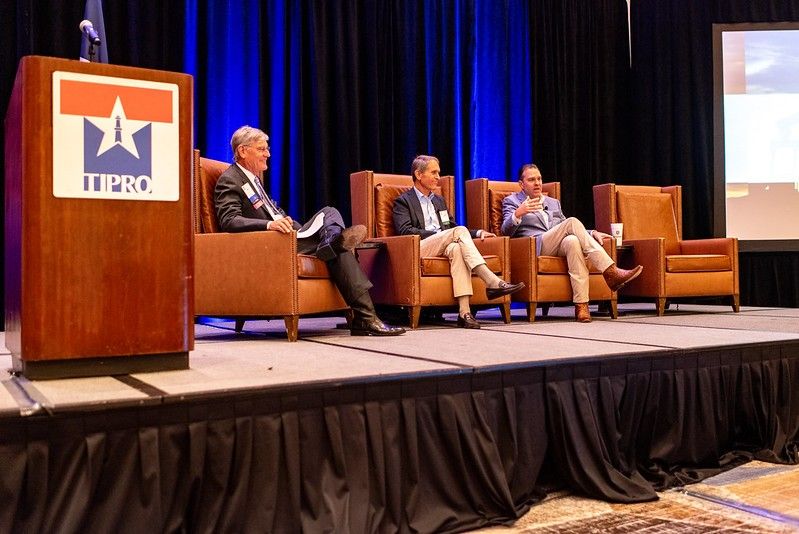
Another forum agenda places him alongside Vital Energy’s Jason Pigott and Diamondback Energy’s Danny Wesson on an “Expanding the Basins” panel at University Lands. A mineral and royalty conference lists him in a discussion about managing large portfolios, balancing existing assets with new acquisitions and considering exits. The subjects are a close fit with the actual work of his career.
His connections also run through board service at Riverbend, Ovation Energy, Chalker Energy II and III, Navidad Resources and Parsley Energy. Those appointments extend the story beyond a founder’s own firm. Board work puts investment judgment into conversation with the management and oversight of other businesses.
Scott Rice is a recurring presence in Newcomer’s public discussions. Rice is Riverbend’s managing partner and chief operating officer, with a petroleum engineering background of his own. The two appeared together on the Minerals and Royalties Podcast in October 2024, discussing Riverbend’s history and strategies in the Bakken, Midland, Delaware and Eagle Ford. Their joint appearance gives the company’s story two voices, reflecting the separate responsibilities of the chief executive and operating chief.
Beyond the familiar barrel
Riverbend’s newer investments broaden the meaning of energy in Newcomer’s biography. In February 2023, the firm led a growth equity investment in Endurans Solar, a manufacturer of materials for photovoltaic modules. The announced purpose included expanding domestic manufacturing and meeting demand for patented solar backsheets. This was an investment in a component of energy production, with a manufacturing business attached.
Later that year, Qube Technologies announced Series B funding from Riverbend. Qube’s business is continuous emissions monitoring. In February 2025, CarbonQuest announced a completed $20 million funding round led by Riverbend, with participation from Energy Capital Ventures and Aligned Climate Capital. That capital was intended to support broader deployment of distributed carbon capture technology in North America.
The examples give substance to Riverbend’s energy transition activity. Solar materials, emissions measurement and carbon capture present different commercial questions from a non-operated oil interest. They also show that the company Newcomer founded has become a home for more than the assets familiar from his early Permian assignments. His present remit spans both established production and businesses addressing how energy systems develop.
Another closing, another beginning
On July 1, 2026, Viper Energy completed its acquisition of Riverbend Oil & Gas IX, an entity owning mineral and royalty interests. Consideration comprised $337 million in cash and approximately 3.7 million Viper shares, subject to customary post-closing adjustments. The distinction matters: the cash number describes one part of an asset transaction. It does not describe Newcomer’s personal wealth or a new financing round for Riverbend.
The firm’s current headline figures include $6 billion managed across thirteen energy-specific investments since 2003, 645 closed deals and eight fully monetized funds. Those are company measures. They describe the platform Newcomer leads, with a team that includes engineering, land, geoscience, accounting and data science specialists. A founder’s name may sit above the enterprise, but the work has many desks.
Outside it, Newcomer and his wife Leslie have three children. His personal interests include sports and hunting, and his community record includes advisory involvement with Yellowstone Academy and Stoney Creek Ranch. These details locate him in a life beyond transactions, without turning a public business career into a fictional private portrait.
The durable thread is the sequence of work. Engineering at Amoco. Financing at EnCap. Founding Riverbend. Assembling portfolios, selling them, returning to acquisitions and extending the firm into other parts of energy. After more than two decades, Newcomer’s story keeps arriving at a familiar place: an asset to evaluate, a decision to make and another beginning to consider.