A basketball hoop can tell you something about a household. A low one suggests younger children. A higher one suggests older children. For Timo Rein, selling educational books door to door, that was useful intelligence before he had even knocked. The merchandise stayed the same; the conversation changed. Years before he helped build Pipedrive, he was learning to notice the person on the other side of the sale.
He also learned to leave. Polite people could absorb a remarkable amount of a salesman’s day without intending to buy anything. Rein set himself a limit of 20 minutes at a house. A clear refusal was useful. An agreeable conversation that never ended could be expensive. It is a curious apprenticeship for a software founder: learning how to make rejection arrive sooner.
Pipedrive would eventually turn a related concern into a business. Salespeople had calls to make, decisions to clarify and deals to move forward. They needed to see the next useful action. Rein’s career is a study in how an ordinary working frustration can become a product when someone stays interested in it long enough.
A psychologist at the door
Rein grew up in Estonia when it was part of the Soviet Union. Independence returned in 1991. He studied psychology, worked for four years in professional recruitment and went on to help build a sales training and consulting business. His education and his work kept returning him to people: how they choose, how they respond and what helps them perform.
In 2000, his experience included selling books door to door with Southwestern. He reached the company’s top one percent of salespeople. That distinction sounds tidy on a biography. The underlying work was less tidy. One person called the police on him. The job offered immediate feedback, occasionally accompanied by a request to leave the property.
His later advice carries very little of the swagger usually attached to selling. Understand the customer. Make the next step specific. Give someone room to decline. There is an appealing practicality here: a person who can comfortably refuse you can also consider your offer without spending the conversation planning an escape.
“Your mission is to understand them.”
Timo Rein, on prospective customers
The hundred-page detour
At Vain & Partners, Rein worked alongside Urmas Purde and Peep Vain. Training other people to sell gave Rein and Purde plenty of occasions to inspect the tools of the trade. They wanted help managing their own sales work, too. The available software left them dissatisfied. A system could be excellent at telling a manager what had happened and still be cumbersome for the person trying to make something happen.
An early attempt to turn their idea into software yielded a specification roughly 100 pages long. Rein remembered it dating to around 2005. The document made the undertaking look larger and more daunting. They put it aside. In his retelling, they still had it years later, an unusually substantial souvenir of a project that had not yet become a product.
That detail improves the familiar startup origin story considerably. There was an idea, then a long document, then a wait. Expertise in a problem did not automatically provide expertise in building software. The eventual opening came through Purde’s work with Estonian technology entrepreneurs. People with complementary experience began talking.
Five founders, and a smaller promise
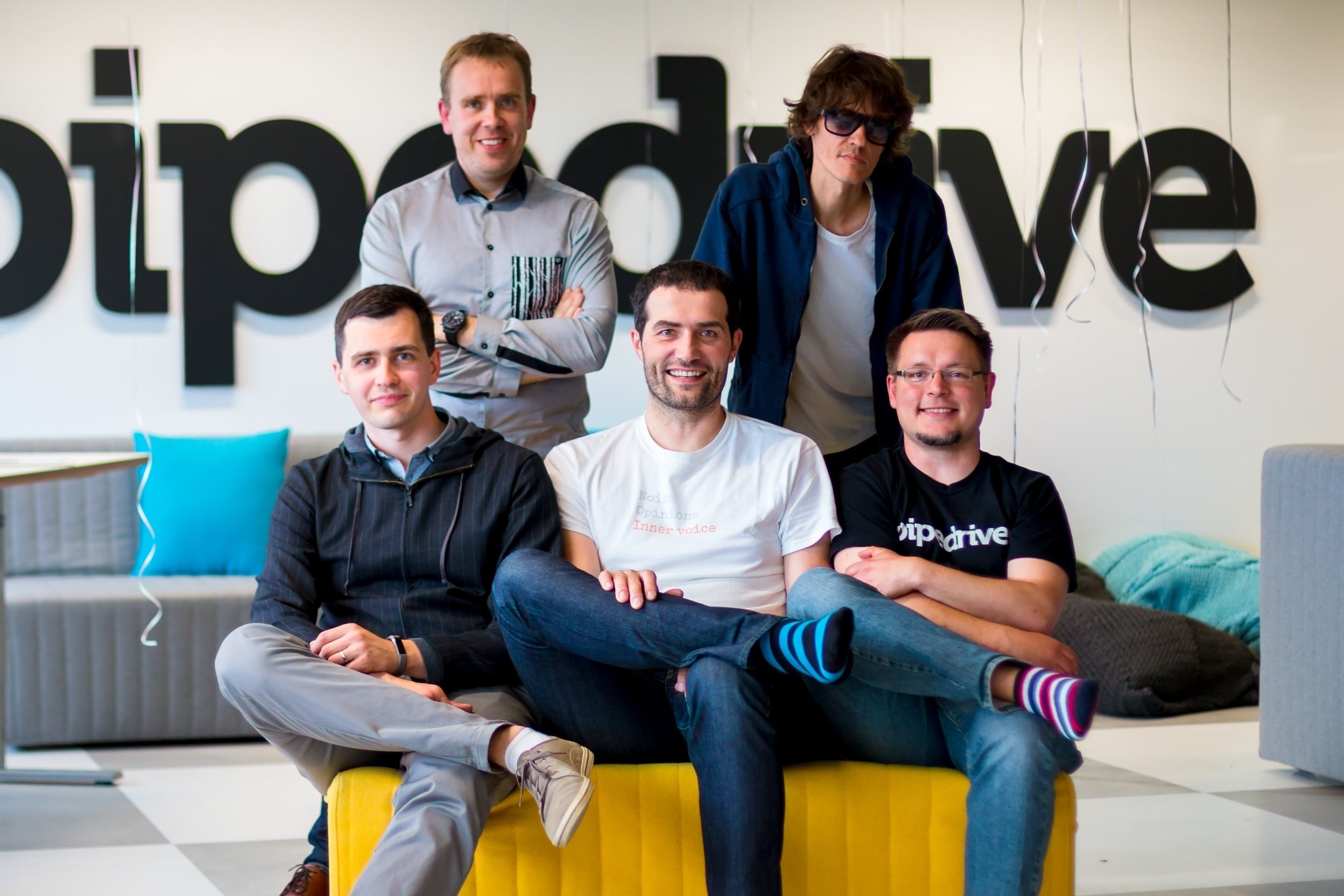
In 2010, Rein and Purde founded Pipedrive in Tallinn with Ragnar Sass, Martin Henk and Martin Tajur. The group brought sales experience and software experience together. The early product was built in a summer house, with founders and engineers working late nights and weekends. Its original name was Growty. Even promising software sometimes benefits from a second conversation about the name.
The product’s proposition was deliberately close to the salesperson’s day. Put the deals where you can see them. Make the stages understandable. Help the user follow up. For a small business, a tool has to justify the time required to learn and maintain it. A demanding installation can consume the very attention the purchase was meant to recover.
Pipedrive joined AngelPad in San Francisco in 2011. An early investment announcement described a product focused on small teams of up to 15 users and already used by more than 1,500 organizations in over 50 countries. A modestly sized team was addressing a geographically broad problem. The audience did not have to be large inside each company to be large across the world.
- 01See the opportunity
- 02Agree the next action
- 03Follow up
- 04Record the outcome
An editorial illustration of the selling approach behind Pipedrive.
A target you can actually do
Rein’s writing about sales culture makes the logic concrete. Asking someone to achieve a certain number of sales leaves a great deal dependent on other people. Asking for a planned number of product demonstrations gives that person work they can schedule and complete. His example was 30 demonstrations in pursuit of 10 sales, with the activity goal informed by the anticipated conversion rate.
The arithmetic is a planning example, rather than a promise that buyers will cooperate. Its attraction is the shift in attention. A salesperson can prepare a demonstration. A salesperson can make the follow-up call. A customer retains the right to buy something else, buy later or disappear into the respectable silence of an unanswered email.
Rein extended the same thinking to recognition. A team should acknowledge retention work and other contributions alongside closed deals. He argued for sharing knowledge and making room for team activities during working hours. Someone who had learned to tolerate rejection at strangers’ doors was also interested in what made colleagues want to stay in the room.
The difficulty of keeping it simple
By 2017, Rein described Pipedrive as a business for ambitious, growing sales teams. The original complaint still shaped his explanation: too much CRM software served senior management while overlooking the people doing the selling. It is an awkward situation when the person expected to keep a tool updated receives too little help from using it.
At a 2018 conference appearance, he returned to the design problem of combining simplicity with usefulness. Adding features is easy to explain. Removing complexity requires deciding whose work matters most. Pipedrive emphasized accessible onboarding and configuration that smaller companies could handle. The user’s patience became part of the design constraint.
“When a tool is bloated and complicated to use, people tend to throw it away.”
Timo Rein, Nordic Business Forum, 2018
That approach also changes how competition looks. A founder can spend all day comparing product checklists while a prospective customer continues to use a spreadsheet. Rein’s attention to ordinary working habits helps explain why a busy software market could still contain an opening. A market can be crowded with suppliers and leave particular customers feeling poorly served.
Growth also brought financing pressure. Rein later recalled running out of money at the end of 2011, followed by roughly six months of bootstrapping and a move into positive cash flow. Near the end of 2014, another shortage required bridge financing before the Series A. These episodes sit awkwardly beside a smooth upward growth chart, which is precisely why they belong in the story. A company can be finding customers and still need to solve the less photogenic problem of paying for the next stretch of work.
A world map comes with meetings
International growth introduced problems that could not be solved by rearranging a sales pipeline. Rein spent about four years in the United States. He encouraged other founders entering that market to live there and learn directly from experienced entrepreneurs and investors. He also stressed the importance of simple, immediately understandable messaging in a noisy market.
Running a company across countries meant thinking carefully about local leadership. A friend willing to relocate was not automatically the right person to lead a particular office. People needed someone who understood their setting, alongside contact with the broader company. Rein acknowledged mistakes in keeping teams informed and connected. The account is refreshingly short of retrospective perfection.
The practical answer involved regular communication. Later, he described company town halls, weekly individual meetings with much of his leadership team, shared tools and extensive documentation. A distributed company needed information to travel reliably. The founder who wanted salespeople to see their next action had acquired another job: making sure colleagues could see what everyone else was doing.
2010Five founders start Pipedrive in Tallinn
2011AngelPad brings the team to San Francisco
2020Vista majority investment announced
What survives the CEO years
Rein’s time as CEO ended in 2020. In November that year, Pipedrive announced an agreement for a majority investment from Vista Equity Partners. At the announcement, the company reported sales teams at more than 95,000 businesses using its software. Existing investors including Bessemer, Insight, Atomico and DTCP would remain minority investors.
The company later passed 100,000 customer businesses. Its account of that milestone included an early investment from Shaquille O’Neal and even a login from Antarctica. For software conceived around the everyday work of sales, the map had become rather expansive. By May 2025, Pipedrive had appointed Paulo Cunha as CEO, continuing the business beyond its founding leadership.
Rein’s subsequent work includes an advisory role at Camber Partners and a seat on Modera’s supervisory board. His public interests have included building useful products, recognizing repeatable business patterns and helping human talent develop. Those interests connect the recruiter, the sales trainer and the software founder without requiring a new personality for each job.
The basketball hoop remains a useful place to end. Before the pitch, there was something to notice. Before the software, there was someone trying to get a day’s work done. Rein’s contribution was to take that person seriously enough to build around the task. The next action might be a call, a demonstration or a graceful goodbye. It ought, at least, to be visible.
More from Rein’s working life
Read, listen and explore the conversations behind the career.
- Pipedrive - company website ↗
- Timo Rein on LinkedIn ↗ · Twitter / X ↗
- The early Pipedrive story - 2013 interview ↗
- Rein on the lessons of door-to-door selling ↗
- Listen: taking an Estonian company abroad ↗
- His 2018 conversation about product simplicity ↗
- Rein’s 2021 founder Q&A ↗
- Watch on YouTube: Pipedrive’s 100,000-customer milestone ↗
- Camber Partners’ advisors ↗ · Modera governance ↗
- Pipedrive’s May 2025 CEO appointment ↗