In a sales office, the most expensive sentence is often the first one after hello. A name and a phone number are easy to buy. A good reason to call is harder. Gagein, founded in 2009, set out to find that reason in the vast and unruly stream of business news. A company raises money. Another hires a new executive. A third opens a market or launches a product. To a hurried reader, these are headlines. To a seller with the right offer, one might be the start of a conversation.
The short version
- Gagein scanned public company sites, media and social sources for business events that might signal a sales opportunity.
- Its 2014 Salesforce app placed those events beside account records; a later release ranked prospects by predicted potential.
- Individual use began free in 2013, with reported paid plans up to about $50 a month. The Salesforce edition used per-seat subscriptions.
- GageIn for Salesforce won the 2014 CODiE Award for best CRM solution.
The company’s earliest public pitch was broad. In a 2010 announcement, CEO and co-founder Luosheng Peng described a platform for tracking businesses, connecting them and helping them grow. That proposition could have served almost anyone in business. By 2013, the public descriptions had become more pointed: track accounts, find prospects, research them and get a trigger alert when something changes. In 2014, the invitation was narrower still. Open a Salesforce account. See what happened. Make the call.
A list is not a reason
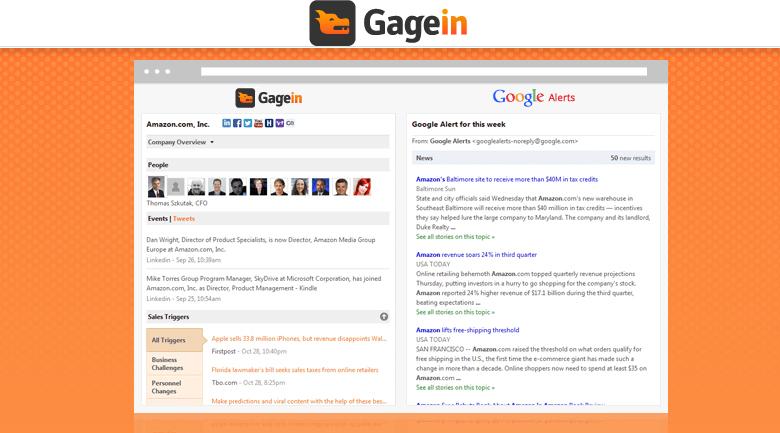
Consider the ordinary alternative: a spreadsheet of firms matching a territory, industry and size. Such a list can tell a salesperson where to begin, but it cannot say why Tuesday is better than Thursday. Google Alerts can send news, but it does not know which item matters to a particular seller. Gagein’s wager was that a useful sales tool had to join three things: the company, the event and the action. The company called these events sales triggers.
In 2013, a review described triggers for mergers, expansion, job changes, funding and new products. Users could follow companies, filter prospects, receive alerts, inspect a company snapshot called a SalesGraph and connect the result to Salesforce. The platform was especially useful where a seller followed many accounts and wanted something more specific than a generic “checking in” email. Its audience was B2B sales professionals and teams; the same monitoring could help marketing and competitive intelligence work.
That last step was where the company tried to earn its fee. A 2012 GageIn brochure said its system crawled 2 million company websites and 20,000 digital publications, then sorted the results for relevance. The figures are the company’s own description of its system at the time. Their scale explains the problem. A seller could never read that much. But software reading it all is useful only if it discards the noise with some judgment.
company websites GageIn said it monitored in a 2012 Salesforce brochure.Company-reported figure; a historical measure, not a current service claim.
The account page became the stage
Gagein’s March 2014 release made its proposition concrete. Gagein for Salesforce, a native Force.com application, put real-time news and background information directly into Salesforce account pages. It could create accounts, leads and contacts, and send breaking news to a user’s Chatter feed. The customer did not have to carry a clue from one dashboard to another. The clue appeared where the next sales action already lived.
“Sales success is all about timing.”
Timing was the pitch, but the product also had to answer “so what?” A new finance chief matters differently to a payroll vendor, a bank and an office furniture supplier. Gagein aggregated company, personnel, competitive and social background so a rep could judge whether a trigger was worth a call. In October, its next release added predictive scoring. The score combined trigger values with time, company size and momentum, then ranked a daily prospect list. A team edition added seat management, shared rules and a graphic view of corporate relationships. Salesforce 2.0 added management reports and groups for leads.
The Gagein loop / 2014
- 01 / LISTENFind the eventScan company sites, publications and social sources.
- 02 / SORTRank the accountScore a prospect using the event and company context.
- 03 / ACTMake the callPut the reason for outreach inside the seller’s CRM workflow.
This was a meaningful difference from a static contact database. DiscoverOrg and other sales intelligence suppliers also offered buying signals, while Google Alerts gave users an inexpensive stream of raw updates. Gagein’s particular emphasis was turning open-web events into a prioritized list and presenting them in Salesforce. The two firms it needed to persuade were the seller, who had to trust the signal, and the sales manager, who had to see whether it led to work worth paying for.
The price of being first
The historical price was approachable. A 2013 review reported free use and packages up to about $50 per month, with separate pricing for the Salesforce version. When the native Salesforce app launched in 2014, it was sold as a per-seat subscription. Public material does not establish the exact later price. For an individual rep, that made Gagein a small wager on better research. For a team, the cost multiplied with seats, and management reporting became part of the sales case.
Funding gave that case a larger stage. In April 2014, Gagein announced a $6.4 million Series A round from undisclosed private investors, saying the money would support staff and expansion. The company also claimed 300% monthly user growth. Neither claim tells us the size of the starting base or how many users paid, so the growth figure works best as a record of the company’s ambition, not a measure of its ultimate market share. A month later, the Software and Information Industry Association named GageIn for Salesforce its 2014 CODiE winner for best customer relationship management solution.
Gagein was also named a Yammer integration partner in 2012, a reminder of its earlier collaboration angle. The visible product arc, however, runs from a wide business network toward a specific sales workflow. There is no public account proving what internal test changed the team’s mind. The releases themselves show the practical choice: make the product less about knowing everything and more about knowing what to do next.
What the clue can and cannot say
A sales trigger is a clue, not consent to buy. A company’s new office might create demand for connectivity or furniture; it might also be fully contracted before the announcement. News can arrive late, and a score can make a weak match look precise. Gagein’s own marketing leaned on the advantage of being first to call. That advantage depends on the trigger being fresh, relevant to the seller’s offer and attached to the right person. Where purchasing happens quietly, or where public announcements trail the decision, the method loses force.
The idea remains easy to copy in miniature. Choose a narrow set of accounts. Define a handful of events that genuinely change the odds of purchase. Monitor reliable sources. Write down the specific connection between each event and the offer before anyone sends a message. Then measure meetings and opportunities created, not the count of alerts delivered. Gagein tried to automate that discipline at web scale. Its enduring lesson is smaller: a prospecting system earns its place when it supplies a defensible next sentence.