Tim Stumbles had a problem with his own presentations. He and his business partner came from enterprise careers, where explaining projects to customers, colleagues and managers was part of the job. Making the timeline took too long. Looking at the finished slide, he could see another problem: the audience might need almost as long to understand it.
There is something quietly comic about that predicament. You know the work. You have done the work. Now you must spend a portion of your working life arranging shapes to prove that the work is happening. PowerPoint, meanwhile, offers the patient encouragement of a room full of empty chairs.
Stumbles and Eddy Malik helped turn that frustration into Office Timeline, the company now called Lucen Software. The useful detail in their origin story is where they looked for the problem. They were thinking about the people watching the presentation, as well as the person making it.
The audience was the clue
Stumbles’s earlier career included enterprise software work at Microsoft and Skype. His startup biography describes experience in enterprise selling, emerging technologies and bringing products to market. Those jobs put communication close to the business itself: explaining an initiative to another person was part of getting anything done.
The founders’ experience gave them a fairly specific complaint. Preparing timelines in PowerPoint was laborious, yet the result could still be too complicated. A great deal of effort was being spent on an explanation that did not quite explain.
“Wanting a better way led to the creation of Office Timeline.”
Tim Stumbles, 2012
They chose to build a free timeline maker inside PowerPoint. Customers already used the application to present plans. Putting the tool there meant the new idea could arrive in a familiar setting, without requiring the audience to change its habits before the meeting could improve.
In his early account, Stumbles recalled being surprised by adoption and enthusiastic feedback. Other people recognized the same chore. The product’s workflow guided users through selecting a timeline, entering information and adjusting its appearance. The software handled the graphics. A very ordinary task had become the starting point for a software business.
A business inside the ribbon
The appeal of that location runs through Stumbles’s explanations of the product. PowerPoint was where the finished work needed to be shared. A timeline might originate in project software, but its next audience could be a manager, a prospective customer or a group reviewing a proposal.
By 2015, he was explaining a Free version alongside a paid Plus Edition. The paid product included ways to import information, show task completion and manage more detailed schedules. Customers were asking for changes, and the team was making them.
In February 2015, Stumbles described fourteen releases during the preceding year, responding to a steady stream of customer requests.
Some of that work was visible in extra templates and styling choices. Some was buried in the machinery, including an algorithm for laying out slides. A clean presentation is often the public face of considerable private fussing. The audience gets the tidy version; someone else has spent the afternoon persuading it to stay tidy.
Smartsheet importing was among the additions he discussed. So was closer integration with PowerPoint, allowing users to share slides with colleagues and clients. The pattern was practical: accept that information already lives elsewhere, then make it easier to bring into the conversation.
One project, two audiences
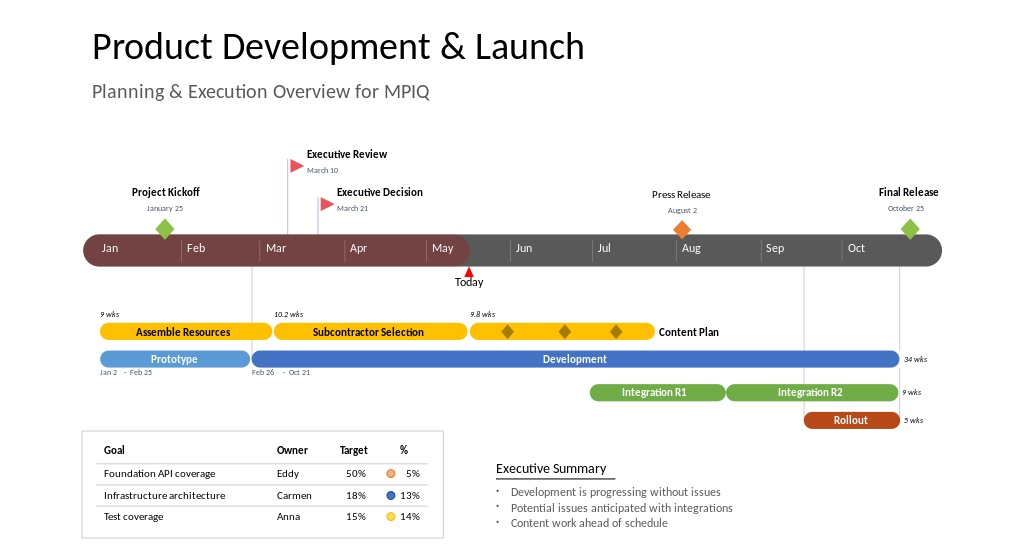
Stumbles made the audience distinction especially clear when discussing the Wrike integration in 2016. Project applications could produce detailed visuals useful to the people managing the work. Clients and executives often needed a simpler view. Both groups had a legitimate interest in the same project.
His response was to connect those worlds. Users could log into Wrike through an import wizard in PowerPoint, choose the project information they wanted to present and turn it into a graphical slide. They did not have to start the explanation from a blank canvas.
The choice of information mattered as much as the connection. The project team’s working detail and an executive’s overview serve different purposes. Stumbles was describing a product that helped the presenter make that translation, while leaving the result in a familiar, editable format.
That concern persisted. In December 2022, Stumbles introduced dependencies and critical-path functionality for the Expert plan, describing them as heavily requested by enterprise customers. The features added more scheduling information to the visual toolkit, including relationships imported from Microsoft Project or Smartsheet.
In July 2023, his introduction of Jira importing addressed another version of the same practical situation: project managers juggling systems while trying to communicate with stakeholders. Across those announcements, the product was taking on more detail while continuing to promise a usable picture.
A schedule can become more sophisticated without becoming more welcoming to its reader. That tension gives the sequence of features its interest. Each extra capability has to earn its place on a slide that somebody else will eventually be asked to understand.
In his 2020 account of the product, Stumbles emphasized ease of use. The controls should feel at home in PowerPoint, and customers should be able to begin with a template, change the appearance and reuse their work. He was talking about people who had projects to run and little appetite for a second occupation in slide design.
That emphasis helps explain the restraint of building within an existing application. The software could take care of recurring design operations while the user concentrated on what the audience needed to see. Familiarity was part of the proposition: the timeline should arrive where the presentation was already being made.
A little help across the Atlantic
Building the business also meant finding people who could help deliver it. Office Timeline entered a partnership with the Romanian software company RomSoft in 2012. In a joint interview, the founders described having a prototype that needed professional development before it was ready for the market.
They were funding the venture themselves. RomSoft’s willingness to share risk and allow a modest start mattered to the arrangement. Over time, the relationship expanded beyond development into other roles. The account describes a business growing through people who became increasingly familiar with its needs.
It is an instructive companion to the product story. The interface was supposed to make collaboration easier for customers. Behind it, the founders needed a working relationship that could survive the uneven demands of a self-funded company.
Their account of visits to Romania emphasized familiarity, trust and a flat working structure. For all the talk that software invites about scale, a young company still depends on particular people agreeing to work things out together. The international partnership supplied an essential part of that company’s capacity.
A cowboy with a calendar
Omair Sarwar offered a more colorful description of Stumbles in a podcast conversation about founder-led businesses. He called him a “cowboy,” then took care to explain the compliment. He meant a thoughtful, mature willingness to act and experiment, rather than getting trapped in analysis.
It is a pleasing description for someone whose company makes schedules. The image suggests a founder willing to move while the product helps everyone else see what is supposed to happen next. Sarwar’s explanation tied that habit to the fast iteration required in product-led businesses.
Stumbles’s company biography adds another, less office-bound detail: amateur surfer. It also describes a tech enthusiast with an ambition to make complex project information easier to digest. That combination gives the public portrait a little texture. There is life beyond the meeting, even for someone who has spent years trying to improve it.
His author archive extends into stakeholder analysis, work breakdown structures and project complexity. These are the surrounding problems of the people using the software. A chart can help present a plan; deciding what belongs in that plan remains a substantial job of its own.
The name on the next slide
In June 2023, Gearbox Capital announced a growth recapitalization of Office Timeline. Stumbles was CEO at the time. He and Malik retained substantial ownership, and the transaction’s terms were private. For a business described as bootstrapped, it marked a change in the resources available for growth.
Stumbles welcomed the expertise and spoke about shared values around the team and communities. The announced plans included expanding the company’s offerings, reaching further into markets and pursuing partnerships and acquisitions. Those ambitions widened the business beyond the original presentation tool.
By May 2026, Office Timeline had adopted the name Lucen Software to reflect a broader portfolio. Its current biography identifies Stumbles as co-founder and first CEO; Omair Sarwar is now CEO. That distinction matters: founding and first leadership belong to his record, while the company has entered another chapter.
- 2012Office Timeline founded
- 2018Online product launches
- 2023Gearbox growth investment
- 2026Lucen Software rebrand
The original observation remains easy to recognize underneath that larger business. Someone understands a project. Someone else needs to make a decision about it. Between the two sits a presentation, and its quality can determine how useful the conversation becomes.
Stumbles’s contribution began with taking that small piece of working life seriously. A timeline was worth improving because it stood between people trying to understand each other. There is a modest courtesy in the idea: before asking the room for its attention, give it something it can follow.
Continue the conversation
- Tim’s writing and company biography
- Tim Stumbles on LinkedIn
- Lucen Software
- The 2012 founder conversation
- A conversation about the Plus Edition
- The 2020 project-visuals interview
- Listen: Omair Sarwar on founder-led companies
- The founders’ RomSoft partnership interview (PDF, pages 13-16)
- The 2023 growth investment announcement
- Watch: Lucen Software’s official YouTube channel