A hammer and a home coffee grinder are awkward objects to put on a curriculum vitae. Tim Keane’s early company story has room for both. The founding team at TYBR Health used versions bought at Walmart in its Houston laboratory work. Keane had a doctorate and international research experience by then. The shopping list was considerably less grand.
That small detail is a useful place to begin with Keane, now TYBR’s co-founder and chief executive. His career has the formal architecture of a research biography: Pittsburgh, London, fellowships, Houston. But the company introduces another register. There are colleagues to find, practical tasks to solve and, eventually, investors and directors to bring into the room. The distance from one kind of work to the other is the story.
In July 2026, TYBR announced a $30 million Series A financing. It is the sort of milestone that can make the preceding years look like a straight road. Looking backward from the lab bench produces a less polished, more interesting picture. The early equipment deserves a place beside the later announcement. Even an ambitious company has to start with whatever is on the bench.
The coffee grinder comes first
The early Houston team included Keane, mechanical engineer Alex Smith and Stephen Ramon. Their work took place at JLABS @ TMC. A photograph from 2020 catches the three in lab coats, with Keane holding a sample tube up to the light. It is a working group gathered around something small enough to fit in one hand.
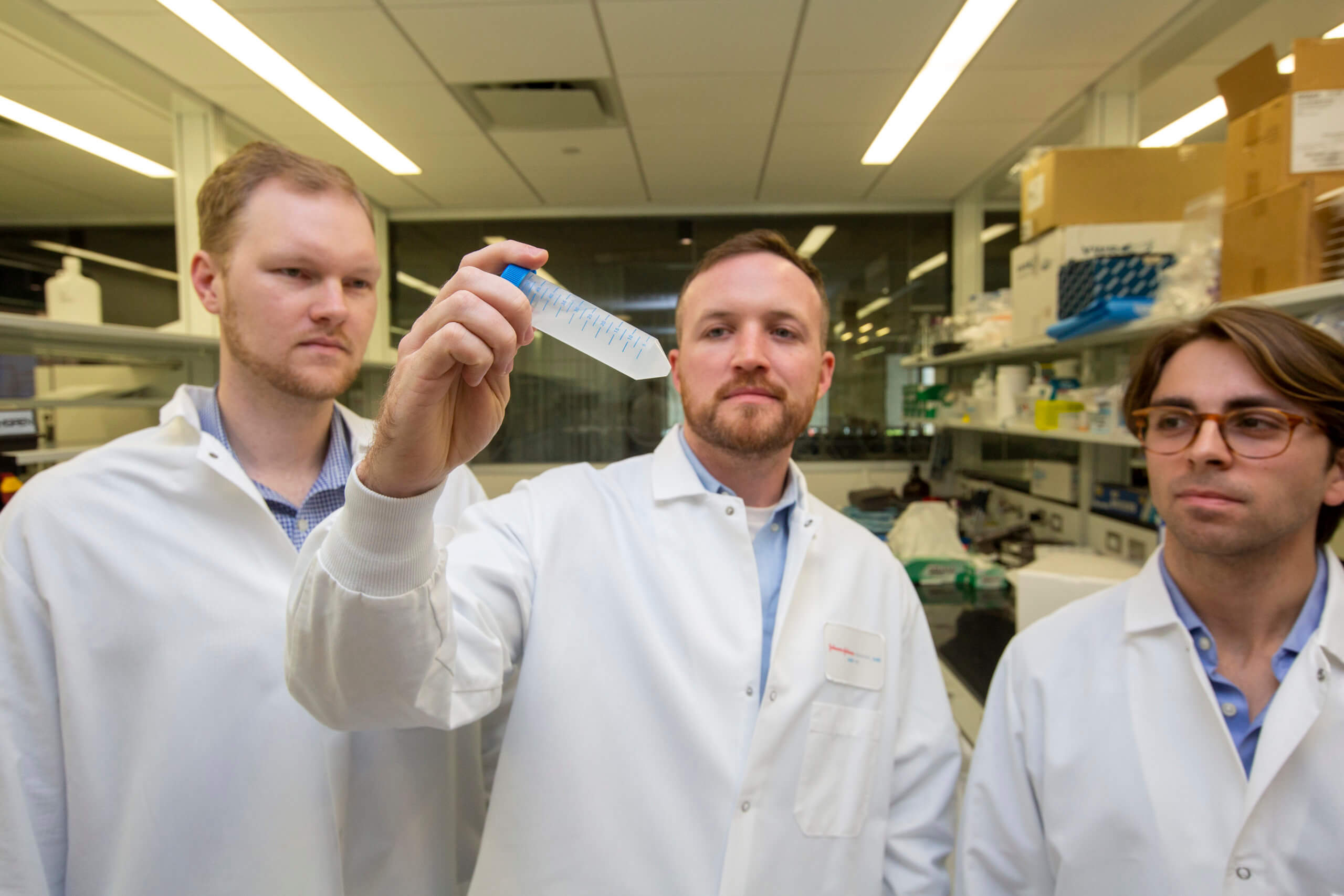
The hammer and grinder were used in early material preparation. They make a memorable pair because the objects are so familiar, while the setting gives them an unexpected job. A coffee grinder generally gets a rather narrow career. This one had been recruited into research.
There is a temptation to turn such details into a universal rule about founders. Better to keep this one at its actual size: a documented glimpse of a young team doing practical work. It neither explains every later decision nor predicts a financing round. It does, however, put some texture back into the word “startup,” which can otherwise become a collection of announcements with the labor removed.
Three cities, several kinds of education
Before Houston, Keane had spent years in formal engineering training. He completed a bachelor’s degree in chemical engineering at the University of Pittsburgh in 2011, with a minor in bioengineering. He later earned his doctorate in bioengineering there in 2016. The undergraduate and doctoral degrees give Pittsburgh a substantial place in the chronology, rather than a brief appearance before the entrepreneurial part begins.
His earlier experience included an engineering internship at MSA in 2009 and student research at the McGowan Institute beginning in 2010. Graduate research followed. These were different settings for an engineer to work in, all before the company that would eventually carry his CEO title.
London came next. From 2016 to 2019, Keane was a postdoctoral fellow at Imperial College London, working in Molly Stevens’s laboratory. His research years included a Whitaker International Scholarship and a Horizon 2020 Marie Skłodowska-Curie fellowship. The move added another institution and another country to a career still centered on research.
- Pittsburgh2011 / 2016Engineering degrees
- London2016-2019Postdoctoral research
- Houston2019 onwardFellowship to founding
Then, in August 2019, he joined the Texas Medical Center’s Biodesign program. That move placed him alongside Smith and Ramon in the group from which TYBR emerged. Houston became the setting for a new professional role. Research experience traveled with him; the responsibilities of a company founder were about to be added.
A company needs more than one kind of engineer
Keane and Smith brought distinct technical backgrounds to their partnership. Keane’s doctorate was in bioengineering. Smith’s was in mechanical engineering, earned at the University of Houston, after earlier degrees at Texas A&M. Their qualifications sat on different sides of the engineering task, giving the founding partnership more than one way to approach a problem.
Ramon, then a University of Virginia medical student, was also part of the original team. The early account is worth keeping in view alongside the later company biography, which names Keane as CEO and Smith as chief technology officer. A founding group and a subsequent leadership roster are different moments in a company’s life. Both belong in its history.
Keane’s role would eventually require him to describe that technical partnership to investors. At a 2025 presentation, he introduced himself with a modest description: “my background is on the technical side.” It is a useful orientation for understanding the career. The speaker asking investors to consider a business had first spent years learning how to investigate and develop things.
“my background is on the technical side.”
Tim Keane, LSI Europe 2025 presentation
The move into leadership placed other disciplines around that expertise. In the same presentation, Keane discussed an experienced commercial team and chairman Tom Dugan. The company was acquiring people whose previous work differed from that of its technical founders. An engineering degree can occupy one line on a biography. The people required to run the business soon need several more.
An accelerator is a date, the work takes longer
TYBR dates its founding to 2020. Two years later, it joined Y Combinator’s Winter 2022 batch. In 2024, it participated in MedTech Innovator. Placed together, those dates describe a sequence of external programs around a company that continued to develop between them.
The dates also prevent a common compression of founder stories. The company did not spring into existence when it appeared in an accelerator directory. Keane had already moved to Houston, worked with his colleagues and begun the practical business of forming TYBR. The institutional milestones arrived along the way.
A 2024 video competition supplied another small assignment: asking people to watch the company’s entry and support it on YouTube. That sits some distance from a doctoral fellowship. Yet both appear in Keane’s public professional life. The CEO’s job can include explaining the company at a conference and encouraging people to finish a one-minute video. The scale of the task varies considerably.
Keane also presented the company’s work at an industry poster session that year. The format is familiar to a researcher, even as the purpose of representing a company adds another responsibility. Across the chronology, his earlier training keeps reappearing in different surroundings.
The circle gets bigger
By July 2026, the financing announcement introduced another set of names. Vensana Capital and Mutual Capital Partners led the announced $30 million Series A, with participation from Neovate Capital Partners and existing investors. Greg Banker, Liz Todia Zambory and independent director Aaron Smith were named as joining TYBR’s board.
The figure is a company financing announcement. Its place in Keane’s story is as a marker of the organization around him: more capital, new investor relationships and additional people participating in its governance. These are concrete changes in the company he co-founded six years earlier.
Series A financing announced by TYBR Health
Led by Vensana Capital and Mutual Capital PartnersEarlier in 2026, TYBR had announced Jeff Tyber’s appointment to its board. The resemblance between the director’s surname and the company’s name prompted a joke from Keane in a public post. Even a board appointment, an event usually dressed in careful corporate language, offered a brief opportunity for wordplay.
Keane has also written about the growing importance of the team around him. That emphasis fits the visible changes in TYBR’s leadership. Smith remains the technical co-founder beside him; commercial colleagues and directors bring other experience. The working group in the old laboratory photograph has become part of a larger organization.
Back to the classroom, from the other side
In August 2026, MedTech Innovator listed Keane as a panelist for a session on structuring financing rounds. The program covered such matters as equity, financing instruments and the terms founders negotiate. The researcher who had joined a fellowship in 2019 was now included in a conversation about how founders finance their next stage.
It is a fitting recent entry in this particular career. Degrees and research fellowships occupy the early years. Starting and running TYBR added a different set of decisions, involving people, money and the shape of an organization. The panel listing puts that later education into a public setting.
Keane’s path is easiest to understand when both kinds of work remain visible. There is Pittsburgh’s long period of training, London’s research, Houston’s founding team and the later expansion of colleagues and investors. There is also that coffee grinder, a pleasingly ordinary object in a professional life full of formal titles.
The financing figure will fit comfortably in a company timeline. The grinder is harder to file. It should stay in the story anyway. It gives the earlier years a physical object to hold onto, back when the people in the photograph were gathering around a sample tube and the next chapter still had to be made.