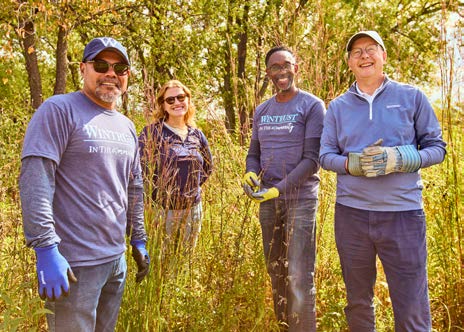
Tim Crane is standing in the woods wearing work gloves. In the photograph, taken at Greenbelt Forest Preserve in September 2025, Wintrust’s president and chief executive officer is on the right, smiling beside three fellow volunteers. It is an agreeable change of scenery for a banking executive: trees have no quarterly guidance to revise. The setting also gives his work a geography. Here is a place near the communities his company serves, with people doing something together.
Wintrust had pledged $500,000 over a decade toward an endowment supporting Greenbelt and Lyons Woods, two Lake County preserves. The scale of the commitment is understandable: a defined sum, a long period, a particular place. Much of his professional life now involves preserving that sense of proximity inside an organization whose financial statements require considerably more zeros.
Twenty-four years on the other side of town
Before Wintrust, Crane spent 24 years at Harris Bank and Bank of Montreal. He eventually became president of Harris Bankcorp, the group’s American operation. His experience covered retail and commercial banking as well as acquisitions. By the time he changed employers, he had spent a substantial part of his working life learning how banking institutions actually function: through customers, branches, credit decisions, and the people responsible for each.
His education followed a familiar Illinois route. An undergraduate degree at the University of Illinois Urbana-Champaign was followed by an MBA in finance at the University of Chicago. Executive leadership programs at Ivey and Northwestern’s Kellogg added further training. The combination put formal finance alongside years of managing banking businesses. The training accompanied a career spent managing the everyday decisions of banking.
At Harris, the business he led included more than 240 retail locations. His work also brought experience with operations in Canada and Mexico. He spoke at financial conferences and served as a faculty member for banking schools. These are useful details about a banker whose later public arguments often concern the delivery of service rather than a new financial invention.
He joined Wintrust in August 2008. The promotion sequence afterward was patient. Corporate treasurer in January 2016. Executive vice president, senior market head and treasurer in February 2017. President in February 2020. The responsibilities included oversight of subsidiary banks, banking operations, and treasury. Those jobs placed him close to both the local businesses and the machinery holding the group together.
A handover in an uneasy spring
Wintrust’s founding story belonged to someone else. Ed Wehmer and his colleagues opened their first storefront community bank in Lake Forest in December 1991. The premise was straightforward: customers would value a bank that knew them and understood their needs. Over the following decades, that proposition developed into a larger group. Crane arrived well into the story and became one of the people responsible for its continuation.
Before stepping aside, Wehmer described Crane as a partner in the company’s major decisions since 2008. The appointment followed a deliberate succession process. That endorsement matters because the founder was entrusting someone else with an institution he had spent three decades building. Crane’s familiarity with the organization gave the handover a foundation extending well beyond the announcement.
Crane joined the board in January 2023 and became CEO on May 1. The calendar supplied an awkward backdrop. That spring, regional bank failures had brought questions about liquidity, risk, and financial strength into everyday conversations. Customers were looking at institutions they had previously taken for granted. A banking leadership transition now took place amid an industry-wide examination of trust.
Crane described the response to the uncertainty: communicating the company’s financial position and its approach to lending and investing to customers, employees, regulators, shareholders, and communities. These were different audiences with related concerns. They needed understandable information about the same business. A community-banking promise acquires urgency when the customer wants to know whether the money will be there.
“Every time we tell a story, we get a chance to win.”
Tim Crane, 2024
His account of that period returns to communication. The task was to explain the institution and its position while people were paying unusually close attention. The sentence about storytelling sounds like something from a marketing meeting. In that setting, it carried a banker's obligation to make the facts comprehensible. Reassurance had to rest on something more substantial than a soothing voice.
Wehmer remained involved as founder and senior adviser. The leadership transition proceeded smoothly, and Wintrust continued expanding its presence in lower-income neighborhoods. Continuity is a modest word to put on a leadership achievement. In a nervous banking spring, it was also an outcome worth having.

The name above the door
Crane’s central management problem becomes easier to see at branch level. A customer may know a Wintrust bank by a local name. The larger organization can provide services that extend beyond that neighborhood, but the customer relationship still has a local address. Maintaining the connection requires decisions about what managers nearby are allowed to do.
Crane’s explanation of the model starts with the customer-facing work. He argues for keeping as much of that interaction local as possible, with community leaders empowered to respond to clients. Shared resources can support the business around them. The arrangement gives his preference for relationships an operational meaning: someone has to decide where authority sits.
The question grew more tangible in West Michigan. On August 1, 2024, Wintrust completed its acquisition of Macatawa Bank Corporation. Macatawa’s bank, headquartered in Holland, brought 26 branches across Kent, Ottawa, and northern Allegan counties, including Grand Rapids. The expansion introduced Wintrust to communities with their own established banking relationships.
Macatawa became the group’s 16th community-bank subsidiary. Its name remained. Crane pointed to the bank’s deposits, asset quality, leadership, and customer-focused culture when explaining the attraction. The transaction subsequently received a Crain’s M&A award. For the broader Crane story, the telling detail is the choice to grow through a bank whose local identity continued to matter.
Community knowledge
Local decisions
Technology and support
Group oversight
An explanation of the operating approach Crane describes, rather than a formal organization chart.
There is a practical tension here. Every additional market increases the distance between the executive office and some customers. Local leaders need room to respond, while a public banking company still needs controls and oversight. Crane’s earlier responsibilities across banks, operations, and treasury make sense in that context. He had worked on the connections before inheriting responsibility for the whole.
A banker in work gloves
His civic commitments extend beyond a company volunteer photograph. Crane’s board roles include Metropolitan Family Services, the Millennium Park Foundation, and ProSight. He is also a trustee of DePaul University. Those connections place him in organizations concerned with Chicago’s families, public spaces, education, and the banking profession. The city appears in his biography through institutions as well as employers.
In November 2023, Metropolitan Family Services honored Wintrust with its Legacy Award, with Crane accepting on the company’s behalf. The distinction belongs to the organization’s support, and his role connected the recognition to its leadership. It is a useful example of how a bank’s civic presence becomes part of an executive’s public responsibilities.
Inside Wintrust, community engagement also has a management structure. In March 2025, the company named Amy Yuhn to a new executive role overseeing brand, engagement, and impact, including marketing, communications, and community work. Crane linked the appointment to serving clients and strengthening communities. The responsibilities had an executive owner, alongside the colleagues doing the work locally.
The greenbelt photograph offers a modest illustration of that connection. It documents participation without requiring a grand claim about anyone’s private character. There are gloves in the frame and colleagues beside the CEO. Banking statements can describe a commitment at length; sometimes a photograph usefully establishes that people actually turned up.
The cost of being available
Crane’s version of local banking includes modern delivery. He has discussed the shift toward online and mobile services alongside the continuing need for advice and personal contact. Keeping a banker available does not remove the expectation that ordinary transactions should work conveniently on a screen. Customers can reasonably want both.
In July 2026, he discussed technology spending across cybersecurity, data management, early work with artificial intelligence, and customer functionality. The range is revealing. Personal service depends partly on systems that customers may never notice until something goes wrong. Investment in those systems belongs in the same operating conversation as branches and relationships.
The financial scale is substantial. Wintrust reported $823.8 million in net income for 2025, compared with $695.0 million in 2024. At the end of 2025, it held approximately $71.1 billion in assets. These figures describe the institution Crane leads; they also establish how far the business has traveled from its storefront beginnings.
On the October 20, 2026 earnings call, Crane reported a seventh consecutive record quarter, with net income of approximately $239.1 million. He also discussed four branches opened during the third quarter. Alongside the earnings, those openings gave his growth strategy a physical expression: more places where Wintrust would have to make its customer promise work.
His challenge continues with each addition. A larger business supplies resources and creates more relationships to maintain. Every new branch, service, and acquisition gives Crane another decision about how the organization will behave. Back in the woods, the photograph captures a smaller unit of participation: four people, work gloves, one place. For the executive responsible for all those zeros, keeping track of the places remains part of the job.