Before Tim Cofer could decide what belonged on a supermarket shelf, his job was to find out what was already there. In the late 1980s, he worked for a Minneapolis market research agency, conducting store audits for consumer companies. The assignment gave him data. He wanted a say in what happened next.
That distinction makes a useful starting point for a career that has passed through chocolate, pizza, pet supplies and coffee. Cofer has spent decades moving closer to the decisions behind familiar purchases. Now, as chief executive of Keurig Dr Pepper, he is helping redraw the company that supplies them. The latest assignment involves buying a coffee business and preparing to divide the enlarged group. A shopping list would be considerably easier.
The education between the aisles
Cofer studied economics and political science at St. Olaf College, then earned his MBA at the University of Minnesota in 1992. His early work in consumer research helps explain the continuity across a résumé that can otherwise look like several different grocery departments. The products changed. The question of how to turn a buyer's preference into a business kept returning.
At Kraft and its successor Mondelēz, he accumulated responsibilities that went well beyond advertising. He ran Oscar Mayer and the pizza business, worked in European chocolate, and took on regional leadership. Those jobs brought factories, delivery systems and local markets into the picture. A brand could have a wonderfully persuasive idea and still need somebody to make the product and get it to the shop.
In 2010, he led the integration of Cadbury. By August 2011, he was leading the European business. In 2013, Mondelēz selected him to succeed Pradeep Pant across Asia Pacific and Eastern Europe, the Middle East and Africa. It was a move between large, varied regions, with different retail habits and different competitive conditions. The assignment required an executive who could work across markets rather than treat a familiar brand as a universal instruction manual.
- 1992MBA, University of Minnesota
- 2013Mondelēz regional leadership across Asia Pacific and EEMEA
- 2019Chief executive, Central Garden & Pet
- 2024Chief executive, Keurig Dr Pepper
His remit expanded again as chief growth officer. In 2017, Mondelēz also put him in charge of North America on an interim basis while recruiting a permanent regional leader. Growth, in that version of the job, came with an operating assignment attached. He had to work on the business already in motion while helping determine where the next opportunities might come from.
A detour into the garden
Central Garden & Pet appointed Cofer chief executive effective October 14, 2019. The change took him out of a food group and into a company serving lawns, gardens and pets. The retail shelf remained familiar territory; the contents became rather less suitable for lunch. Founder Bill Brown returned as chairman as Cofer joined the board and took over from George Roeth.
There was a personal fit, too. Cofer described himself as a dog owner and an enthusiastic gardener. He saw room to develop Central's brands and its relationships with retailers. Those interests give the career move a welcome touch of ordinary life. Even executives who spend their working days discussing consumer behavior can go home and become customers themselves.
Central's fiscal 2021 results show the scale of the task. Sales rose 23% to $3.3 billion, and diluted earnings per share increased to $2.75 from $2.20. Cofer's Central to Home strategy put investment into consumer research, digital marketing and new products. The company also added four acquisitions that year. Market conditions helped, and the result belonged to a whole organization. Still, it gave his strategy a measurable operating record.
He stayed until October 2023. Central named lead independent director Beth Springer interim chief executive when he announced his departure for KDP. The next move returned him to food and beverages, with a succession plan already laid out. He would spend a period as chief operating officer before taking the top job.
First, go to the store
KDP announced that plan in September 2023, and Cofer joined on November 6. Bob Gamgort would guide the transition and become executive chairman. The arrangement gave the incoming leader several months to learn the company's workings before assuming the chief executive title. Cofer formally became CEO and a director on April 26, 2024.
His induction included visits to headquarters, manufacturing and distribution sites, and stores with direct delivery teams. Knoxville and Northlake appeared on the itinerary alongside Dallas and Boston. There were championship football events with Dr Pepper, too. The combination matters: the brand's public theater and the less photogenic work of moving cases were both part of the business he was taking over.
His initial framework emphasized brands, the product portfolio, distribution, productivity and capital allocation. Each part placed a condition on the others. New products needed routes to customers. More efficient operations could help pay for marketing. Acquisitions had to earn their place alongside investments in businesses KDP already owned. It was a program with several moving parts and very few opportunities to ignore the loading dock.
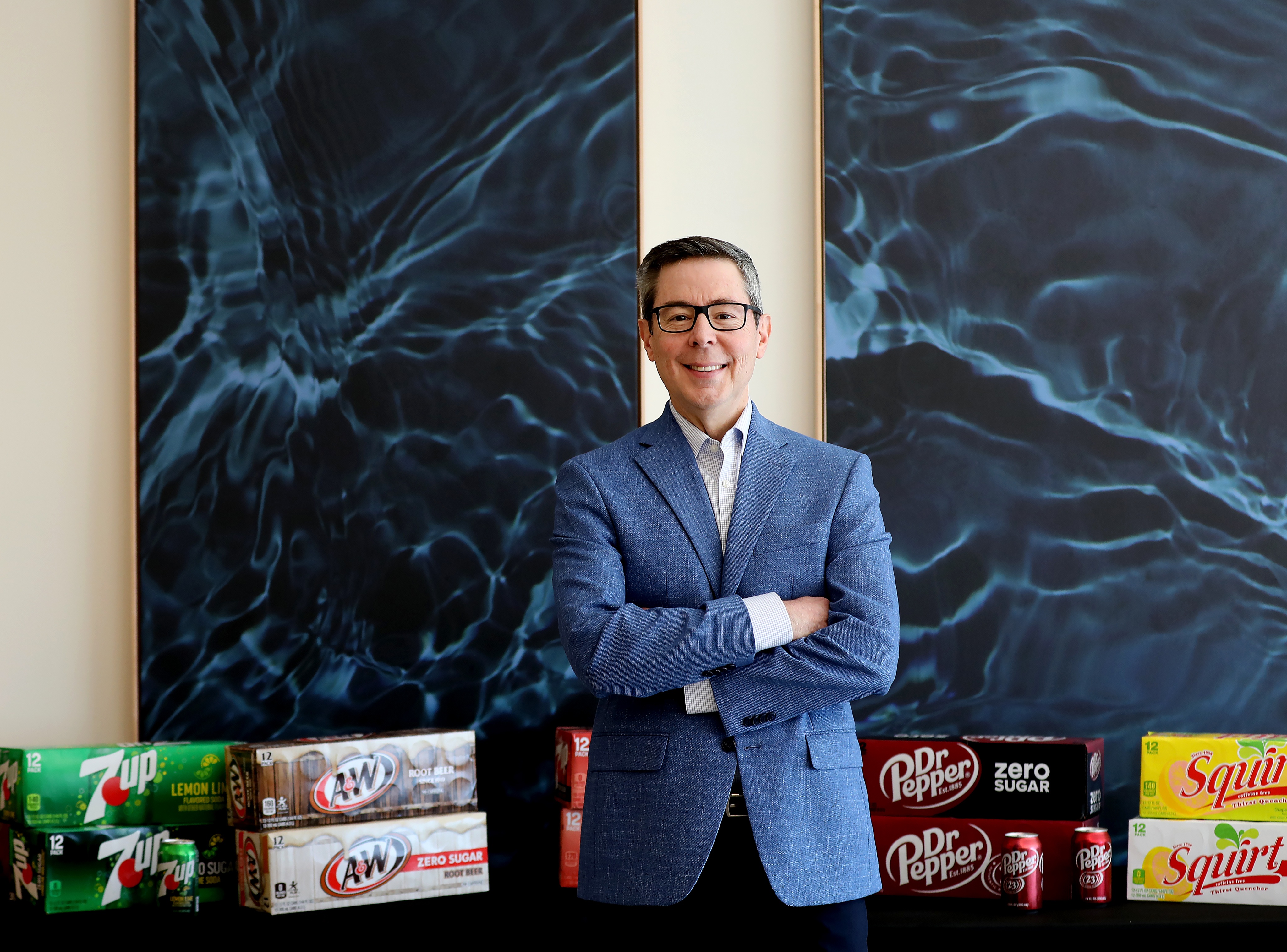
The Kalil Bottling transaction made that distribution emphasis tangible. Announced in May 2024 and completed that August, it brought production, sales and distribution assets in Arizona into KDP. The announced footprint served roughly 4,500 retail outlets. It included a Tucson production plant and sales and distribution facilities in Tucson and Tempe.
For Cofer, the attraction included closer contact with local consumers and retailers. Owning more of the delivery operation also gives a company more choices about how to use it. A new brand can travel through an existing system. More products on a delivery can improve its economics. In his September 2024 investor discussion, he described that cycle of adding business and reinvesting in the network.
“Amplifying our route to market advantage is a key investment priority for KDP”
Tim Cofer, May 2024
The chief executive takes a sip
Cofer also found a more accessible way to talk about products. Taste Test with Tim pairs the chief executive with colleagues to sample drinks and discuss the people and decisions behind them. The inaugural episode featured consumer insights director Julie Cudmore and explored Dr Pepper Creamy Coconut and Canada Dry Fruit Splash. Research had acquired a camera and a couple of cans.
The format offers a public view of a leader who is willing to participate in his company's marketing. It also puts other employees in the conversation. A discussion of a flavor has somebody who helped understand its audience sitting beside the person responsible for the company's performance. In May 2025, the second season opened with research and development executive Asif Khan.
There is a pleasingly literal quality to the series: the chief executive tries the thing he is selling. Viewers can watch rather than decode a strategy presentation. The videos are company promotion, of course. Their usefulness as a portrait lies in what Cofer chooses to put on camera: products, colleagues and the reasoning that connects them.
What a new drink needs besides a flavor
GHOST brought a different kind of decision. In October 2024, KDP announced an agreement to buy an initial 60% stake for approximately $990 million. The remaining 40% was scheduled for purchase in 2028 at a valuation tied to future performance. The distinction matters whenever the transaction is compressed into a single acquisition price. Its ownership and payment schedule had stages.
The agreement also anticipated spending up to $250 million to transition distribution arrangements before moving GHOST Energy into KDP's delivery network. Alongside the brand and its packaging sat the practical cost of changing how cans reached stores. The deal joined Cofer's two recurring interests: identifying products with room to grow and organizing the means to sell them more widely.
The first full calendar year after he became CEO produced $16.6 billion in KDP net sales in 2025, an 8.2% increase. GHOST contributed to that growth. For 2024, sales had risen 3.6% to $15.4 billion, while reported net income fell and adjusted earnings increased. Those differing measures are a reminder to read past the headline. A larger business and a better result are separate questions, even when they arrive in the same release.
Buy the coffee. Then prepare two companies.
In August 2025, KDP announced its proposed purchase of JDE Peet's for approximately €15.7 billion in equity value, followed by a separation into coffee and refreshment beverage companies. The logic was specialization: each future business would have its own operating priorities. The work required both combination and division, a demanding pair of verbs to place on one executive agenda.
Cofer designated CEO after separation
Legacy Keurig coffee + JDE Peet's
The acquisition closed on April 1, 2026, with KDP initially acquiring 96.22% of JDE Peet's shares through the offer. Cofer remained chief executive of the enlarged group and was designated to lead Beverage Co. after separation. By June, KDP said coffee operating unit head Rafa Oliveira would leave at the end of July for an outside chief executive opportunity. The board opened a search for the future coffee company's CEO.
August's quarterly results revealed the uneven terrain beneath the reorganization. U.S. Refreshment Beverages sales grew 10%, while U.S. Coffee sales fell 3.2%. Adding JDE Peet's substantially changed the consolidated comparison. Cofer had to oversee integration and preparations for separation while the underlying businesses faced different trading conditions. The coffee aisle and the soft drink aisle were providing different answers.
By September, KDP described combined U.S. coffee operations using one sales team, one invoice and one truck. It was also buying green coffee jointly and capturing initial savings. Those details bring a large transaction back down to a recognizable scale. Somebody places an order. Somebody receives a delivery. The arrangement has to work for both.
Cofer's career now spans the person recording what is in a store and the executive deciding which companies should supply it. The distance between those jobs is considerable. The connection remains easy to see. For all the acquisitions, presentations and proposed new company names, his next chapter still has to arrive on a shelf.