Louie Pastor grew up in Cincinnati with four older brothers. Before the corporate titles, before the acquisitions and the earnings calls, he had a crowded field to negotiate at home. He connects that upbringing to a thick skin and an ability to stand out. It is an economical explanation of executive preparation. Five boys would make a fairly demanding committee.
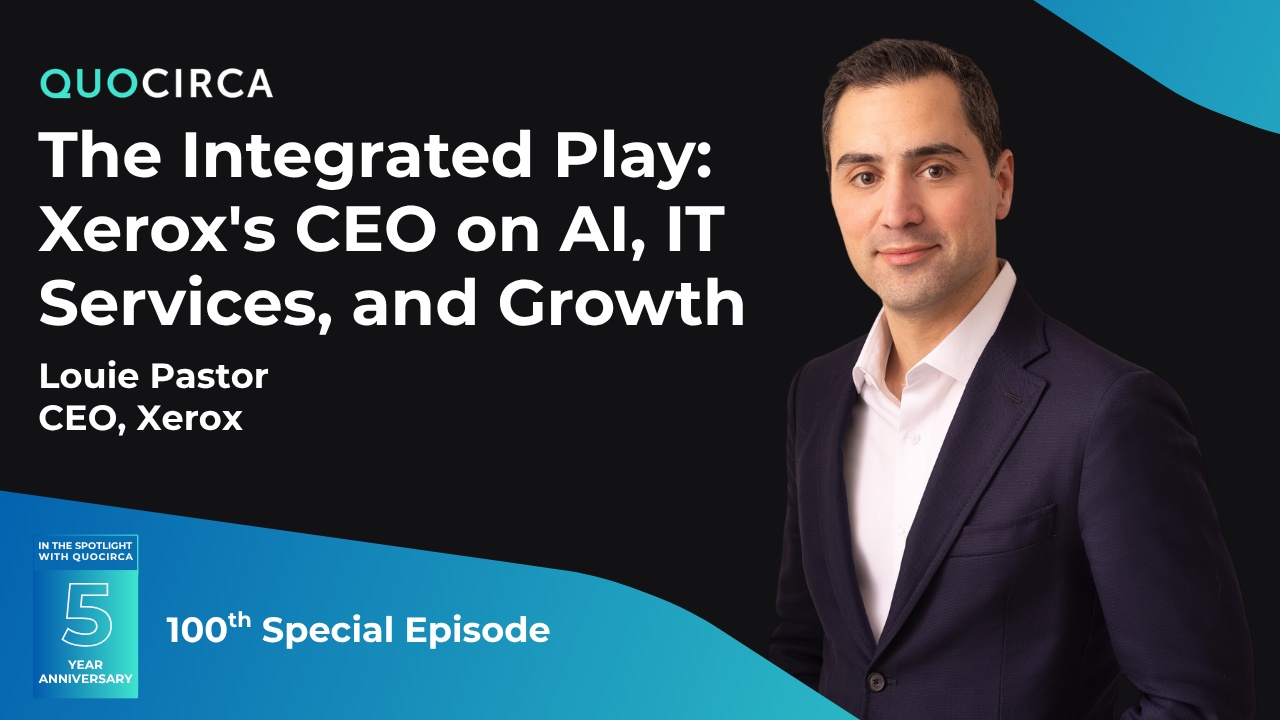
In March 2026, Pastor became chief executive of Xerox. His route there included corporate law, the investment world, a first spell at the company, a departure, and a return with a different assignment. The return is the hinge of the story. He came back to help change how Xerox operated; a little over two years later, the responsibility for the whole company was his.
Four older brothers, then a room full of lawyers
Pastor earned a Bachelor of Arts at Ohio State and a law degree at the University of Pennsylvania. He began his legal career at Simpson Thacher & Bartlett in New York, advising public companies on mergers and acquisitions, securities offerings, governance and general corporate matters. His professional starting point was the architecture of business: how companies combine, raise money and make decisions.
He subsequently became deputy general counsel at Icahn Enterprises. That work involved acquisitions and disposals, investments in public and private companies, and oversight of legal departments across operating subsidiaries. It placed him close to businesses being reshaped by owners and transactions. The later operating career had a substantial legal apprenticeship behind it.
Xerox hired him as executive vice president and general counsel in October 2018. He reported to John Visentin and joined the executive committee. His remit included legal affairs, corporate security and government-related activities. The brief was already wider than contracts alone: a global business brings its legal questions along wherever it goes.
Read backward from the CEO appointment, that first role can look like the opening move in a predetermined ascent. The record is less tidy, and more interesting. The responsibilities changed, and Pastor would leave before he returned to take on the machinery of the business.
The departure that belongs in the story
In April 2023, while executive vice president, chief corporate development officer and chief legal officer, Pastor resigned to pursue other opportunities. His departure took effect on April 28. He also entered an agreement to serve as an outside consultant for up to a year. A departure and an immediate severing of every professional connection are different things.
The distinction matters to his biography. He had stepped away from his executive posts, with John Bruno taking on substantially all of the corporate development responsibilities. Yet there remained a formal route for him to advise the company. The episode interrupts the clean line that an organization chart likes to draw through an executive’s career.
By the beginning of 2024, he was back as chief transformation and administrative officer. This time he would lead the Xerox Reinvention Office and oversee Global Business Services. Information technology, information security and real estate also sat within his responsibilities. It was an assignment concerned with the ways a company spends, coordinates and gets work done.
Xerox was introducing an operating model organized around business units. The January announcement put Pastor’s return alongside that redesign. Shared services would work across the enterprise, rather than leaving every part to solve similar problems on its own. Behind the grand word “Reinvention” sat a familiar managerial problem: persuade a large organization to act as a coherent one.
- 2018General counsel
- 2023Departure; consulting agreement
- 2024Returns to lead transformation
- 2025President & COO
- 2026Chief executive
A bigger desk, a longer list
Pastor became president and chief operating officer on September 1, 2025, succeeding Bruno. Bruno remained on the board and was to chair its new integration committee, overseeing the combination with Lexmark. The succession put Pastor into the operating role while preserving a separate board responsibility for the integration. An acquisition creates plenty of work to go around.
His COO responsibilities eventually encompassed enterprise transformation, global service delivery, revenue operations, marketing and communications, and the people and technology organizations. The list describes how far his working life had traveled from a law firm associate’s desk. He now had to help the company’s internal arrangements produce results across its external business.
On March 30, 2026, Xerox announced that Steve Bandrowczak would step down and Pastor would become CEO immediately. Chairman Scott Letier emphasized his familiarity with Xerox, operational discipline and role in strengthening the operating model. The board was selecting someone who had already been involved in the changes he would now be expected to carry forward.
“We have a strong team and a clear focus on execution.”
Louie Pastor · March 2026
For a new chief executive, execution is a convenient word. In his case, the preceding job descriptions give it substance. Service delivery, technology, revenue operations and shared services had already been on his desk.
What a deal leaves behind
The company he inherited had become larger through acquisition. Xerox completed its purchase of Lexmark on July 1, 2025, in a transaction valued at $1.5 billion including net debt and assumed liabilities. At closing, the combined organization was described as serving more than 200,000 clients in over 170 countries. That gives an operating brief a considerable geographical reach.
A combination on that scale leaves a long list of practical questions. Which products reach which customers? How do sales and service organizations work together? Where can internal systems be combined? The transaction announcement establishes ownership; customers encounter the answer through the people, devices and services that arrive afterward. Pastor’s earlier transformation work sits close to those questions.
Capital is part of the same story. In February 2026, while still COO, he helped explain a joint venture with TPG structured around certain Xerox intellectual property assets. It raised $450 million in financing, with proceeds distributed to Xerox for purposes including liquidity, transformation and possible debt repayment. A long-term license preserved Xerox’s ability to use the transferred name, trademarks and other intellectual property.
That arrangement puts two parts of his career in the same frame. Corporate transactions shape what a business owns and how it is financed. Operations determine what the business can do with those arrangements. As CEO, Pastor has responsibility for the relationship between the two. A deal can provide breathing room. The work then has to justify it.
A race with dates attached
Pastor has found a plain way to describe the pressure. During the July 2026 earnings call, he explained Xerox’s task as a race with three hurdles: debt maturities in 2028, 2029 and 2030. Stabilizing revenue determines running speed. Increasing profitability supplies the ability to jump. Reducing leverage lowers the hurdles.
It is a useful metaphor because the obstacles have dates. It also makes clear why progress in one area cannot settle every question. Better sales, better profits and a lighter debt burden do different jobs. The company needs them to reinforce one another before the calendar brings the next obligation into view.
The numbers resist a tidy ending
July brought evidence of progress and reasons to keep reading. Xerox reported second-quarter revenue of $1.92 billion, up 22 percent from a year earlier. On a pro forma basis, incorporating Lexmark in the earlier comparison, revenue fell 6.5 percent. The company was larger; the comparable business still faced a decline. Those figures describe different aspects of the same quarter.
Xerox raised its full-year revenue and adjusted operating income guidance. It also increased its Lexmark gross cost synergy target to at least $350 million. That figure is a target for integration benefits, rather than a statement that every dollar had already been saved. The distinction is essential to understanding what Pastor and his team still have to deliver.
The reported profit figures also included a $105 million pretax benefit from the recognition of tariff receivables. Leaving that detail out would make the quarter look simpler than it was. Pastor’s phrase “While we have more to prove” fits a business whose operating improvement, acquisition effects and accounting benefits must be read together.
Back on familiar ground
For a more personal view of the assignment, consider Pastor’s account of a client event at Ohio Stadium. His undergraduate years were at Ohio State; returning to a stage there as Xerox CEO carried an obvious personal meaning, which he acknowledged. More than 100 clients and technology leaders attended the event with HPE, Microsoft and Dell involved.
He came away emphasizing the conversations between sessions. Customers, he argued, increasingly manage print, infrastructure, security and AI as one environment. They want a partner accountable for the whole outcome. It is an argument for the company he now leads, and a practical test of it: the expanded portfolio has to become useful inside a customer’s working day.
On October 29, Pastor and chief financial officer Chuck Butler are scheduled to discuss Xerox’s third-quarter results. The next set of numbers will add another installment to an unfinished operating story. The youngest brother from Cincinnati has acquired a much larger room in which to stand out. His own chosen measures are already on the table.