Tim Burr’s company had a problem that more programmers could not solve. Scopic was growing, its people were scattered across countries, and too much of the organization still depended on its founder. The work of running the business needed somewhere to go. An office might have supplied a place to put the paperwork. It would have done rather less for the underlying problem.
By 2012, Scopic had reached a hundred people. Burr had started it in 2006, following more than two decades in software. The early business was heavy on programmers and light on management. That arrangement had an obvious appeal: people spent their time making things. Eventually, though, somebody had to organize all that making.
The turn in Burr’s story comes here, in the territory between writing software and building an organization. A founder’s technical competence can get a company started. As the company grows, the job changes around him. Every new colleague brings more capacity, along with another set of decisions, dependencies and questions.
The founder becomes the queue
Scopic’s answer was to add managers across operations, finance, sales, marketing and human resources, supported by internal tools. Accounting, time approval and performance reviews acquired more structure. Those are unglamorous words. They describe the parts of a business that become remarkably interesting when they stop working.
Burr’s early technical company gradually became an organization with separate responsibilities. He remained involved as teams grew more independent. That is a difficult balance for a founder: stay close enough to understand the work while giving other people room to carry it. A company can add names to an organization chart faster than it changes its habits.
Read this stretch of his career as an exercise in making growth usable. Recruiting a hundred people is a milestone. Having those people move work forward without every road leading back to the same desk is the longer assignment. In Burr’s case, the desk did not even need to be in a shared building.
Team size at three points in Scopic’s early history. Bars share a 100-person scale; they do not imply growth between dates.
A career spent adjusting the detail
Burr arrived at entrepreneurship with a long technical apprenticeship. His working life included IBM, Teradyne, Adaptive Media and Mok3, with experience on both American coasts. His academic background includes a Master of Science from The George Washington University. Before Scopic, he had participated in roughly thirty commercial software releases.
One particularly revealing artifact is a computer graphics patent granted in January 2001. It lists Timothy J. Burr as inventor and concerns continuous level of detail: ways to vary the complexity of a digital model while rendering it. A detailed object asks more of memory, transmission and processing. The engineering problem is deciding how to represent it efficiently.
There is something pleasing about finding this problem in the record of a future company builder. A business also accumulates detail. It develops more relationships, more exceptions, more information to carry. The resemblance is an editorial one; a graphics invention supplies no ready-made instructions for managing people. Still, it shows a career with substantial experience beneath the executive title.
In 2004, Burr became a vice president of engineering and lead architect at a Greater Boston company. His responsibilities included building an engineering team and overseeing complex image-alignment algorithms. Founding Scopic two years later joined those two strands of work: making software and assembling the people who could make it together.
“The company was very ‘lean and mean’, but it was not scalable.”
Tim Burr, reflecting on Scopic’s early organization
An address is optional. An organization is not.
A remote business still needs a place for a project to live. Scopic’s project management history offers a practical view of what that means. At one stage, it was handling more than 150 projects with a distributed team of almost 250 people. It had been using four different project management tools before choosing Teamwork.
The changes Burr described concerned ordinary sources of friction. Conversations needed to remain visible. People needed to find information without hunting through email. Clients needed access to their work, with permissions controlling what they could see. Reports and scheduling needed less manual handling. Each improvement addressed a specific inconvenience rather than a grand theory of the workplace.
Permissions deserve their small moment of glory here. A team needs to discuss a project internally and communicate clearly with a client; those conversations do not always belong in the same room. Software has to preserve the distinction. The virtual organization depends on these boundaries just as surely as a physical office depends on doors.
Burr said the new arrangement helped projects move faster and made clients more active participants. The larger point is visible in the details. Removing a shared office increases the importance of deciding where information belongs, who owns a task and how somebody else can understand its progress. The filing cabinet has acquired better search.
- ResponsibilityGive decisions an owner.
- VisibilityKeep the project understandable.
- BoundariesShare the right information.
An editorial reading of the management and communication problems in Scopic’s growth.
The dashboard needs an editor
Once a company can collect information, it faces another problem: deciding how much of it deserves attention. Burr’s discussion of analytics is refreshingly concerned with the cost of looking clever. Metrics require maintenance. Managers have to pay attention to them. A large collection can develop a small bureaucracy of its own.
He described building the capability internally, with a team whose financial experience developed into a combination of finance and analytics. At the time of that conversation, about five analysts were helping the business understand its operations. The task was partly technical and partly persuasive: department heads and other managers needed to use what the numbers showed.
Burr’s advice was to reduce the collection to the measures that told the necessary story. That is an editing job as much as an analytical one. A report can contain accurate numbers and still leave its reader with work to do. Selecting fewer measures forces a decision about what matters.
It is a useful glimpse of his managerial interests. He talks about the machinery behind decisions: collecting information, getting people to engage with it, and resisting the temptation to keep adding. Even a company selling technical expertise has to ask whether its own systems are earning their keep.
After the software ships
Burr’s company also expanded the work it offered clients. Software development led into design and digital marketing, with Scopic Studios becoming a sister company. The connection is straightforward. A business can pay to build an application and still need help finding the people who will use it. The handover is rarely the end of the commercial story.
For Burr, this broadens the founder’s assignment again. Development, marketing and design require different skills, while clients want the pieces to work together. The appeal of a connected service is easy to describe. Delivering it requires the same organizational patience that mattered when Scopic first needed managers.
In May 2025, another relationship changed shape. Scopic announced its acquisition of ZoomRadar, a weather visualization business it had previously helped develop. The announcement connected ZoomRadar’s radar maps and weather information with Scopic’s software and AI capabilities. Meteorologists, broadcasters and online platforms were among the users it described.
An earlier collaborator becoming an acquisition is an interesting turn for a services company. The relationship carries technical history into a new arrangement. It also gives Burr another set of practical questions: how to improve an existing product, support its users and decide which capabilities to build next. The announcement supplies an intention; the subsequent work has to supply the result.
These shifts also complicate the familiar picture of a founder. Burr’s public work now reaches from technical development to the commercial life around it. His company has to understand a client’s problem, build something useful, organize the people doing the work and support what follows. That makes the small operational decisions consequential. Each additional service or product brings another reason to make responsibilities clear. The founder who once supplied the labor has become responsible for how many kinds of labor fit together.
A company with places to go
Today, Scopic’s About page puts its team above 280 employees. Its expert biography describes a presence across more than sixty countries. Those figures suggest considerable distance between colleagues. Burr’s October 2025 visit to Poland and Ukraine supplies a more personal way to understand the map.
In Krakow, recruiting specialist Joanna Kusiak spent time with him walking around the city. Their conversations included company projects and the NFL season. The details are wonderfully ordinary: the sort of talk that fills the space around a working relationship when there is time to let it.
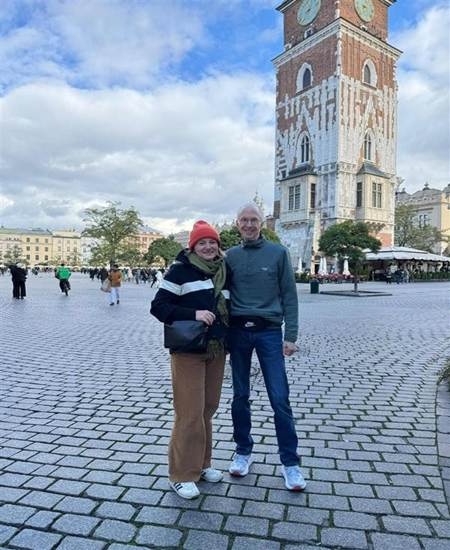
That visit gives the story a useful ending because it brings the scale back down to two people. The systems matter. So do the occasions when colleagues can spend time together beyond a project agenda. A company spread across countries contains many local lives, and its founder sometimes turns up in one of them.
Burr’s current technical interests include AI. In March 2026, he reviewed a Scopic article on AI product development, where his comments emphasized a more predictive and structured development process. The concern with making complicated work more manageable continues. The tools change; the work of choosing, organizing and understanding remains.
Scopic began with a programmer able to do the work himself. Its growth asked him to build an organization in which other people could take responsibility. Twenty years later, that is still a more interesting measure of the company than the absence of an office. There are plenty of decisions to make, and plenty of places to go.