The trouble in the room was that everyone knew something. At Manzanillo International Terminal in Panama, dispatchers knew which machines should move containers. Equipment operators knew where they were. The radio carried these pieces of knowledge back and forth. Putting them together was another matter. Terminal manager Oscar Caballero remembered a control center where “everybody was talking on top of each other.” A room full of information had become a room full of noise.
- The job: coordinate cargo, planning and equipment at marine and rail terminals.
- The edge: software born inside terminal operator Carrix, backed by implementation and support.
- The evidence: deployments at MIT, CSX, Freightliner, FIT and POMTOC.
- The useful lesson: make the operating picture reliable before automating decisions.
A yard too large to keep in your head
Before Terminal View, MIT’s controllers relied on operator updates and mental maps of the fleet. More equipment meant more positions to remember. A location report could be unreliable; the next instruction could then begin with a mistaken picture of the yard. The first thing under strain was the shared understanding of what was happening.
Tideworks’ 3D visualization gave the team a common view of equipment locations and activity. Controllers could inspect the whole yard on large screens or search for a machine on their own PCs. MIT’s account describes steadier equipment productivity and lower operating costs. The appealing detail is quieter: dispatchers no longer had to carry an entire terminal in their heads.
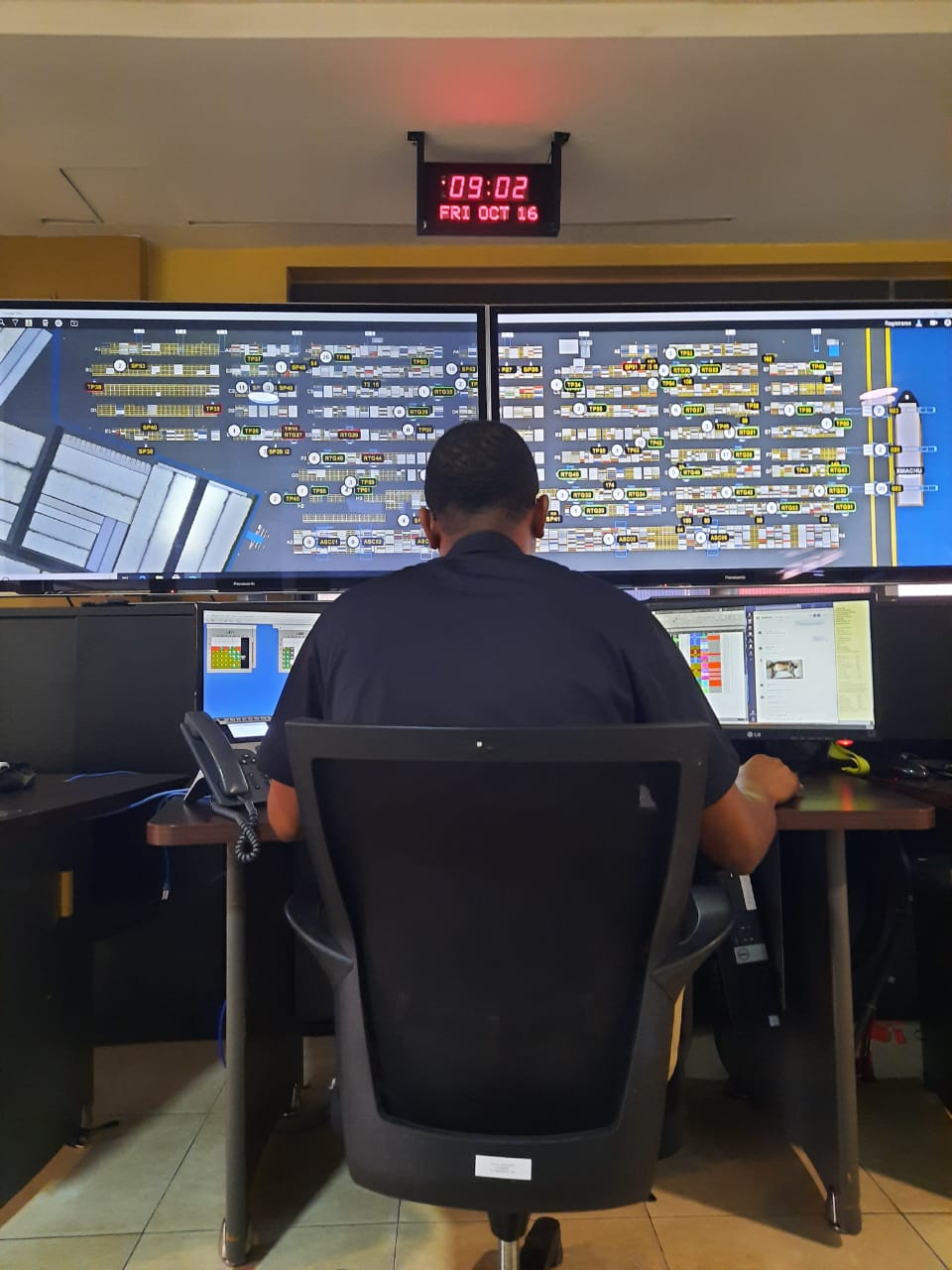
That is a useful way into Tideworks Technology. Its customers own physical operations with expensive machinery and finite space. The software helps them decide what goes where, what should happen next and which machine should do it. The value lives in the connection between those decisions.
Built by the people moving the boxes
In the 1990s, Carrix assembled a software team because it wanted an operating system it could not buy. Tideworks launched in 1999. The origin gives the business a particular temperament: its product began as an answer to the parent operator’s own problems.
A 2019 account of its development describes an early marine terminal management application on IBM’s AS/400. It lacked planning and execution systems and was hard-coded around the operation. Growing vessel sizes helped prompt the development of graphical planning. Spinnaker made the bay plan and yard visible; Traffic Control followed to execute the instructions. The product family accumulated around the work.
The names have a pleasing nautical confidence. Mainsail, Spinnaker, Forecast: a software catalogue that sounds as though it ought to come with a weather report. Underneath is a fairly sober proposition. Ports need inventory records, plans, instructions and transactions to agree.
One automated terminal became a network deployment.
CSX offers a documented example of how that proposition spreads. It selected Tideworks for its highly automated Northwest Ohio terminal in 2009. After seeing operational improvements, according to CSX’s account, it expanded the relationship. Bedford Park completed deployment across its then 31-site network in 2019, using Intermodal Pro and Traffic Control. The initial terminal gave the buyer a reason to commit more broadly.
How a plan becomes a move
The portfolio is easier to understand as a sequence than as a list of trademarks. Mainsail is the marine terminal operating system: cargo inventory, vessel activity, gate operations and associated business functions. Intermodal Pro, or IPRO, provides the corresponding operating foundation for rail terminals, including conventional and automated operations.
Spinnaker supplies graphical vessel, berth, yard and rail planning. Traffic Control takes work into electronic dispatch, coordinating equipment execution. Terminal View makes the operation visible in 3D. Forecast gives external users a customer-service portal. EDI Porter manages the messages passing between the terminal and its trading partners, including bookings, manifests and releases.
- 01 / RecordMainsail or IPRO
- 02 / PlanSpinnaker / IPRO planning
- 03 / DispatchTraffic Control
- 04 / ObserveTerminal View
Consider Freightliner. Its integration, rolled out across UK terminals in 2024 and announced in 2025, connected IPRO to Decisions, a low-code automation platform. Tideworks’ Business Rules Engine and Planning API supplied planning data. Terminal-specific rules then automated booking assignments to virtual railcars.
Freightliner reported better planning speed and consistency. The mechanism is more instructive than the broad promise: pass the data to a rule set that understands the terminal, then use it to make assignments. For a buyer, the question becomes whether the software can represent the rules that actually govern the operation.
The cab is part of the interface
At Florida International Terminal, Traffic Control went live in the first quarter of 2025. The terminal already used Mainsail 10, Spinnaker and Forecast. The addition replaced radio and paper instructions with electronic dispatch, balancing work and prioritizing container moves.
Tablets and laptops helped coordinate driver interactions so drivers could remain in their vehicles. New physical barriers were part of the safety changes too. FIT reported improvements in safety and truck turn times. Those outcomes belong to the combined operational change; the software did not independently install a barrier or teach someone how to use it.
This is where a terminal system becomes interesting to people who never visit a port. An interface can change a person’s route through a workplace. A better instruction can remove a conversation, a wait or an unnecessary journey. Good software sometimes earns its keep by giving people fewer things to improvise.
The price includes a change of habits
Tideworks sells to businesses running terminals. Its offering includes hosted subscriptions, integration, configuration, training and continuing support. In March 2026, POMTOC announced Mainsail 10 and Spinnaker running through an AWS-hosted cloud subscription, alongside existing gate and EDI tools. Moving the systems into a hosted environment reduced the need for on-site infrastructure.
The implementation work matters as much as the purchasing model. At New Orleans Terminal, Tideworks and gate technology supplier Smart-Tecs worked together on TOS, gate, appointment and yard systems. The customer case study says the integrated deployment went live in four months in 2016. That timetable describes one project, with its own partners and requirements.
A buyer should count data conversion, equipment interfaces, training and the transition into live operation when assessing the investment. This is an editorial implication of the deployment scope: the subscription invoice alone cannot describe the work required to change a terminal.
Kaleris’ Navis N4 is an alternative in this market, with its own optimization and automation capabilities. Tideworks’ case rests on its operating heritage, configurable product family and close customer involvement. Buyers can compare that proposition against their own cargo mix, interfaces and staffing. A vendor’s relationship with a terminal becomes meaningful when it helps solve the terminal’s particular problem.
The platform customers declined
In a 2026 interview, interim president and engineering head Subbu Bhat described a course correction. Tideworks had considered exposing its own TOS data platform. Customers wanted an enterprise platform encompassing information beyond terminal inventory and moves. The company shifted toward supplying data through APIs and events, with decisions able to return through APIs for execution.
“AI does not filter out noise; it amplifies it”
Subbu Bhat / 2026 interview
The lesson has some numerical context. A 2025 Tideworks and Port Technology International survey covered 121 terminal professionals. While 86% used TOS and planning tools, 30% used real-time analytics. These are survey responses across varied operations, rather than a census of ports. They illustrate the distance between owning software and having connected information.
A reader can copy the discipline behind these projects: identify a strained handoff, establish a shared record, encode the local rules and examine the result. This approach depends on trustworthy location data, working integrations and people who can handle exceptions. A broken equipment feed or an unexamined process will travel into the next system with remarkable enthusiasm.
Tideworks’ most persuasive stories are about bounded changes: a shared yard view, an electronic dispatch instruction, a booking assigned consistently. Each gives the next person a better basis for action. In a business devoted to moving boxes, agreement about the next move is a product worth examining.
Watch the moves, explore the tools
See the products at work, follow company updates, or explore the customer stories.
Company website ↗Product demos & videos ↗Terminal View demo ↗Tideworks on YouTube ↗LinkedIn ↗Twitter / X ↗Company news ↗Company blog ↗