Two hundred family interviews is a pleasing prospect until somebody has to arrange them. At California’s Ventana School, that is the scale of the recruiting season described in a Ravenna customer story: more than 200 conversations, each with a family that needs a time, a place and a chance to be heard before the decision committee meets. A school’s philosophy may be expansive. Its calendar is stubbornly finite.
The school uses Ravenna, part of VenturEd Solutions, to reduce the scheduling back-and-forth and keep the process moving. The detail is revealing. In education technology, attention often goes to what happens inside the classroom. VenturEd’s business begins earlier, with the work that gets a child into it.
- Who buys it: private, independent and faith-based K-12 schools, plus educational organizations.
- What it connects: applications, financial aid, enrollment commitments and tuition billing.
- Why families notice: fewer administrative detours between interest and enrollment.
- What to inspect: fees, integrations and the actual sequence of steps your families must complete.

01An acceptance letter has a long tail
Follow an applicant through a private school and the number of separate jobs becomes apparent. Someone answers the inquiry. Someone reviews the application. Another person assesses financial need. A contract goes out, a deposit comes in, a payment plan is chosen. Eventually, the student appears in the records used by teachers and administrators.
These jobs concern the same family, but they need different information at different times. The opportunity for software lies in those handoffs. Re-entering an address is a small nuisance. Multiplying that nuisance across families, departments and school years gives it a rather respectable career.
Ravenna Admissions handles the front of that journey. Its regional admissions platform lets families apply to multiple participating schools, while school teams manage outreach and applications. It can stand alone or connect with other systems. The wider Enrollment Suite brings admissions together with financial aid and TADS contracts and billing. Schools select the components that suit their needs.
- 01InquiryFind the school
- 02ApplicationMake the case
- 03Financial aidAssess the need
- 04CommitmentSign + deposit
- 05BillingPlan + pay
Connected records; decisions remain with the school.
Once the student arrives, TADS Educate covers attendance, assignments, grading, reporting and family communication. VenturEd positions it for small and mid-sized private schools. That specificity matters: the daily requirements of a modest school office deserve as much attention as the ambitions of a large institution.
02The tax return leaves the filing cabinet
Financial aid is where an enrollment process becomes particularly personal. A school needs enough information to assess a family’s circumstances. A family has to disclose it while making a consequential decision about a child. An upload button may look innocuous to its designer; to the applicant, it can mean another evening locating documents.
In January 2025, VenturEd announced a TaxStatus partnership for its financial aid platform. The integration retrieves family and business tax records from the IRS with consent, replacing manual tax-document collection in that workflow. The product now called Ravenna Financial Aid was previously known as School and Student Services, or SSS.
VenturEd says families can authorize IRS tax data in under a minute. That measures authorization, not an admission decision or a completed aid award.
Explore the financial aid workflow ↗The aid platform also uses an NAIS-backed methodology and provides financial reporting. Its purpose is to give administrators a more consistent basis for reviewing need. The distinction between processing and judgment is essential: VenturEd’s user terms state that schools make admissions and financial aid decisions. Faster paperwork does not enlarge an aid budget. It gives people a better chance to work with the budget they have.
03An address should only have to move once
The appeal of connected school software is sometimes best expressed by someone who has had to reconcile the records. Marilyn Hicks of Arete Scholars puts it simply in VenturEd’s customer testimonial:
“Everything communicates. It just works together.”
Marilyn Hicks / Arete Scholars
Arete is a scholarship organization, extending the customer picture beyond school admissions offices. Its TADS account describes simpler scholarship data collection, state reporting and fund disbursement. It also reports removing the need to hire seasonal bookkeepers. That is a specific operational benefit, though it should not be converted into a savings figure the account does not supply.
Reporting takes the same idea further. VenturEd’s Reporting Intelligence offering ranges from daily dashboards and built-in reports to custom analysis and executive views. Enrollment Insights combines admissions, aid, enrollment, retention, tuition and payment data. The interesting question is whether people who once saw separate fragments can now examine the same story.

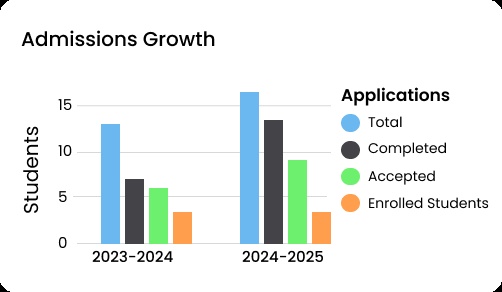
A dashboard is useful when it provokes a better question. Did more inquiries become completed applications? Did accepted families actually enroll? Does an aid pattern coincide with retention? Seeing those measures together makes such questions easier to ask; it does not establish why a family made its decision.
04The bill arrives on both sides of the desk
VenturEd sells cloud software and services to institutions, while families use the portals those institutions choose. The business model therefore has two audiences: the buyer who wants a manageable operation, and the parent who wants to finish the task.
The TADS tuition-management FAQ describes a mix of family fees and an annual school fee, with a proposal based on service needs. A buyer should examine both sides of that bill. A charge borne by parents is still part of the experience the school has selected for them.
TADS billing handles more than tuition, including incidental charges, and carries line-item detail through its reporting. Payment-plan flexibility helps schools offer different terms. For a family, however, a manageable installment schedule and a lower total price are different things. Software can administer an agreement; affordability also depends on tuition and the school’s aid policy.
There is an operational cost in changing systems, too. VenturEd describes approximately two to three months to configure and train for its SIS. The sensible demonstration is one that follows your real process, including exceptions. Bring an existing family record, an aid adjustment and a revised charge. Watch what happens when information crosses the departmental boundary.
05A new name; a more specific job
The October 2024 rebrand from Education Brands, formerly part of Community Brands, made K-12 the explicit focus. Nick Laird became CEO, and the announcement named Insight Partners and Genstar Capital as backers. The familiar product names remained useful: schools already knew Ravenna and TADS.
Its market position is easiest to understand as a portfolio of connected school operations tools. In the US, the emphasis is private-school enrollment and finance. The UK portfolio covers communications, payments, analytics, data integration and school marketing. Names such as Groupcall, WisePay and Xporter appear in that wider family.
School-software buyers have alternatives. VenturEd’s own 2026 tuition guide names FACTS, Blackbaud and Gradelink. Its case rests on connecting specialist admissions, aid and billing products while accommodating existing systems. That proposition is strongest when the handoffs are the problem. A school seeking only simple invoicing has a narrower job to solve.
06The next improvement may be one fewer click
Recent TADS changes are refreshingly concrete. The April 2026 enrollment redesign added progress bars, collapsible sections and consolidated pages. The August release introduced an optional Contract First workflow for the 2027-2028 school year: families can sign and pay a deposit before later registration and payment-plan forms. The sequencing recognizes that commitment and administrative completion need not happen in the same sitting.
The release log also records repairs, including a May fix for financial-aid blocking, intended to prevent an eligible family from signing a tuition agreement before its aid assessment was complete. These details deserve scrutiny. A connected process must preserve the right order as well as move data quickly.
Inside the company, a different kind of friction appears in an April 2026 training-provider case study. VenturEd already had Microsoft and GitHub Copilot tools, but teams needed practical help using them. Chris Parsons describes training on the company’s own work, followed by coaching across UK, US and India teams. His account reports an engineer building a Ravenna AI feature in roughly two days using an unfamiliar stack, and another reviving a product untouched for six months. These are the provider’s reported outcomes, rather than an independent productivity audit.
There is a useful lesson for any school evaluating the portfolio: follow an ordinary task all the way through. Count repeated information, unclear instructions and transfers that require someone to intervene. A polished admissions page is welcome. The more revealing moment is whether the next office already knows what the family has just told the last one.