Before a child picks up a lunch tray, somebody has ordered the ingredients, worked out the quantities, checked the menu and made sure the meal can be counted correctly. Afterwards, somebody must reconcile the money. The pizza slice is the visible part. The rest of lunch takes place in offices, spreadsheets and systems that parents rarely see.
LINQ has made a business of that less photogenic territory. It supplies software for the people keeping K-12 districts running: nutrition directors, business managers, payroll teams and state program administrators. Its proposition is wonderfully unromantic. Stop making capable people carry the same information from one computer system to another.
- School nutrition, district finance, HR and payments sit within LINQ’s product portfolio.
- The strongest customer stories concern less repeated work, rather than more screens.
- Families use LINQ Connect through participating districts. Free account features and payment fees are separate matters.
Lunch has an office job
The scale helps explain why this is a business worth examining. LINQ reports that its nutrition tools support one billion school meals a year and serve 17 million students. Those are company figures. Even with that qualification, the unit of work is revealing: a meal must be served today, then recorded well enough for someone else to trust the numbers tomorrow.

For a school, the cafeteria has both a front and a back. At the front, students need meals, cashiers need accurate accounts and parents need information. At the back, staff need recipes, purchasing, inventory and records. LINQ’s School Nutrition Suite, launched in January 2025, brings those jobs into a connected offering, including menu compliance feedback and tools for forecasting demand and controlling costs.
Consider the ordering problem. A recipe specifies a quantity. A school needs a different quantity. Someone has to convert one into the other, check what is already in stock and turn the result into an order. Repeating the arithmetic across buildings creates work before anyone has turned on an oven. That is the sort of friction the product is intended to remove.
Fifteen hours is a very long order
In Colorado, St. Vrain Valley School District’s nutrition director, Katie Cossette, wanted software that connected front- and back-of-house work. In LINQ’s customer account, five supervisors had each spent about 15 hours a week transferring ordering figures from spreadsheets into financial software. After the change, she put that work at roughly two hours per supervisor and estimated more than 60 hours saved across the district each week.
The appeal was practical: quantities calculated automatically, menus easier to update, less time spent repeating entries. Cossette also described families retrieving meal-eligibility letters themselves rather than making a trip across a large district. The beneficiary of the change was sometimes a supervisor; sometimes a parent who no longer needed to get in the car.
“There’s a lot of automation that takes the guesswork out.”Katie Cossette / St. Vrain Valley School District
The lesson travels beyond education. When a process feels inexplicably slow, look at the points where one person must translate the work of another. A spreadsheet may be perfectly adequate on its own. The trouble begins when somebody becomes the connection between it and everything else. Count those crossings before adding another dashboard.
The other line that must keep moving
Lunch is only one deadline. Payroll supplies another. LINQ ERP covers accounting, finance, HR, payroll, purchasing and reporting. The intended customer is a district business office that needs these functions to share useful information, including employee records and the movement of money through budgets and accounts.
Here the consequences of a clumsy handoff are personal. An employee record is also a person expecting the correct pay. A purchasing approval is also somebody waiting for supplies. Administrative software earns its keep when those ordinary expectations are met without an office inventing a fresh workaround each week.
Richmond Public Schools offers a concrete example. LINQ’s January 2026 announcement describes a district processing about $12 million in biweekly payroll that had relied on a legacy system with recurring corrections and manual workarounds. The new ERP went live in March 2025. LINQ reported 98% payroll accuracy afterwards, alongside better access to financial and workforce information.
That percentage deserves careful reading. It describes a reported result, not perfection; the announcement also identifies further reductions in corrections as ongoing work. For a prospective buyer, the sensible follow-up is to define how accuracy is measured and which errors remain. A round number makes a good poster. A clear definition makes a better purchasing decision.
Follow the meal all the way to the state
LINQ’s distinctive angle becomes clearer further up the chain. Its state nutrition products address applications, reimbursement claims, compliance reviews, accounting and reporting. A district’s lunch count can become part of a state agency’s administrative work. The same meal acquires a second life as evidence.
Illustrative workflow. Available integrations depend on the district and state systems.
That district-to-state ambition has an acquisition history. LINQ bought TITAN and Colyar in 2020, then Alio and Script in 2021, as its 2023 platform announcement recounts. Colyar brought experience in state child-nutrition administration; the acquisition release described customers in nearly 40 state agencies. Combining related businesses gave LINQ access to different parts of the administrative chain.
Ownership supplied another piece. In January 2022, Welsh, Carson, Anderson & Stowe invested alongside existing backer Banneker Partners. The announcement set out growth through both existing operations and acquisitions. In March 2023, executive chairman Tim Clifford explained the consolidation of acquired brands under LINQ as a way to make the company easier for customers to understand and do business with.
A common name, of course, does not tell a buyer which modules exchange data automatically. The worthwhile demonstration follows one real transaction across the systems a district actually uses. LINQ has a market position built around connected operations; the proof arrives in the handoff.
The app is free. The payment is another matter.
Parents encounter a smaller version of this ambition in LINQ Connect: meal accounts, menus and school payments accessible through a family-facing app and website. A district can bring payments for different activities into the same place. The product mockup makes the idea plain: a field trip, chess club, bus pass and meal funds can share a cart.
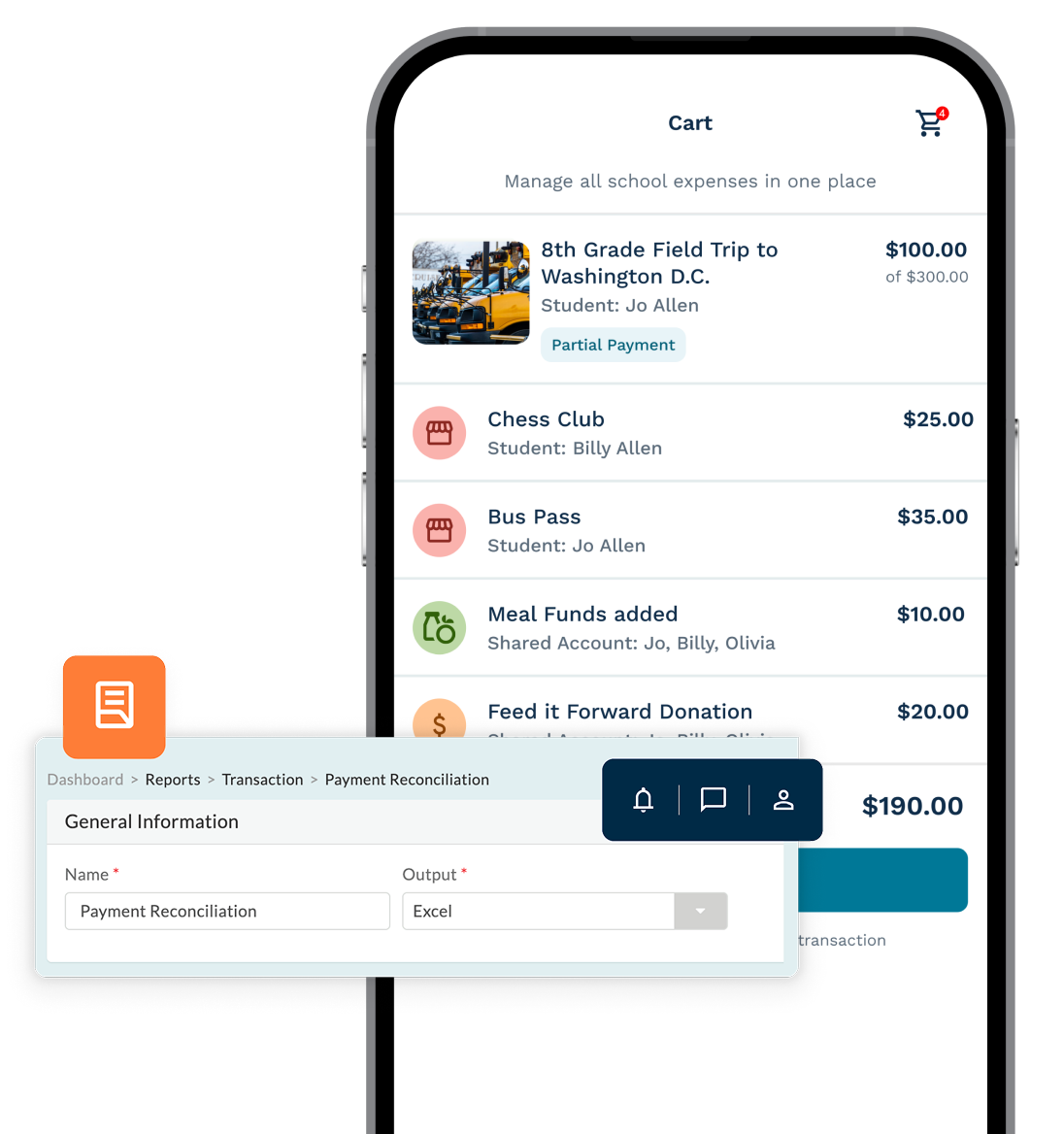
That last condition matters. Blue Valley’s published FAQ says its families can use Connect for meal-account payments only. A product’s possible capabilities and a particular district’s enabled services are different things. Families cannot put every school expense into the app simply because a promotional screen shows a generous cart.
The economics are equally specific. Cabarrus County Schools publishes fees of $2.85 for card payments and $1.85 for ACH payments below $72.15, with a 3.95% fee for larger payments. It says balance checks and other account features are free and offers cash or check at school as a fee-free alternative. These are that district’s published terms.
Illustrative card payment under Cabarrus’s published schedule. The fee equals 14.25% of the $20 deposit.
Payment failures have consequences too. In a September 23, 2026 notice, Howard County Public School System told families that returned electronic checks would incur a $25 fee from October 1. It also described disabling automated meal payments for accounts with a returned check. For families, reliable payment details and clear fee explanations belong in the same conversation as convenience.
The software still needs people
LINQ’s commercial relationship is institutional: districts and agencies contract for software, with subscription terms governed by their agreements. Implementation has its own work. In April 2025, the company announced expanded onboarding and support, including an implementation portal, a customer-success contact, staff training and an AI support assistant called Q.
Its published employment offering includes remote work, professional development and paid volunteer time. These are company statements about how it operates. The stronger test of expertise sits with customers: can the people supplying the software understand a payroll deadline or a cafeteria’s busiest ten minutes?

Love and CTO Eric Wood used their formal introduction to emphasize district conversations and dependable technology. It is an appropriate standard in a market where Skyward also offers finance and HR tools, while Heartland School Solutions supplies nutrition and payments products. Buyers have alternatives. LINQ’s breadth has value when it removes work that would otherwise fall between them.
For a district with well-connected existing tools, changing vendors needs a more compelling case than a tidier product diagram. For one drowning in repeated entries, the starting point is concrete: pick an order, a payroll correction or a claim; measure the effort; ask what would disappear. A child waiting for lunch will never admire the integration. That seems a perfectly respectable outcome.