Five minutes into the presentation, the questions started. In July 2007, two American consultants, Anders Brown and Lincoln Popp, had come to Beijing looking for an offshore partner. At other companies, they had been allowed to talk for an hour. At iSoftStone, the managers interrupted them with questions about working together. Brown remembered the exchange as a welcome change. A sales pitch had become a conversation.
Tianwen Liu, iSoftStone’s founder, later offered a compact explanation: “I think openness is the key word.” His company bought the visitors’ business, Akona Consulting, in February 2008. Brown credited Liu with creating a culture that accommodated Chinese and Western colleagues. The acquisition gave iSoftStone a foothold near Microsoft, a customer, and a team with local knowledge. Here was one version of Liu’s international ambition: acquire people who understood a market, then give them room to work.
Nearly two decades later, Liu is pursuing another expansion of the company’s remit, this time into the equipment, computing capacity and applications behind enterprise AI. The question has grown considerably larger than the one in that Beijing meeting. How much of a customer’s technological world can one company take on?
An education in joining things up
Liu’s professional history offers a fairly good explanation for his interest in that question. From 1991 to 1993, he worked as an IT consulting manager at Digital Equipment Corporation. He then became a senior project manager at Bechtel, before leading the China systems integration department of Siemens Business Services between 1996 and 1999. Consulting, project management and systems integration all require people to make separate parts function together.
His education crossed disciplines, too. He holds a master’s degree in electrical engineering from the University of Massachusetts and an MBA from MIT. He was a Sloan Fellow. There is a pleasingly practical combination here: learn how the equipment works, then learn why someone might pay for it. Neither qualification guarantees a business, though they give an aspiring founder plenty of ways to discover what has gone wrong.
In 1999, Liu co-founded AsiaEC.com, an online office supplies and services company. Office Depot acquired it in 2006. Before that transaction, he had already launched iSoftStone in 2001. His entrepreneurial career therefore developed through overlapping ventures. The second business was underway while the first was still finding its place in the market.
IT consulting
Systems integration in China
Co-founder
A new services business
A Chinese base, an international address book
The opportunity looked inviting from a distance. Up close, it came with awkward questions. China was becoming an economic force, but a company selling sophisticated IT services still had to find customers, recruit experienced staff and establish credibility. Indian providers already occupied much of the international outsourcing market. Liu had chosen an industry in which the existence of capable engineers was only the beginning of the argument.
A 2011 business case about iSoftStone framed the decisions plainly: which services to offer, how to balance Chinese and overseas customers, and how to distinguish the company from established rivals. Those questions help explain the acquisitions. Buying a business could bring customer relationships and specialist knowledge alongside its employees. An overseas office needed something more useful than an overseas mailing address.
iSoftStone also built delivery capacity in China. Its Wuxi campus, announced in 2008, joined Tianjin as part of the infrastructure supporting international work. Liu connected that investment to growth in North America, Europe, Japan and Korea. The geography had two ends: teams close to customers, and campuses able to do the work. Expansion required attention to both.
Wall Street was a chapter
In December 2010, iSoftStone arrived on the New York Stock Exchange. The initial offering raised about $140.8 million at $13 a share. Its first trading day ended with the shares up 27.8 percent. That was an emphatic reception for a company selling consulting, software services and business process outsourcing - activities whose daily dramas seldom come with an audience of traders.
Public attention supplied its own timetable. By 2013, the company reported $444.2 million in annual net revenue and 18,643 employees. Keeping those people assigned, trained and working effectively was central to the business. The scale makes Liu’s occupation easier to picture: a founder managing the machinery of an organisation, as well as deciding where it should go next.
The New York chapter ended in August 2014, when a merger took iSoftStone private. Liu belonged to the buyer group, together with funds managed by China Everbright Investment Management and other participants. He said the management team would bring the company closer to the Chinese market and pursue opportunities in IT services and smart cities. In March 2022, iSoftStone returned to public markets through Shenzhen’s ChiNext, under code 301236. The operating story continued across different ownership arrangements and exchanges.
The campus connection that outlasted the MBA
Liu kept MIT in his working life. At the 2011 MIT Sloan CIO Symposium, he joined a CEO keynote panel with HubSpot co-founder Brian Halligan and Deloitte technology executive Eric Openshaw. The company also joined MIT’s Industrial Liaison Program that year. An alumni connection was becoming a channel for discussions about business and technology.
By the 2013 MIT China Conference in Beijing, Liu was talking about cities. Larger smart city projects, he said, demanded more sophisticated consulting, systems integration and engineering knowledge beyond IT. That was a revealing admission. Growth could mean accepting assignments that stretched the company’s capabilities, then preparing people to handle them. The next contract might require a broader education than the last.
His interest extended to the officials making urban decisions. He wanted them exposed to international planning and management expertise, including MIT technologies, practices and executive education. In remarks published in 2014, he spoke of “sustainable and more livable future cities.” The engineer’s subject had expanded from computer systems to the places in which people lived and worked. His university network provided one way to bring other disciplines into the discussion.
“sustainable and more livable future cities”
Liu on China’s urban development, 2014
Cement is an unforgiving audience
By November 2022, Liu was discussing the industrial internet at a conference in Shenyang. The language of the technology industry had acquired another fashionable expression: the industrial metaverse. iSoftStone’s platform, iSSMeta, was being tested in industries including cement and aluminium. Whatever the label promised, its customers still had materials to process and production to manage.
“Real-world business is used to gauge its effectiveness,” Liu said. He described lower cost solutions that could be repeated across industries, helping customers improve efficiency and quality while reducing costs and inventory. It was a useful standard for an industry fond of naming the future. A factory manager can forgive an inelegant product name more readily than an interrupted production run.
The discussion also showed how far the assignment had spread. Manufacturing software touches equipment, operations and knowledge held by different partners. Liu argued for cooperation across companies, universities and research institutions. Read alongside his earlier career, the emphasis suggests continuity: the systems integrator was still trying to get specialists working together, on a larger canvas.
Hubei belongs on the map
There is a more personal geography to Liu’s business. He comes from Jingshan in Hubei and studied at the institution now known as Huazhong University of Science and Technology before pursuing graduate education in the United States. Beijing became the base for iSoftStone. Hubei remained part of his story.
In March 2026, Liu said the company’s Wuhan headquarters project in Optics Valley was due to enter use that month. iSoftStone had started building its Hubei presence in 2012. By then, it employed 6,600 people in the province, with Wuhan at the centre of a network that included Yichang, Xiangyang and Jingmen.
Liu explicitly connected investing in Hubei with affection for his home province and commercial strategy. The two reasons sit comfortably together. He also serves as president of the Hubei Chamber of Commerce in Beijing and chairman of the Beijing Informatization Association. His professional connections reach across provincial business, technology and the company he founded.
Taking on the machinery
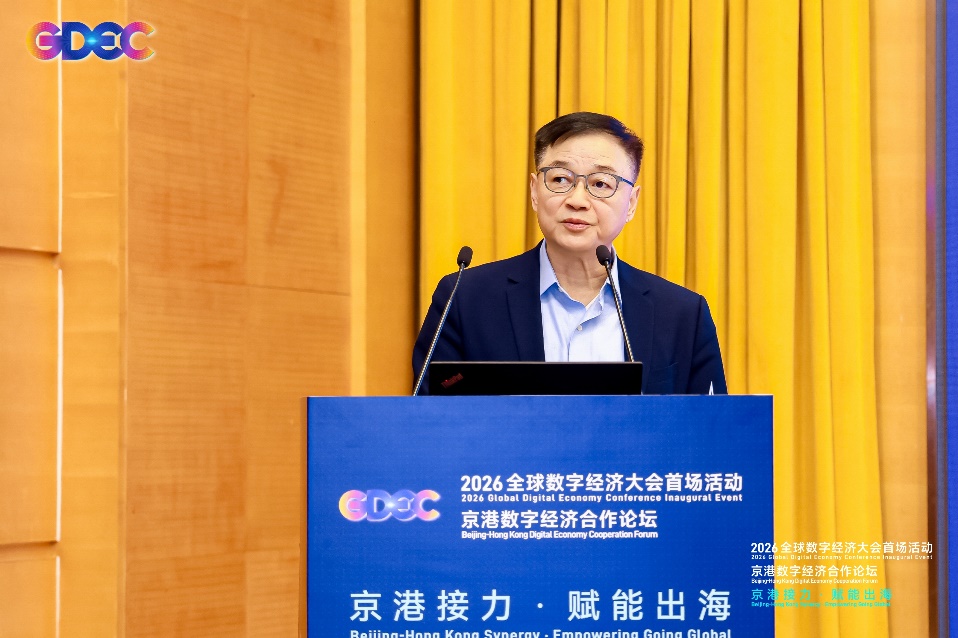
At the Beijing-Hong Kong Digital Economy Cooperation Forum in January 2026, Liu described an ambition spanning computing power, models and terminals. iSoftStone was widening its identity from software services toward integrated hardware and software. Servers, operating systems, AI applications and devices now belonged in the same strategic conversation.
In March, he attended an event during NVIDIA GTC at which iSoftStone Digital unveiled MerakAI, its global AI services brand. In September, he led the company’s delegation to Huawei Connect in Shanghai. The company introduced the commercial release of Merak AI AgentOS 1.2 at a related forum. These appearances place him among the partners and customers needed to turn that wider ambition into work.
The financial picture makes the next stage more demanding. For the first half of 2026, iSoftStone reported revenue of RMB 18.61 billion, up 17.91 percent, alongside a net loss attributable to listed company shareholders of RMB 264.66 million. Its second quarter was profitable on that measure. The half year still ended in loss.
Revenue: RMB 18.61 billion. Figures rounded from the half-year filing.
Those figures leave Liu with a concrete task. A wider catalogue and rising sales have to become a business that earns consistently. Read together, the numbers give his current expansion a sharper edge than a launch ceremony alone. After a quarter century, the founder remains responsible for making the parts add up. The conversation that began with questions in a Beijing meeting room has become rather more expensive to answer.