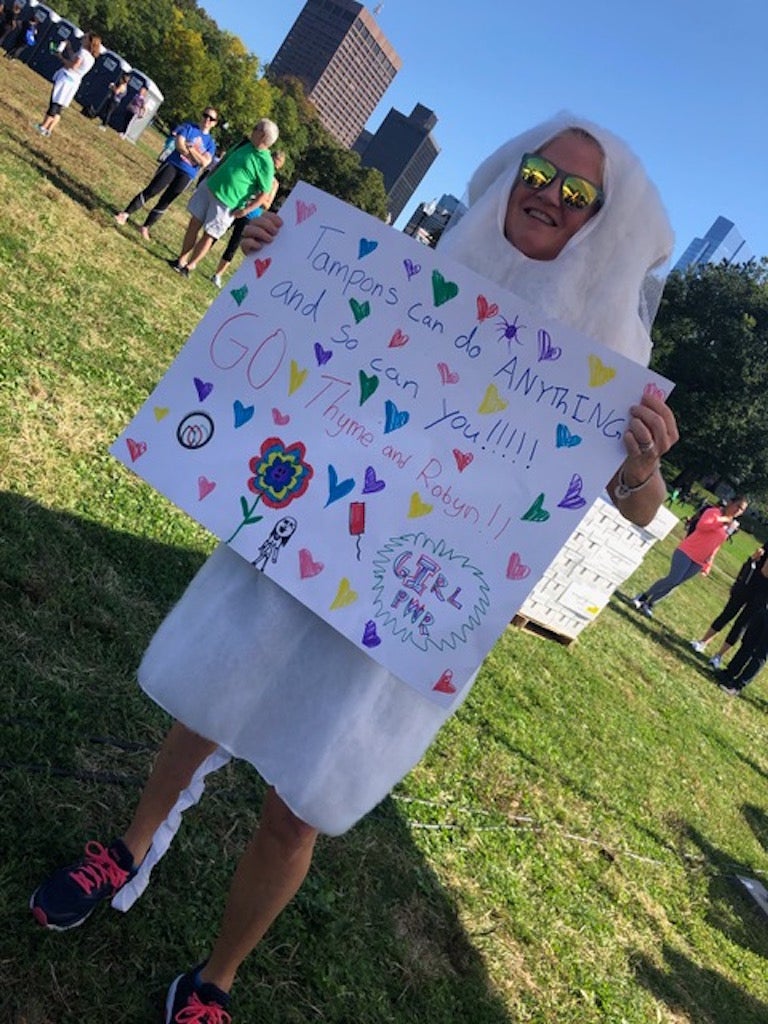
Thyme Sullivan ran the Boston 10K for Women dressed as a tampon. There are quieter ways to introduce a new company. They generally involve a name badge, sensible shoes and the hope that somebody will remember your surname. Sullivan went with a costume, sunglasses and six miles of public commitment.
It was October 2019. She had spent much of her working life inside large food and beverage companies, where the sales targets were substantial and the dress code presumably left less room for strings. Now she was selling products through TOP the organic project, the company she had started with her cousin, Denielle Finkelstein. At the water stops, people cheered.
“If you can laugh about it, you can talk about it,” Sullivan said. A photograph from the day shows her holding a handmade sign covered in hearts. It is difficult to look aloof while wearing your inventory.
The costume makes a tempting summary of Sullivan: experienced executive discovers her inner show-off. Her business story has another turn, though. Getting noticed helped. Later, she and her colleagues would have to reconsider what all that attention was supposed to accomplish, and change the company they had worked so hard to establish.
The executive who began on a delivery route
Sullivan grew up in Massachusetts and studied economics at the University of Massachusetts Amherst. Her first job after college involved driving a Frito-Lay truck. That is a useful beginning for someone who would eventually spend her days thinking about how products reach people: the delivery route makes the distance between a business plan and a customer quite literal.
Over 27 years, she worked at PepsiCo, Coca-Cola and Nestlé. Her work encompassed national accounts, sales, operations and supply chains. At Nestlé, she reached leadership of wholesale grocery. These were years spent learning the machinery behind familiar brands, including the unglamorous work of moving goods and keeping commercial relationships working.
The scale of the job did not guarantee that she liked describing it. When people asked what she did, she would sometimes reduce it to selling Hot Pockets and move the conversation along. She remembered enjoying the more entrepreneurial assignments in her career, including work with Gatorade and Nesquik, where she could build something new.
That distinction matters. Sullivan had experience with large businesses, and she had also noticed which parts of that experience she wanted more of. A senior title and an interesting working day had become separate ambitions.
Behind door number three
The break with corporate life arrived through a restructuring at Nestlé. Sullivan was 48. She was offered relocation to Chicago or Washington, DC, and chose a severance package. Her children were in middle school, her husband liked his work, and she wanted to remain in Massachusetts.
She is refreshingly plain about the sequence. “I didn't have courage. I got laid off.” The courage, in her telling, came afterward. Losing a job and deciding what to do with the opening it creates are two different experiences. At first she interviewed for other corporate positions. Another large employer was an available next step.
There was a household calculation, too. Sullivan had been the family breadwinner. Starting a company meant discussing a different standard of living with the people who would share it. The familiar founder story often moves briskly from dissatisfaction to revelation. Her account makes room for the awkward financial conversation in between.
She also wanted a different relationship with her own time. The business would require work, but she wanted more say in what that work served. She had already accumulated plenty of experience succeeding on somebody else's terms.
A cousin, a lunch, a new company
Finkelstein reached out through social media after the cousins had spent decades out of touch. They met for lunch. Both were considering what came after long corporate careers; both had daughters; both were interested in building a business with a purpose they could explain at home.
Their backgrounds fit together. Finkelstein had worked in fashion at businesses including Coach, Kate Spade, Ann Taylor and Talbots. She brought merchandising, marketing and brand experience. Sullivan brought the commercial and operational knowledge earned in grocery aisles and national accounts. Their family connection came with a practical division of expertise.
They launched TOP the organic project in 2018. The initial proposition was organic period products sold through retail and direct channels. Sullivan understood grocery. Finkelstein understood brands. Selling a consumer product was familiar ground on which to try an unfamiliar working life.
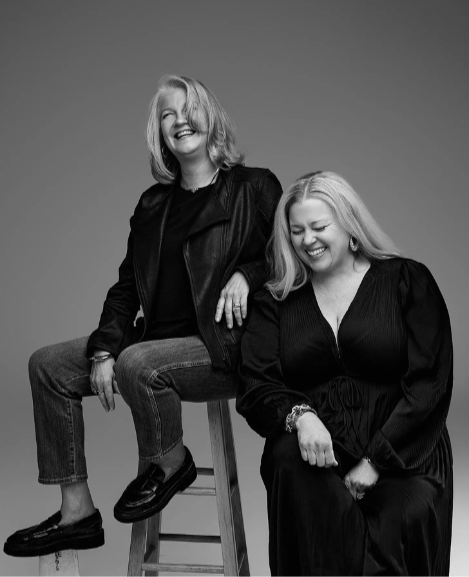
They call themselves the “Triple Co”: cousins, co-founders and co-CEOs. It is a tidy description of a partnership with several layers. They could share the uncertainty of a new venture with someone who understood both the ambition and the family decisions behind it.
Permission to be a little embarrassing
Large-company habits did not all travel well. Sullivan has described getting advice that a CEO should hire someone else to wear the costume. She wore it herself. For a founder trying to make an introduction, the ability to absorb a little embarrassment was a usable resource.
Her daughter initially found the outfit horrifying. This is a risk inherent in having a parent with a marketing strategy. Sullivan kept going. The race brought a public audience to a small business whose founders could hardly purchase the recognition their former employers enjoyed.
There is a commercial discipline beneath the joke. A costume gives a stranger a reason to stop, ask a question or remember a name. It also gives the founder something to do besides reciting a polished biography. Sullivan had spent years learning how to sell. She was now learning how much of herself she could bring to it.
“Be yourself. Have fun.”
Thyme Sullivan
The shelf was only part of the journey
TOP won retail distribution. Its products reached stores including Wegmans, H-E-B and Sprouts. From outside, an expanding list of stockists looked like progress, and it was. For a consumer brand, persuading a retailer to give you space is a meaningful achievement.
Yet the founders were also examining the economics. Distributors, brokers and promotions each took their share. Retail growth could consume resources without giving a small company the room it needed. Meanwhile, bulk customers were asking about dispensing products in workplaces.
That question brought the team closer to a different buyer and a different location. A building operator could provide the products as a routine supply. The dispenser could sit inside the stall, beside the toilet paper. The purchasing decision would move from an individual shopping trip to a facilities budget.
In 2022, the team made the pivot that became UNICORN in every stall. Ellen Cynar and Lindsay Domaas, who had joined the founding team in 2021, were part of that transition. Sullivan and Finkelstein were building with colleagues whose contributions extended beyond the original partnership.
Sell to the shopper.
Win space among existing brands.
Sell to the organization.
Make restocking a facilities routine.
The uncomfortable part of changing your mind
The pivot tested the founders' relationship with their investors. Sullivan has recalled that those investors had backed the team partly because of its experience in consumer products. Moving away from retail required an explanation. Revenue fell during the change, making the conversation harder.
It is an instructive predicament for an experienced operator. The thing you know how to do can become the thing other people expect you to keep doing. A familiar channel offers evidence of competence. Leaving it asks others to trust a judgment whose results have yet to arrive.
Fundraising had already challenged their assumptions. The founders call an early stretch of unsuccessful investor meetings their summer of un-love. They subsequently found support from investors including Barbara Clarke. Their experience gave them reasons to think carefully about whose money they accepted and what room it left them to make decisions.
Sullivan's role required both sides of her working personality: the salesperson who could make an unusual idea approachable, and the operator prepared to argue through the numbers when an established plan stopped serving the business.
A shorter question for a bigger room
One encounter distilled the sales approach. When the founders met JPMorgan Chase chief executive Jamie Dimon, Finkelstein asked whether he carried toilet paper around with him. The question gave the unfamiliar purchasing proposal a familiar comparison. Chase became an early adopter of the dispensers.
The current company names organizations including Toyota, PepsiCo and American Express among its customers. Its system uses in-stall dispensers and refill cartridges, with distribution through facilities suppliers as well as direct ordering. Sullivan is back among the kinds of large organizations she knows, approaching them from the other side of the sale.
She and Finkelstein continue talking publicly about the decisions behind the company. In an August 2026 conversation, they returned to the importance of listening to customers and allowing a business to change. The ambition remains simple to state: make these supplies an ordinary part of the building.
For Sullivan, getting there has meant a delivery truck, national accounts, a severance package, a reunion lunch, retail shelves and one memorable race outfit. She has kept the sales experience while loosening the rules about how an executive ought to behave. Somewhere along that route, looking ridiculous became an entirely reasonable thing to do.
More from Sullivan’s working life
Conversations, company updates and a closer look at the business.
Thyme Sullivan on LinkedIn ↗UNICORN in every stall ↗Watch: From Retail Shelves to Every Bathroom Stall ↗Watch: You Belong in the Room ↗Listen: Starting a Business Later in Life ↗The Boston race-day story ↗