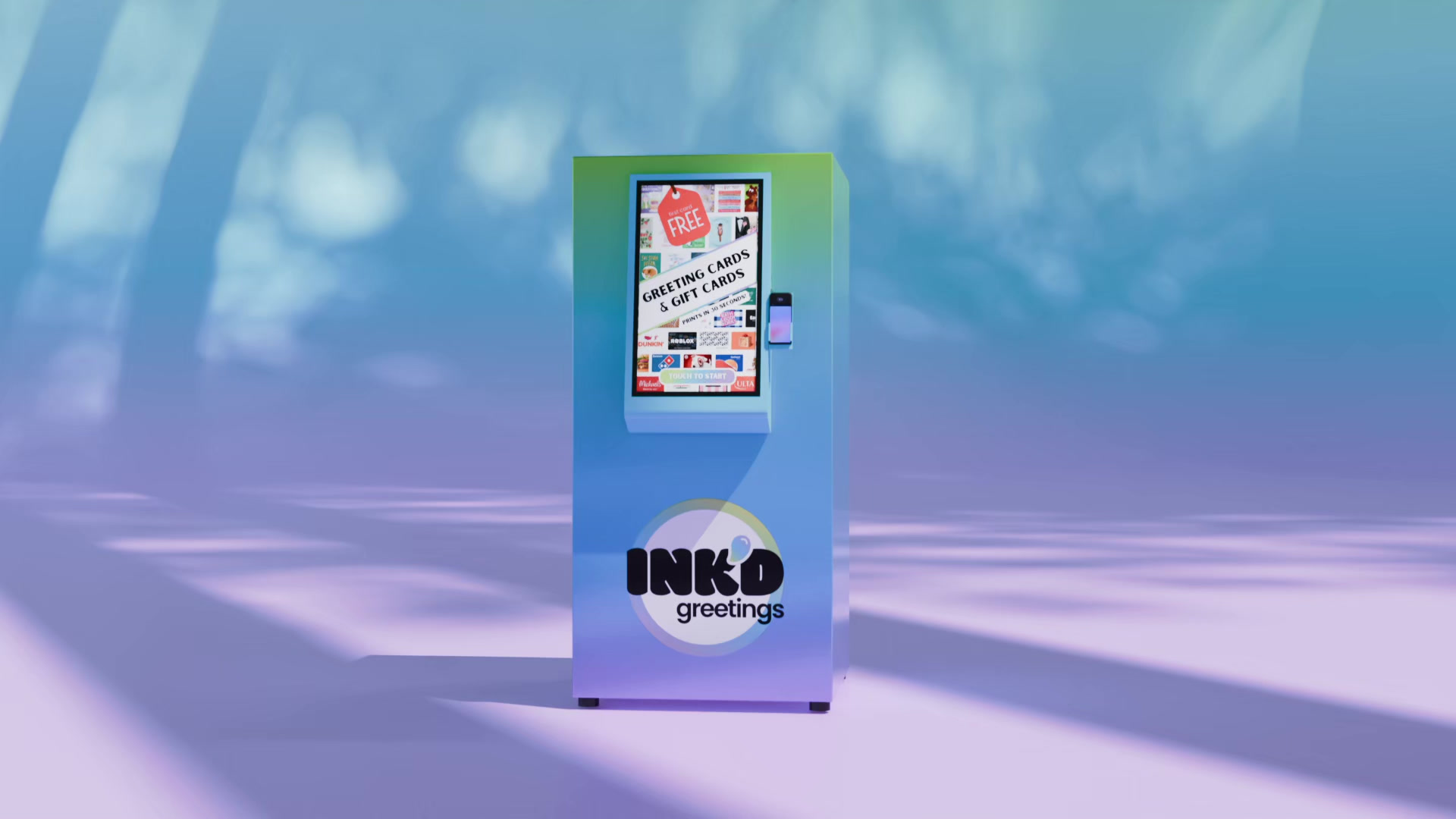
Here is a fact about the greeting card business that ought to bother somebody: it is worth billions of dollars, it runs on guilt and deadlines, and it has barely changed in a generation. Ink'd Greetings noticed, and decided the fix was a vending machine.
The origin story is almost too neat, which is usually a sign that it is true. It was Valentine's Day. Andrew Ekmark had bought a thoughtful gift and needed a card to go with it, so he did what people do: he drove to Target at the last minute and stood in front of the card wall. The card wall, as anyone who has met one knows, is an adversary. It is enormous, poorly organized, and priced with a straight face at seven dollars for a folded piece of cardstock. Andrew searched, gave up, and bought something mediocre. This is the part where most of us go home. Andrew, apparently, went and started a company.
He did not do it alone. Ink'd Greetings is run by Andrew and his wife Sammi Ekmark, who describe themselves as "entrepreneurial love birds," which is the kind of phrase you either find charming or you don't, and either way it tells you something about the company. Andrew is the CEO and, by his own account, a hater of card shopping. Sammi is the chief product officer and a genuine card enthusiast - an ASU English-literature graduate and former Sun Devil tennis player who had already run a cookie company as a student. The division of labor writes itself: one founder represents the customer who is annoyed, the other represents the customer who actually cares. A greeting card company probably needs both.
The product is a kiosk. You walk up to a touchscreen, browse from more than two thousand designs, personalize the message, and - this is the part that makes the unit economics interesting - you can attach a digital gift card from any of 75-plus retailers, printed onto the physical card as a scannable QR code. Then you pay, and the machine prints your card on real cardstock in roughly thirty seconds. Every card costs $2.99. There is no premium tier dressed up as a choice, no decoy pricing designed to make the $5 option feel reasonable. It is a flat number, which in this category counts as a design decision.
"It's really a convenient, fun and affordable way to give gifts and make people smile."
Sammi Ekmark, Co-Founder & Chief Product OfficerThe bet: move the machine, not the aisle
The instinct, if you want to compete with Hallmark and American Greetings, is to build a nicer card or a slicker app. Ink'd did something quieter and more interesting: it changed where the card gets made. Instead of fighting for shelf space in a store where the cards already lose, it put a machine at the point of the panic - the mall, the campus store, the convenience-store run - and let the card be manufactured on demand, at the exact moment someone realizes they need one. This is a distribution strategy disguised as a hardware product, and it is the whole game.
It also solves a problem retailers quietly have, which is that greeting cards take up a lot of floor space and turn over slowly. A kiosk collapses an entire aisle into a footprint the size of a phone booth and stocks two thousand designs behind glass. That is the pitch to the retail partner, and it is a decent one. A card wall is dead inventory dressed up as choice; it demands square footage, restocking labor, and a customer patient enough to read four hundred punchlines to find one. A machine that reprints only what sells, on demand, from a file, turns the whole thing from a physical problem into a software one. That is a better business even before you count the gift cards.
The on-demand part matters for a reason that is easy to miss: a printed inventory of cards is a bet about what people will want, placed weeks in advance and usually wrong. Ink'd doesn't place that bet. The designs live as files, and the machine manufactures the specific card a specific person chose, in the moment they chose it. Nothing goes stale, nothing gets marked down, and adding a new card - a topical joke, a seasonal line, a licensed character - is a software update rather than a print run and a shipping manifest. For a category that has always run on the physical logistics of paper, that is a meaningful shift in where the costs sit.
The gift-card attach is the part a spreadsheet loves. A greeting card is a low-price, low-margin object; a gift card riding along inside it is a second transaction that lifts the whole basket. Ink'd has essentially bundled the two things you were already going to buy - the card and the thing that goes in the card - and sold them in a single tap. In a lot of retail, that is the entire innovation, and it is often enough.
"When I saw their prototype machine at Chandler Fashion Center, I was sold. There should be tens of thousands of such kiosks all over the country."
Hamid Shojaee, Lead Investor (AZ Disruptors)Traction before the check
The detail that should make investors pay attention is the order of operations. Before Ink'd raised any money, it put a prototype in Chandler Fashion Center and sold more than five thousand cards. That is not a slide; that is a machine in a mall, taking real dollars from real people who did not know or care that it was a startup. It was that prototype, not a pitch deck, that convinced Hamid Shojaee of AZ Disruptors to lead a $1 million seed round in 2024, with a group of Arizona-based investors alongside. Shojaee's line - that there should be tens of thousands of these things across the country - is the kind of thing lead investors say, but he said it after watching the machine work.
With the money came a growth plan that is refreshingly concrete: get to 75-plus locations, using named retail partners including 7-Eleven and mall operator Macerich. By late 2024 the company reported 16 kiosks running nationwide, six of them in the Phoenix Valley, and it had opened one at Arizona State University's Sun Devil Campus Store - a fitting homecoming, given Sammi's degree. College campuses are a smart early market: students are broke, forgetful, far from home, and constantly owing someone a card or a small gift. A $2.99 machine in the campus store is aimed directly at that.
Andrew is candid that the machine you see now is not the machine they started with. "There are probably 20 or 25 things that we've learned over this last year that have really impacted the quality of both the print and the customer experience," he has said - which is the un-glamorous truth of any hardware business. The card has to feel like a card, not a receipt. The screen has to be fast enough that an impatient shopper doesn't walk. The printer has to work at nine at night in a mall with nobody standing next to it. None of that shows up in a press release, and all of it is the actual product. A kiosk company that has already iterated through two dozen of those problems has a head start that is hard to see and harder to copy.
The catalog has a sense of humor
A kiosk lives or dies on whether the two thousand designs are any good, and Ink'd seems to understand that the way to stand out in a screen full of cards is not to be tasteful. The lineup runs from ordinary occasion cards to dad jokes to the licensed grumpiness of Aunty Acid, and then keeps going into an adult-humor line called, with no particular subtlety, "Cards After Dark." That is a range, and range is the point. The greeting card business has always quietly run on humor and on the specific relief of finding the card that says the thing you couldn't. A machine that can print the earnest one and the filthy one in the same thirty seconds is playing the category correctly.
There is also a demographic argument tucked underneath all of this, and it is the one the greeting card industry has been trying not to say out loud for years: younger people text their birthday wishes and do not walk down the card aisle at all. The physical card, left alone, drifts toward being a thing your grandmother buys. Ink'd's implicit answer is that people did not stop wanting to give something real - they stopped wanting to spend twenty minutes and seven dollars to do it. Put the card where the phone-native shopper already is, make it fast, make it cheap, let it be funny or crude or sincere, and staple a gift card to it. That is less a bet against digital than a bet that the physical card survives by acting a little more like an app.
None of this guarantees anything. Kiosks are capital that has to be placed, maintained, restocked, and defended against the boring physics of retail - foot traffic, lease terms, printer jams. Hallmark is not going to be startled into extinction by sixteen machines in Arizona, and a hardware rollout is the kind of thing that looks linear on a slide and gets lumpy in the field. But the thesis is clean, the pricing is honest, and the founders had the discipline to prove the machine worked before asking anyone to fund it. For a business that started with one man losing an argument with a wall of cards at Target, that is a reasonably good place to be.