He built a vending machine for feelings
Walk past it in a mall or a 7-Eleven and you might think it sells lottery tickets. It sells the thing you forgot to buy. Touch the screen, scroll a few hundred designs, type a message that's yours and not a stranger's, and watch it print on real cardstock in about half a minute. That machine is Andrew Ekmark's whole argument.
Andrew Ekmark is the CEO and co-founder of Ink'd Greetings, a Phoenix company doing something the greeting card business has not bothered to do in decades: question itself. The legacy model is a wall. Hundreds of pre-printed cards, sorted by occasion, picked over, frequently out of the one you actually need. Ekmark's model is a kiosk. One footprint, an effectively unlimited catalog, and a card that does not exist until you ask for it.
The cards run $2.99, and a new customer's first one is free. Inside many of them you can tuck a gift card — not a plastic rack card, but a QR code printed on demand. Because the code is generated at the moment of purchase, the company describes it as effectively fraud-proof. It is a small, clever inversion: the part of the card people usually slip in by hand becomes the part the machine does best.
Three aisles, one bad card, $7
The company has a founding myth, and unusually for a startup, it is small and specific and true to anyone who has ever shopped late. It was Valentine's Day. Andrew rushed into a Target to grab a card to go with a gift for Sammi, his wife. What he found was three aisles of scattered, half-empty, confusing inventory. He dug through it, gave up on finding the right thing, and paid $7 for a card filed under “funny” that he did not particularly find funny.
Most people would have shrugged and driven home. Ekmark turned the annoyance into a thesis: if buying a card is this miserable, the category is not going to survive another decade in its current form. The fix was not a better wall of cards. It was getting rid of the wall.
He and Sammi launched their first Card Kiosk prototype in November 2023. They are married co-founders — Andrew runs the company as CEO, Sammi leads product — which means the business and the relationship share a calendar. The early work was unglamorous. They lowered the kiosk screen so it was easier to reach, tilted it so typing felt natural, and sped up the software after watching real customers hesitate. The 20-some lessons Ekmark talks about were not whiteboard insights. They came from standing near the machine and watching strangers use it.
The unlikely resume behind a card company
Ekmark is a Phoenix native who studied engineering at Stanford University. Before greeting cards, his path ran through places that teach you how systems and markets actually work — consulting at Boston Consulting Group, time at Carvana, the high-growth used-car company that turned a clunky purchase into a vending-machine spectacle of its own. It is not hard to draw a line from a car you buy from a giant glass tower to a card you print from a kiosk. Both take a transaction people assumed had to be tedious and make it feel like a small piece of theater.
That background shows up in how he talks about the business. He frames Ink'd less as a card company and more as a retail-technology company that happens to sell sentiment. The product has to be efficient and profitable for the retailer hosting the kiosk, and convenient, affordable, and genuinely fun for the person standing in front of it. Get both sides, the thinking goes, and the machine sells itself.
Aunty Acid, dad jokes, and Cards After Dark
For a man with an engineer's resume, Ekmark is unusually serious about being funny. Ink'd's catalog leans hard into humor: a cranky cartoon line called Aunty Acid, a deep bench of dad jokes, and an after-hours range cheekily branded Cards After Dark. The bet is that the card aisle lost its sense of play somewhere along the way, and that a machine offering 2,000-plus designs can afford to be weirder, ruder, and more personal than a wall that has to be family-safe by default.
It is a smart wedge. The forgettable, dutiful card is exactly the kind a kiosk can replace without anyone mourning it. The card that makes someone laugh out loud is the one people will hunt for — and the one a 2,000-design library is built to deliver. Ekmark is not trying to out-sentiment Hallmark. He is trying to out-surprise it.
The idea that shocked the investors
In 2024, Andrew and Sammi took the pitch to television, appearing on Season 13 of Entrepreneur Elevator Pitch in front of a panel that included Kim Perell, former NFL linebacker turned entrepreneur Dhani Jones, and PR founder Jon Bier. The episode was framed around the surprise of it: a greeting card startup, of all things, holding its own against investors who have seen every flavor of app and gadget. The greeting card is so familiar that proposing to disrupt it sounds either obvious or absurd, and Ekmark has learned to enjoy living in that gap.
The momentum has been real. Ink'd has raised roughly $2.5 million, including a $1 million seed round. One investor, Hamid Shojaee of AZ Disruptors, put it plainly after seeing a prototype at a Chandler mall: he was sold, and figured there should be tens of thousands of these machines across the country. In 2025 the company landed on Pepperdine Graziadio Business School's Most Fundable Companies list — a quiet validation that the bad-night-at-Target thesis has legs.
From one mall to the whole country
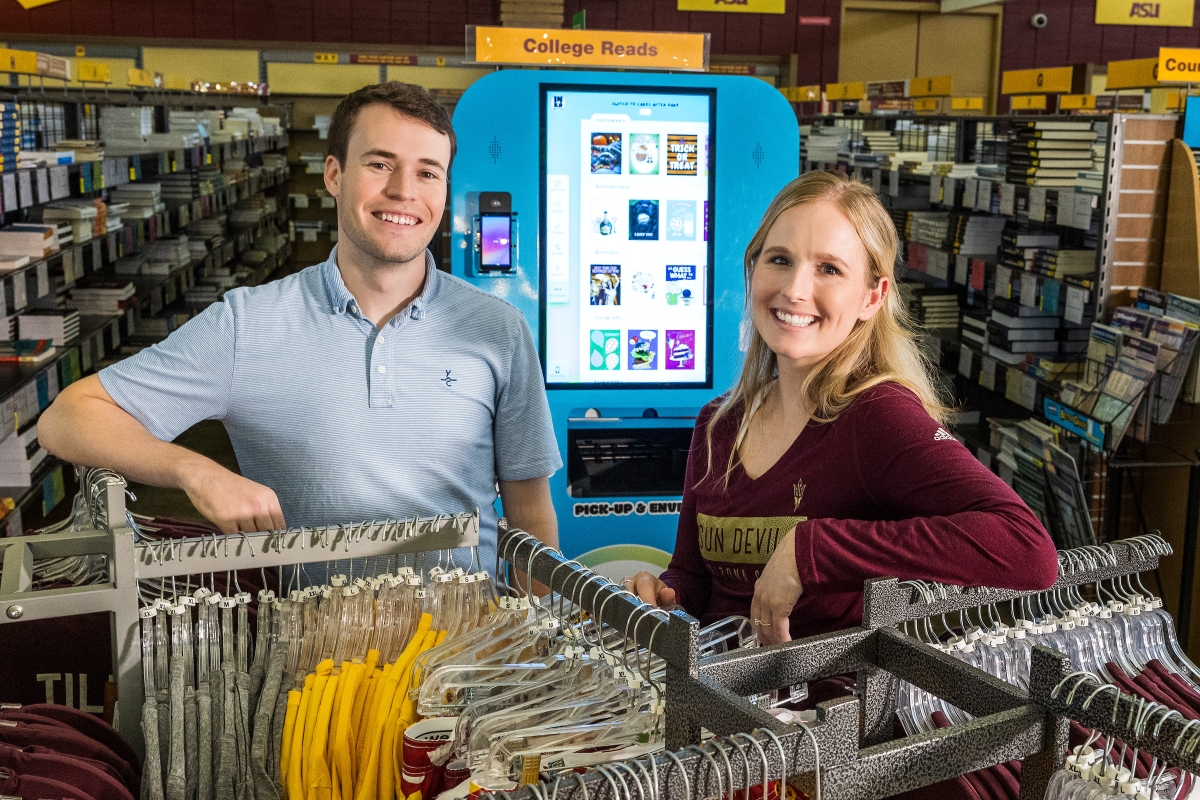
The expansion plan is straightforward to describe and hard to execute: put the machine where people already are when they remember they need a card. That has meant college campuses — including a kiosk at the Sun Devil Campus Store on Arizona State's Tempe campus, aimed at students who need a last-minute birthday card and a gift card in one stop — and retail and convenience footprints, with names like 7-Eleven and mall operator Macerich in the mix. The kiosks now reach across dozens of states, and Ekmark talks openly about a future measured in the tens of thousands of machines.
It is a deceptively ambitious goal dressed up as a humble one. Nobody wakes up wanting to revolutionize greeting cards. Ekmark's whole approach is to make the revolution feel like a convenience — faster, cheaper, funnier — and let the disruption happen quietly, one forgotten card at a time.
Watch & listen
Andrew has talked through the business and its early lessons in a couple of filmed conversations — useful if you want the story in his own cadence rather than ours.