He backed up your phone before the cloud was cool. Now he is teaching AI to draw up the blueprints for whatever you build next.
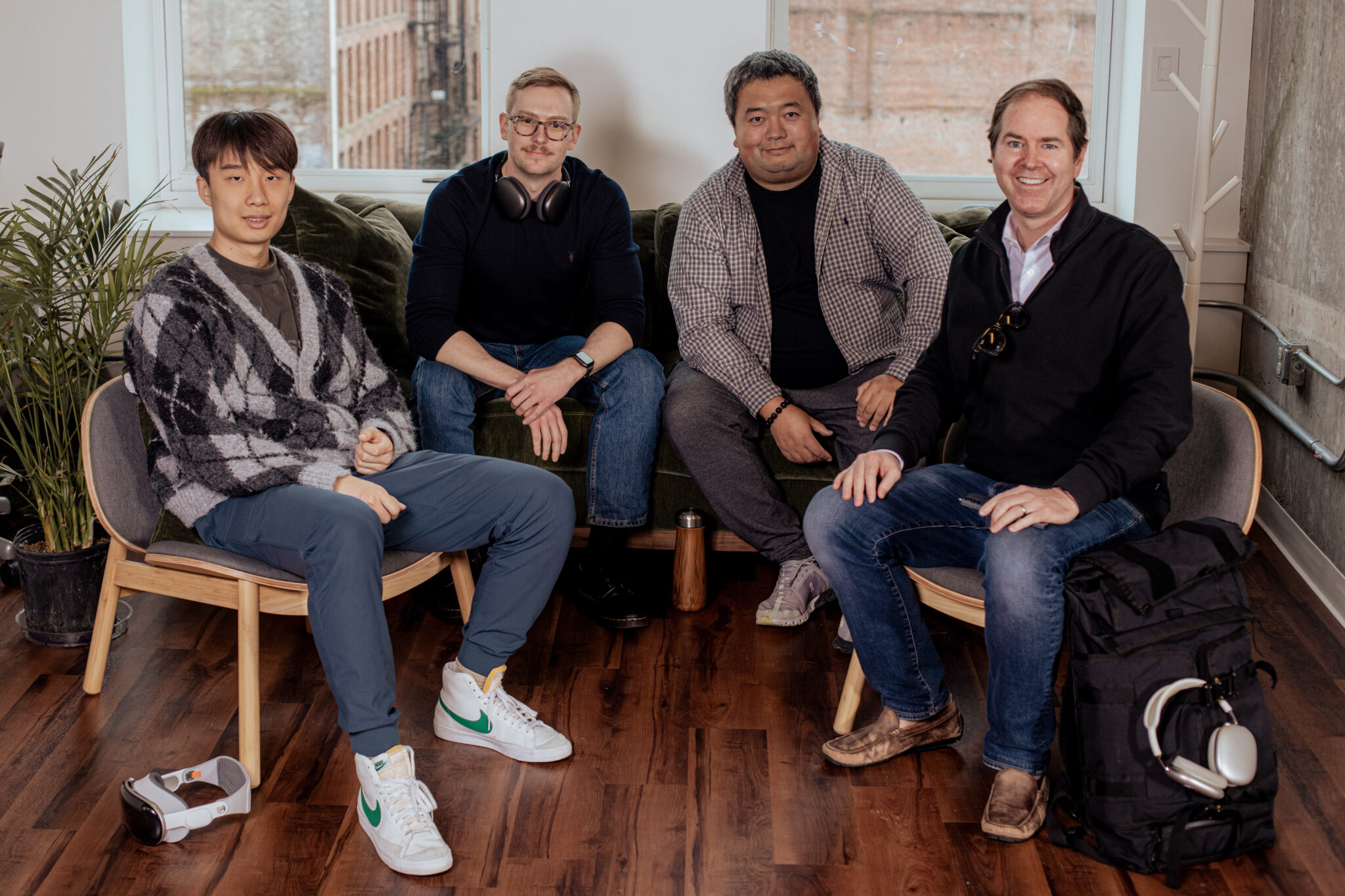
The Enzzo crew, from left: Ricardo Ma, Patrick Fiori, Zheng Liu, and Ford Davidson (right) - four people betting that the hardest part of hardware happens before anyone touches a prototype. Photo: Enzzo.
Ford Davidson runs Enzzo, a Seattle company with a deceptively simple job: get a hardware idea from a napkin sketch to something an investor will fund, in roughly half the usual time. Not the manufacturing. Not the marketing. The messy, unglamorous middle - the requirements, the specs, the risk analysis, the endless documents where good hardware ideas quietly go to die.
That middle is where Davidson has spent his career. Enzzo, which he co-founded in 2023 out of the Seattle startup studio Pioneer Square Labs, is an AI platform that generates specifications, validates demand, and keeps a room full of stakeholders pointed at the same version of the truth. The company came out of stealth in March 2024 with a $3 million seed round led by Unlock Venture Partners, with PSL Ventures and the Mayfield/Pioneer Square Labs AIStudio Fund along for the ride.
The pitch lands because the person making it has lived the problem four times over. Davidson helped build new-category devices and services at Microsoft, HTC, Amazon, and Meta - the four companies that, between them, defined the smartphone, the voice assistant, and the mixed-reality headset. He knows exactly how many weeks a team can burn arguing about what a product is supposed to do before a single component is ordered.
Enzzo is his answer. Generative AI reordered how the world makes words and images. Davidson's bet is that physical products are next, and that the winners will be the teams who let AI handle the definition work while humans keep the taste. "Enzzo represents what we believe is the new way that product teams will work," he says, "by leveraging gains from AI in combination with human creativity to define and create hardware products faster."
"Our team can do things in a week with Enzzo that typically takes three months."
- A chief product officer at a global consumer-product company, on using Enzzo
Ask anyone who has shipped a physical product where the pain lives, and they will not point at the factory. They will point at the beginning - the stretch where a team is still deciding what the thing is. Requirements shift. Stakeholders disagree. A spec written in week two turns out to be wrong in week ten, and by then the wrongness is expensive. Every revision that slips downstream costs more than the one before it.
Enzzo aims straight at that stretch. The platform takes a founder or a product team's raw intent and, using foundation models plus the team's own inputs, drafts the specifications, surfaces the risks, and produces the documentation that usually eats weeks of meetings. The company describes the result plainly: idea to investment-ready in half the time, with demand validated and stakeholders aligned before the money gets spent on tooling and prototypes.
The claim is not that AI replaces the engineer or the designer. It is that AI can carry the heavy, repetitive definition work so the humans can spend their hours on judgment and taste. That distinction matters to Davidson. His framing pairs the two on purpose - "gains from AI in combination with human creativity" - because he has watched enough product teams to know the creativity is the part you cannot automate, and the paperwork is the part you should.
It is a contrarian place to plant a flag. The loud, obvious AI applications of the last few years have been in software, text, and images - domains where the output is bits and the feedback loop is instant. Hardware is slower, riskier, and unforgiving. That is exactly why Davidson finds it interesting. The teams that figure out how to compress the definition stage do not just save time; they get more shots on goal.
Davidson did not build Enzzo alone, and he did not build it in a vacuum. The founding team is four deep - Ricardo Ma, Patrick Fiori, Zheng Liu, and Davidson - and the company was hatched inside Pioneer Square Labs, the Seattle startup studio that has spun out dozens of Northwest companies. Studios like PSL work by pairing an idea with an operator who can actually run it. In Enzzo's case, the idea was AI for hardware, and the operator was a founder who had spent two decades shipping exactly that kind of hardware.
The backers followed the logic. Unlock Venture Partners led the $3 million seed, joined by PSL Ventures and the Mayfield/Pioneer Square Labs AIStudio Fund - a vehicle built specifically to fund AI companies coming out of the studio. It is a tidy alignment: a studio that produces AI startups, a fund that exists to back them, and a founder whose entire career is a case study in the problem being solved.
Enzzo has also started to build a voice beyond its product. Together with the design publication Core77, the company runs "Hardware is the New Salt," a series of interviews, videos, and podcasts with product leaders about how AI is reshaping the way physical things get imagined and made. It is part marketing, part manifesto - a way of arguing, in public and on the record, that the next great AI story is not written in text at all. It is manufactured.
"Hardware is the new salt."
Enzzo's series with Core77 on how AI is reshaping physical products
A phone backup service in the late 2000s was early. HTC bought it in 2011. The pattern - build for the wave before it breaks - repeats.
As Senior Director, he led connected services across a global Android portfolio. Founders who can also operate at size are rare.
Principal PM on Echo and Echo Show communications - shipping devices that millions of people talk to every day.
At Reality Labs he worked on social metaverse experiences, the hardest kind of new-category hardware there is.
Coolr tackled employee engagement; PROPS Media spotlights consumer products. Enzzo is the throughline: better products, faster.
AI, hardware, and the definition stage where projects live or die. Every prior chapter reads like preparation for this one.
His companies span nearly every consumer-hardware wave of the last two decades - phones, voice assistants, and mixed reality - which is a strange thing to be able to say.
Enzzo is a spinout of Pioneer Square Labs, the Seattle studio behind a long list of Pacific Northwest companies.
His education is a four-school tour: Harvard, Harvard Business School, Stanford, and Kellogg executive education.
Enzzo runs its own interview series and podcast, "Hardware is the New Salt," made with the design publication Core77.
Read Davidson's path in reverse and it looks almost inevitable. Dashwire taught him to build for a wave before it arrived. HTC taught him to run things at global scale. Alexa put him inside the living room, shipping hardware that millions of people speak to. Meta pushed him to the frontier of new-category devices. Each stop added a layer of the exact expertise Enzzo now depends on, and each one deepened his frustration with the same bottleneck: the slow, expensive front end where a hardware idea has to become a plan.
His aspiration is not modest. He wants AI to become a co-pilot for physical product creation - to take the weeks-or-months work of turning a hardware vision into market-ready specifications and compress it into days, without surrendering the human judgment that makes a product good rather than merely finished. If generative AI has already changed how the world writes and draws, Davidson is wagering that the next chapter is written in metal, plastic, and silicon, and that Seattle - his city, and a quietly serious hardware town - is a fine place to write it.
Enzzo is still early. The seed round closed in 2024, the team is small, and the thesis has plenty left to prove. But the person carrying it has been rehearsing for this role his entire career. That is the whole argument, and Davidson makes it without raising his voice: the paperwork should be fast, the creativity should be human, and the two should finally stop getting in each other's way.