The turning point was a wall. Denielle Finkelstein and her cousin, Thyme Sullivan, had already built the sort of startup that reads well in an announcement: organic period products, national reach, roughly 1,500 retail locations by 2021. Wegmans carried them. Sprouts carried them. Erewhon, the Los Angeles grocer famous for expensive smoothies, carried them. From a distance, the company looked as if it had arrived. From inside the spreadsheet, the picture was different.
Small consumer brands pay for every inch of that apparent success. A distributor takes a cut. A broker takes a cut. Promotions take another. Larger brands lean into the same shelf with more money. At a strategy meeting, the team did what experienced merchants do when the display looks better than the economics: they read the numbers without sentiment. Retail was hard to make profitable. Worse, it was failing the founders' original purpose.
A box on a store shelf could offer a better product to someone already shopping for it. It could not help the person caught off guard at work, already inside a bathroom stall. The company had solved ingredients and packaging. Access remained awkwardly unsolved. Finkelstein had spent her career looking for white space in fashion. Now the white space was a few square feet of neglected bathroom wall.
“Period products need to be where there’s toilet paper.”Denielle Finkelstein
The first exit
Finkelstein was raised in Rhode Island and graduated from Union College in Schenectady, New York. After college she moved to New York with her future husband and began in fashion retail at Ann Taylor. Over the next 22 years, she moved through merchandising and leadership jobs at Ann Taylor, Coach, Kate Spade and Talbots. The work taught her how to build a category, spot an opening and coordinate teams around a customer. By 2018, she was a senior executive at the height of a reliable career.
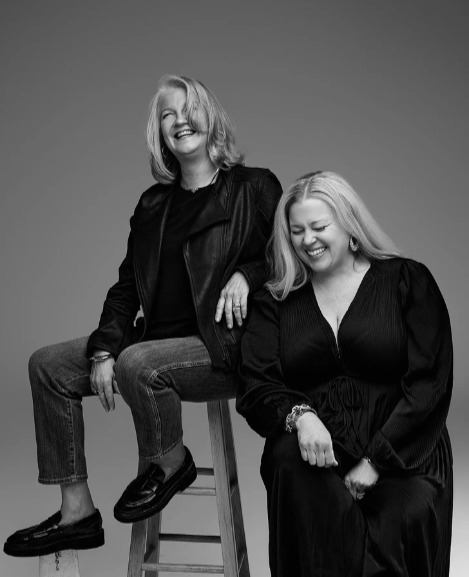
She also wanted a different relationship with work. Finkelstein and Sullivan were both family breadwinners, which made leaving corporate life a household decision, not a motivational-poster gesture. Their idea came through their daughters. The cousins were looking for period products that matched the organic choices they made elsewhere and found the category short on the options they wanted. They launched TOP the organic project in 2018, selling direct, through Amazon and then through retailers across the country.
The cousins brought complementary operating histories. Sullivan had worked across consumer goods at Frito-Lay, Coca-Cola, PepsiCo and Nestlé. Finkelstein understood merchandising, brand building and the theater of the shelf. They also brought a personal connection with an unusual gap: cousins who had gone decades without seeing each other, then reconnected before becoming business partners. The company became their second act and a way to model purposeful work for their children.
The second exit
TOP gained distribution and raised about $3 million by 2021. It donated products and offered discounted community pricing. Yet the founders kept returning to the same stubborn object: the old restroom dispenser. The familiar machine sat in a common area, demanded a quarter, was often empty or broken, and offered products people did not particularly want. Customers buying in bulk for offices asked whether TOP's products could fit inside those machines.
The question led the team toward institutions. Their first dispenser followed convention and sat outside the stall. Then came the useful embarrassment: they had modernized the machine without rethinking its location. Privacy mattered. A person already inside the stall should not have to leave, search, pay, ask or improvise. The dispenser moved inside. A consumer-products company began turning into a facilities company.
In 2022, the team left retail, rebranded and rebuilt around UNICORN in every stall. The decision removed impressive logos from a pitch deck in order to create a better business. It also sharpened the message into one sentence: wherever there is toilet paper, there should be period products. The market was no longer a crowded shelf. It was every workplace, campus, school and commercial facility with bathrooms to operate.
A merchant builds infrastructure
The system carries traces of Finkelstein's merchandising education. The stainless-steel dispenser looks considered rather than institutional. It uses sealed cartridges of organic pads and tampons with plant-based applicators. The installation is peel-and-stick, with no drilling. Refilling means replacing a cartridge instead of loading products one by one. UNICORN offers the dispenser free with a first cartridge order, then sells replenishment through direct orders and facilities distributors.
Operating figures published by UNICORN for its current facilities system.
This is the quiet cleverness of the model. The visible object is a dispenser; the recurring business is the refill. The buyer is often a facilities or workplace-experience team, not the person using the product. A good installation reduces maintenance work while improving a small daily encounter. The system can start at one site and expand through an organization's existing supply chain. The founders turned dignity into an operations specification.
Named customers have included JPMorgan Chase, American Express, Blackstone, Pepsi, Toyota and Peloton. The company says it went three and a half years without losing a customer after the pivot. Its stainless-steel dispenser is now described as patented, and its program has received recognition under features of the WELL Building Standard. In 2025, the team's work won the “Pick A Problem” category in the Next Work Environment Competition.
The question for Jamie Dimon
Finkelstein's retail career also left her comfortable with presentation, but her favorite sales story contains no deck. She and Sullivan were invited to a small reception with JPMorgan Chase chief executive Jamie Dimon in Boston. There were about 120 people in the room. The founders briefly wondered why they had been invited, then reminded each other that invitation was the answer. Finkelstein has a rule at events: sit in the front row, show up and use the opportunity.
After Dimon spoke, the cousins approached him. Finkelstein thanked him and asked, “Do you carry toilet paper around with you?” The line was surprising enough to stop the usual reception choreography. She used it to explain why period products belonged inside stalls. Dimon replied that he understood the issue through the women in his family and said the bank would figure out how to make it happen. A few days later, a Chase executive called. The conversation opened a relationship that Finkelstein says changed UNICORN's trajectory.
“You belong in the room for a reason.”Denielle Finkelstein
The anecdote has become part of her founder advice, but its useful detail is not merely boldness. Finkelstein prepares herself to be visible before the moment arrives. She chooses the front row. She does not treat networking as a sweep for business cards. She looks for a genuine exchange and a memorable way to frame the problem. The toilet-paper question worked because it compressed the company's entire argument into an ordinary object no one plans to carry.
The business of humans
“We are in the business of humans,” Finkelstein has said. The phrase runs through how the founders raise money and choose partners. Early in the company, they learned that their executive résumés did not guarantee access to useful capital. Rather than continue knocking on doors that stayed closed, they found mission-aligned investors and advisers who could open different ones. When an investment group felt wrong, they declined the money. Finkelstein summarizes the filter more colorfully: “No assholes on the cap table.” Sullivan adds a dinner test - would they want to share a long meal with the person?
That relationship bias appears inside the company too. UNICORN has operated remotely, but its small team gathers every other month. The setting is often Finkelstein's dining-room table, with notebooks, coffee, shared meals and long walks. Strategy and personal life occupy the same visit. A colleague has called Finkelstein the rock of the team and its curator of the best meals. The detail suits her. Fashion taught her that presentation matters; family taught her that the table does too.
Her public life has become more personal as she approaches 50. She writes about her children as her reason for taking risks and about music as her family's love language. One recent summer plan involved five concerts in two weeks: Jack Johnson, Mumford & Sons and three Goose shows. The founder voice is direct, full of exclamation points and bathroom selfies, and comfortable mixing corporate facilities with the pleasure of a good meal or a loud concert.
A standard becomes invisible
The latest chapter is less about convincing a shopper and more about changing what a building operator considers complete. UNICORN is on the GSA Schedule, works through a growing distributor network and serves offices and institutions in the United States and Canada. In 2026, the company launched a monthly newsletter called The Stall Standard. It also announced a campus toolkit with Swipe Out Hunger and reported that its dispensers had been installed throughout the bathrooms at JPMorgan Chase's 270 Park Avenue headquarters.
Finkelstein's aspiration is large but concrete: a period product in every stall. The work is measured in seconds to install, seconds to refill and individual moments of avoided friction. Her route there has not been linear. She left a senior career, built a national retail footprint, and then gave up the most legible evidence of success. The second decision made the first one meaningful.
There is a founder lesson in the geography. Companies often ask who the customer is and what the product should do. UNICORN added a more literal question: where, exactly, does the need occur? The answer was on the other side of a stall door. Once Finkelstein followed the problem all the way there, the wall stopped being empty. It became the business.