The Story
A cleaning day that became a company
In the spring of 2020, Katharine Lau was doing what a lot of city dwellers were doing while the world sat still - cleaning out her apartment. She had spent her entire career in commercial real estate, working as an investor, developer, operator, tenant and brand-builder, and she had toured more buildings than she could count. What she needed that spring was mundane: somewhere safe and easy to reach to put her belongings, close to home. What she found was a gap.
Self-storage, a roughly $48 billion industry in the United States, had been built for the car. The typical unit sits inside a fluorescent-lit facility off a highway, a drive away from the dense neighborhoods where most people actually live. For a New Yorker without a car, "self-storage" often meant a valet service or a long trip. Lau, who had a habit of noticing the quirky, funky spaces in buildings that never seemed to lease, saw a simpler answer sitting in plain sight: the empty rooms cities already had.
That observation became Stuf. Rather than build storage facilities, Stuf partners with the owners of commercial and multifamily buildings to convert their underused space - basements, garages, mechanical floors, hard-to-lease retail - into clean, tech-enabled storage for the people and businesses nearby. The landlord earns money from square footage that was sitting idle. The renter gets storage within walking distance. Stuf handles everything in between.
"Stuf monetizes underutilized or hard-to-lease spaces in commercial and multifamily buildings, creating a win-win for landlords and renters."
— On the Stuf model, via Multi-Housing News
By The Numbers
Stuf at a glance
Figures reflect publicly reported milestones through 2024. Location counts are approximate and growing; Stuf has said it aimed for roughly 40 locations by the end of 2024.
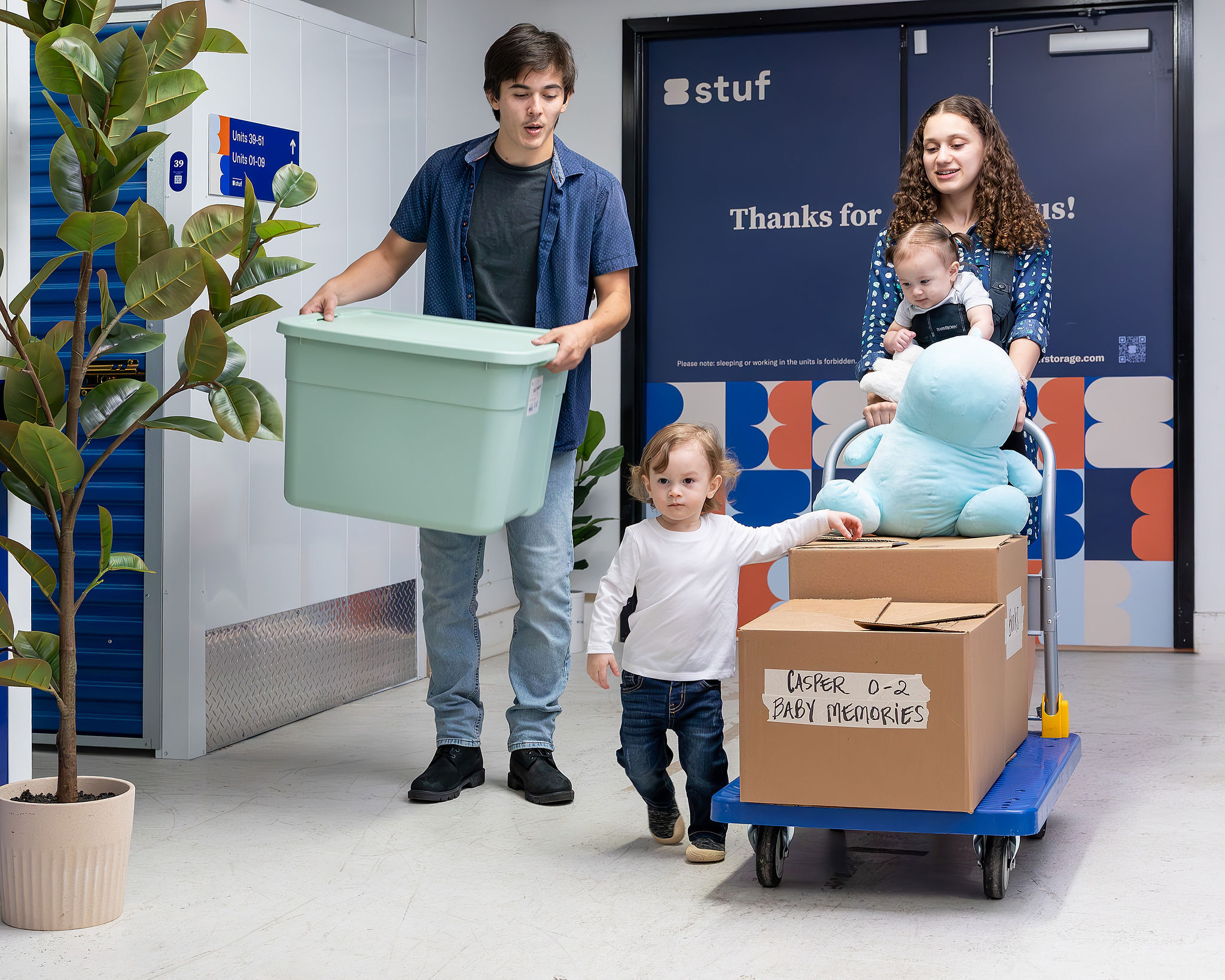
Stuf pitches storage as a neighborhood amenity rather than an errand. Its locations are designed to feel closer to a well-run building lobby than a warehouse aisle. Photo: Stuf Storage.
How It's Different
Asset-light, and proud of it
The traditional self-storage giants - Public Storage, Extra Space, CubeSmart - own and build. On-demand players like the former Clutter and MakeSpace picked up your things and stored them elsewhere. Stuf sits in a different place entirely: it neither owns real estate nor moves your boxes for you. It converts existing space and runs it remotely, which is what lets a very small team operate a surprisingly large footprint.
Stuf runs 30+ locations with a core operations staff of just three - software and design doing the work a front desk used to.
— Reported by Swivl
Where Stuf plays in the market
Illustrative positioning based on Stuf's publicly described model - relative, not measured. Stuf deliberately targets the hardest, densest markets, where entry is tough and copycats are slow.
The Founder
Katharine Lau
CEO and co-founder. A career-long commercial real estate professional who has stood on every side of a building deal - investor, developer, operator, tenant. That range is the reason Stuf's pitch lands with landlords and renters alike.
Lau has been named to Inc. magazine's Female Founders 100 and recognized in Connect CRE's 2024 Next Gen Awards. Under her leadership, Stuf earned a spot on Fast Company's list of the World's Most Innovative Companies in 2022.
Lau has always been drawn to the quirky or funky spaces that sit perpetually empty or never get leased.
— Founder profile, Harlem Capital
The Money
Funding history
Seed · Dec 2020
$1.8M
Led by Harlem Capital Partners & Wilshire Lane Partners
Backed the asset-light concept in its first year.
Series A · Feb 2023
$11M
Led by Altos Ventures & Allegion Ventures
With Wilshire Lane Capital and Harlem Capital returning.
Total disclosed funding: approximately $12.8M. Stuf has framed its capital as fuel for expansion into new and existing dense urban markets rather than for buying real estate.
The Map
Eight cities, all dense on purpose
Stuf operates in New York, Los Angeles, San Francisco, Atlanta, Boston, San Diego, Seattle and Washington, D.C. These are the markets where parking is scarce, apartments are small and driving to a highway facility is a genuine chore - which is exactly where neighborhood storage is worth the most.
New York
Los Angeles
San Francisco
Atlanta
Boston
San Diego
Seattle
Washington, D.C.