There is a peculiar moment in the life of a successful company when its reputation stops behaving like an asset and starts behaving like a filing cabinet. This is PR. That is lead generation. These people write releases. Those people build franchise websites. In early 2024, BizCom Associates bought Brand J, joining a Dallas-area public-relations firm founded in 1999 with a franchise-development shop known for websites, video, and lead generation. The terms were undisclosed. The logic was easy to see. Explaining the new whole was harder.
BizCom had spent a quarter-century becoming legible. Scott White and Monica Feid had built it around public relations, marketing communications, and the odd blend of local theater and national ambition that franchising requires. Brand J, founded in 2008, came with a different reputation: recruitment sites, storytelling films, digital campaigns, and the practical business of finding prospective owners. Put them together and the agency could handle almost everything between a franchisor's first positioning question and a candidate's completed inquiry.
Yet the market kept sorting the combined firm into its old drawers. Clients still saw the BizCom people and the Brand J people. One side meant PR; the other meant leads. A portfolio had been assembled, but a company had not quite appeared.
A reputation is wonderfully efficient. It tells the market what to remember, then quietly decides what the market is allowed to forget.Thunderly's rebrand problem, in one sentence
The first campaign was the company
In February 2025, BizComPR and Brand J discarded both names and emerged as Thunderly. The word was designed to do two jobs: lightning supplied precision and speed; thunder supplied the noise afterward. This could have been a cosmetic exercise involving a dramatic logo reveal and several expensive adjectives. Instead, the company described the rebrand as an answer to an operating problem. Two legacies had to become one offer, one culture, and one explanation.

The new explanation is called Amplified Integrated Marketing, or AIM. The acronym sounds like agency machinery, but the idea is refreshingly ordinary: prospective franchisees do not experience a vendor chart. They encounter an advertisement, Google the brand, watch an owner talk on YouTube, read a trade article, inspect the recruitment site, and scroll the chief executive's LinkedIn posts. If each stop offers a different reason to care, every additional channel creates another small doubt.
One point of view, repeated with purpose
Thunderly sells the coordination. Its menu includes PR, crisis preparation, media training, paid search and social, website design, SEO, influencer campaigns, personal branding, graphic design, video, podcasts, and franchise lead generation. Its customers are franchisors and multi-brand operators: Sport Clips, The Joint Chiropractic, Eggs Up Grill, TeamLogic IT, WellBiz Brands, Neighborly, Benetrends, and others named in its public work. Some want more candidates. Some want more credible candidates. Others need a milestone to travel farther than a ribbon-cutting photo.
One haircut, many signals
Consider Sport Clips. Thunderly's published case study describes a system rather than a single clever advertisement: a new franchise recruitment website, owner-focused podcasts, video, search articles, and targeted digital ads. The site was the home base. Every other piece either brought a prospect toward it or supplied an answer the prospect would need once there.

The agency reports that the redesigned site converted leads at 2.5 times the franchise-industry average and that its wider work contributed to more than 200 new Sport Clips openings over four years, including multi-unit deals. “Contributed” is the important word. Locations open because of economics, operators, real estate, capital, sales follow-up, and dozens of other causes. Marketing can organize the evidence. It cannot operate the salon.
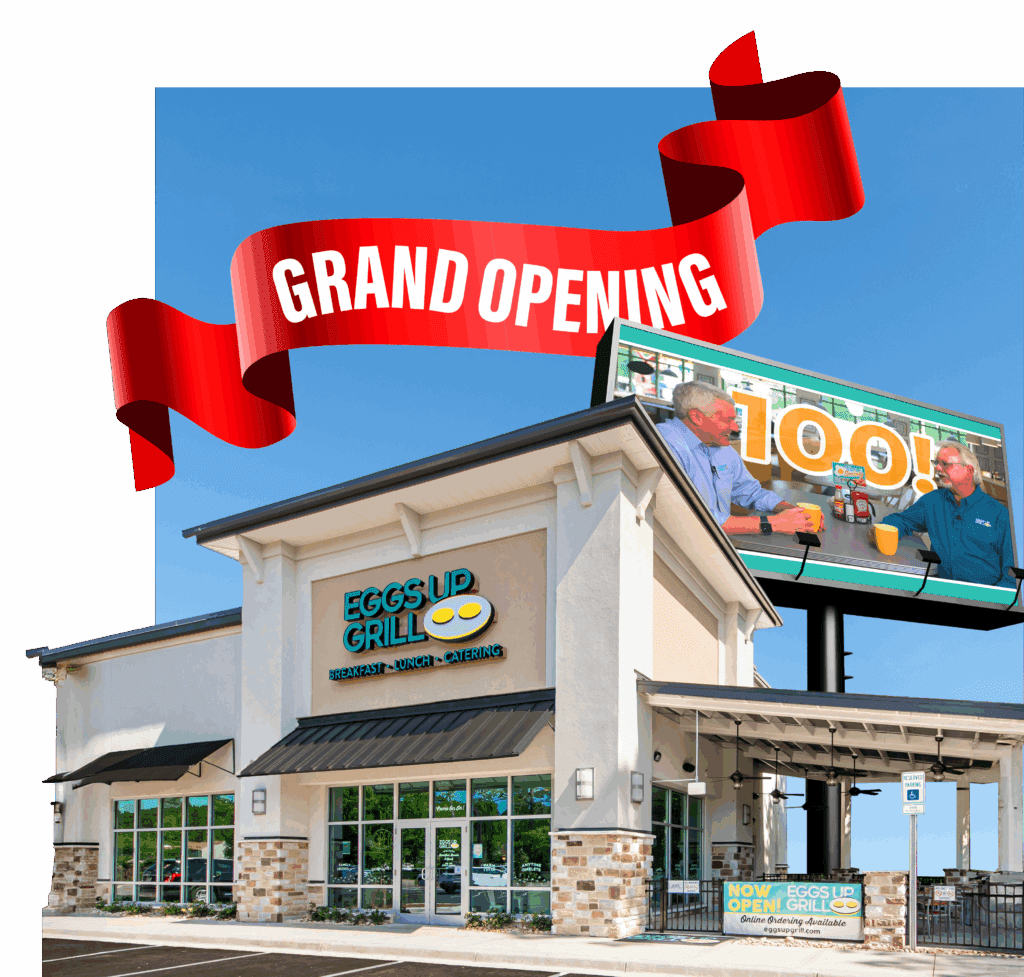
For Eggs Up Grill, the object was different but the method rhymed. Its 100th restaurant opening in Kingsport, Tennessee, became a sequence: teaser, opening announcement, grand opening, local pitching, national and trade outreach, influencer engagement, executive commentary, photography, video, and social posts. Thunderly reports 308 placements with potential audience reach above 74 million, plus 19,700 social impressions around the milestone. One restaurant door opened. The story entered through many doors.
The three-day content year
The most copyable example begins at a conference. TeamLogic IT, a business-technology franchise system, already had franchisees, presentations, conversations, and an annual gathering. What it lacked was a way to preserve that temporary concentration of people and proof. Thunderly arrived for three days, conducted 10 in-depth franchisee interviews, recorded presentations and informal footage, and photographed the event.
Then came the multiplication. Long interviews became short clips. Owner experiences fed the website and lead-nurture material. Footage supplied social posts and ads. Themes became articles. The agency says the resulting library sustained a year of output and helped lift website conversion by 39 percent. The reusable method is not “post more.” It is to design the distribution plan before the camera turns on.
Choose the questions candidates repeatedly ask and recruit interviewees who can answer from experience.
Capture complete interviews, atmosphere, presentations, stills, and the unscripted connective tissue.
Edit by audience and channel: full stories for trust, short clips for discovery, excerpts for nurturing, and themes for search.
This is where Thunderly fits in the market. A conventional PR agency may win attention. A performance shop may buy clicks. A production company may deliver a beautiful film. An in-house franchise-development team may manage the pipeline. Thunderly's pitch is that these activities should share a point of view, a calendar, and a definition of a qualified prospect. The customer buys fewer handoffs and, ideally, less contradiction.
Amplification has a prerequisite
There is a limit hidden inside the name. Thunder makes something easier to notice; it does not make the underlying thing sound. An integrated campaign will struggle when unit economics are weak, existing franchisees will not validate the opportunity, the sales team follows up slowly, or leadership cannot agree on what it is promising. Nor is one full-service agency automatically right for a company that already has a strong internal orchestration function and best-in-class specialists.
What another company can borrow
Start with one precise promise. Audit every place a prospect encounters it. Plan major events as raw-material opportunities, not one-day happenings. Record credible operators answering real questions. Cut each answer to fit the medium without changing the meaning. Finally, measure the handoff to sales, because attention without follow-up is merely expensive weather.
Thunderly's own history makes the argument more persuasively than its meteorological branding. It first accumulated capabilities through acquisition. Then it discovered that capabilities do not integrate themselves. The old names kept announcing the old divisions, so the company removed them and forced a clearer question: what should all this work say together?
That is the modest revelation at the center of a loud name. Modern marketing does not suffer from a shortage of places to speak. It suffers from a shortage of things worth repeating, and from organizations unable to repeat them consistently. Thunderly built a business around repairing that gap. Before it asked clients to trust the idea, it placed two familiar names on the table and struck them out.