There are two ways to understand a communications agency. The first is by reading the service menu. Neuger, an independent firm founded in Northfield, Minnesota, in 2002, has a long one: branding, public relations, advertising, websites, media strategy, crisis counsel and custom digital tools. The second way is to look at the work that never becomes an invoice. By that measure, the revealing number is five percent.
Employees may spend up to five percent of a 40-hour week volunteering for causes they choose. In the five years before the agency received a Minnesota Keystone award in 2021, the firm estimated that its people had contributed about 7,500 hours of service. Neuger also says it now donates more than ten percent of pre-tax earnings to charitable causes. Those figures do something a values statement cannot: they put a clock and a ledger behind the sentiment.
The billable work explains the free work
David Neuger did not arrive in Northfield as an advertising prodigy with a garage and a mood board. He had already worked in health-care communications, led a Twin Cities public relations firm and served as chief communications officer at St. Olaf College. He founded Neuger Communications Group in 2002. The company opened a Minneapolis office in 2014, then cut “Communications Group” from the name in 2020. The shorter name suited a business whose remit had become much wider.
Its customers include colleges, school systems, manufacturers, banks, law firms, cities and nonprofits. The work can be conventional - an identity, a media plan, an advertising campaign - but the better clues are in assignments where communication turns into infrastructure. For signage manufacturer Gemini, Neuger helped create TrueQuote, a tool able to configure and quote 25 product lines, plus a memorial designer and a customer portal tied to order data. Before the portal, a customer could look up only one order number at a time. Afterward, customers could see quotes, orders and statuses from receipt to delivery.
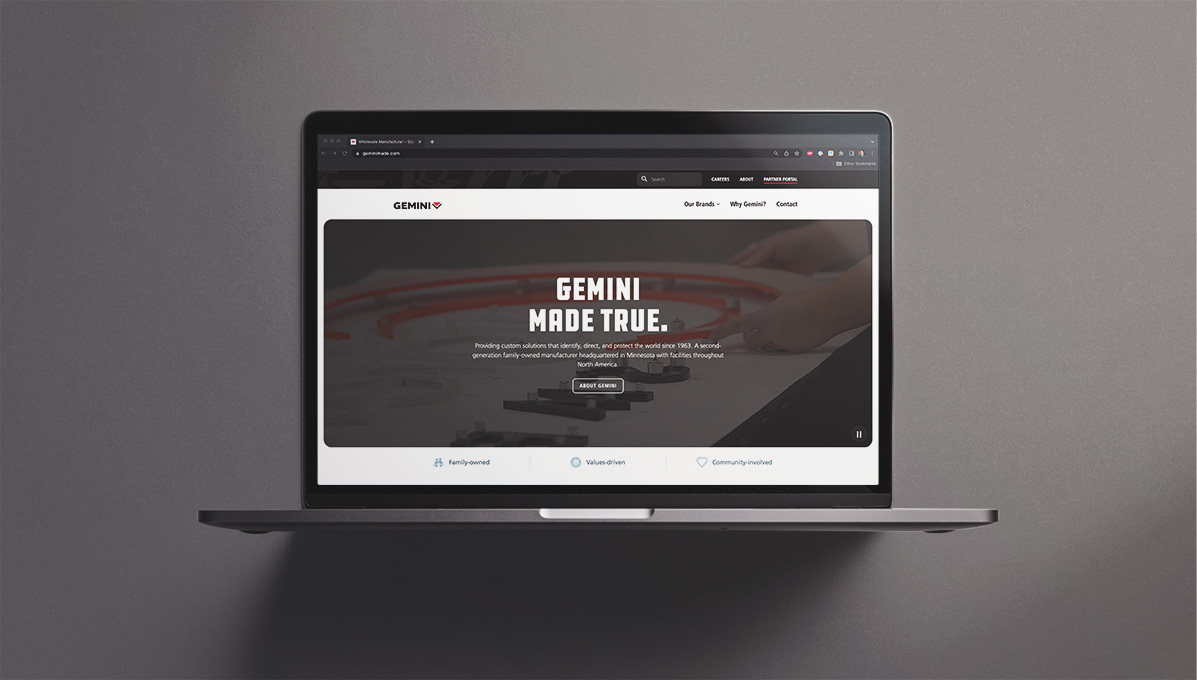
The portal won a MarCom Platinum Award in 2022 and a Minnesota PRSA award in 2023. The prizes are less interesting than the sequence. The first thing that failed was not the color palette. It was the one-order-at-a-time experience. Neuger’s solution was software. In this version of the agency business, “telling the story” can mean removing the part of the story where a buyer gets annoyed.
First listen. Then draw.
The firm’s stated process is almost aggressively unromantic: listening and research, dialogue, recommendations, results, testing and active assessment. It is useful precisely because so much agency theater begins at the reveal. For Westonka Public Schools, Neuger began with a communications audit, phone interviews and a focus group. The district had more than ten legacy logos circulating across academics, athletics and activities. Research gave the committee a shared problem before designers offered a shared answer.
- Listen + research
- Open dialogue
- Recommend
- Make + launch
- Test + assess
What changed minds was not a fashionable mark. It was a platform the district could recognize as its own: “The Ideal Blend,” a way to join small-school intimacy with big-school opportunity. The resulting system replaced the visual thicket with a stable family of marks and a launch plan spanning newsletters, video and the district website. In 2025, the project received two Minnesota PRSA awards, including one for the research behind it.
“They promised to delight us and they delivered.”Kevin Borg, Westonka Public Schools superintendent

Responsiveness is an operating decision
Neuger promises to answer clients within one business day. Agencies routinely call themselves responsive, much as hotels call their beds comfortable. Neuger at least connects the claim to a structural choice: keeping strategy, creative, PR, advertising and web work in-house. Fewer handoffs give the firm more control over speed and quality. The model puts Neuger between a specialist studio and a national network - broad enough to coordinate a campaign, small enough that a client is unlikely to need a map of the account team.
That position makes sense for organizations with complicated constituencies and no appetite to manage four vendors. A university needs recruitment advertising, reputation counsel, web accessibility and a brand system to agree with one another. A manufacturer may need engineers, distributors and buyers to understand the same product from different directions. A nonprofit may need a case for support before it needs a prettier brochure. Neuger sells the coordination as much as the artifacts.
What it costs, when the price is public
Most of the agency’s work is custom-priced. Its AI-enhanced digital advertising offer is an exception, with three public monthly tiers. Each includes strategy, creative variants, platform management and reporting; media spend is separate, with a recommended minimum of $1,500 a month. “AI” here mostly describes faster testing and allocation. Neuger’s own writing is careful to preserve human judgment as the editor of the machine’s abundance.
The public pricing is a small act of positioning. It tells prospective clients this is managed professional service, not a self-serve ad tool. It also makes the limits visible. An organization without clear conversion goals, sufficient media budget or someone able to handle the leads is not fixed by more variants of an ad.
Five things worth stealing
- Put values in units. Hours and percentages are harder to decorate than adjectives.
- Find the operational irritation first. The broken lookup may matter more than the campaign.
- Research before consensus. Interviews can turn opinion into a shared brief.
- Make response time a system. A promise works only if staffing and handoffs support it.
- Let service create the proof. Pro-bono work is more credible than a purpose slogan.
The five-percent policy is the most portable idea. It does not require a foundation or a gala. It requires permission, a cap and enough managerial trust to let people choose where their time goes. The Common Good Breakfast Series extended the logic by lending Neuger’s audience to lesser-known nonprofits. This is the communications equivalent of giving someone the microphone, not merely applauding from the back row.
The fit test
This model is strongest when a client’s problem crosses disciplines and the organization wants one accountable partner. It is weaker when a buyer needs a single narrow commodity, wants the scale of a global network, or has not assigned an internal decision-maker. Integrated work still needs someone on the client side to settle priorities. Community investment also depends on healthy margins and protected time; without both, the five-percent rule becomes an aspiration employees are too busy to use.
A small place can be a strategy
Northfield sits close enough to Minneapolis-St. Paul for David Neuger to call the firm “big city,” while retaining the quality of life of a smaller community. That is not a claim of innocence. It is a market position. Neuger can work on a global manufacturer’s ordering system, a statewide college campaign and a local nonprofit breakfast without pretending those assignments belong to different moral universes.
The agency business is full of borrowed distinction. Everyone is strategic. Everyone collaborates. Everyone has a proprietary process with arrows. Neuger’s sharper distinctions are plain enough to be missed: a reply by tomorrow, several disciplines in the same building, five percent of time for somebody else, more than ten percent of earnings returned to the community. None is dazzling alone. Together they form a company that has made its habits legible.
That may be the real product. The ads, identities, press plans and portals are evidence. What Neuger sells is the relief of finding an organization whose public language and private machinery appear to be talking to each other.