A golf tournament is an event with a ruthless expiration date. The foursomes finish, somebody holds up a trophy, the rented tables disappear. Then everyone goes home. When Guiding Eyes for the Blind hired Co-Communications to publicize its golf classic, the obvious move was to make the event louder. The White Plains agency did something more useful: it changed the unit of the story.
The tournament was not really about golf. It was a window into how guide dogs are trained, how volunteer puppy raisers work, how blind golfers compete, and how families of children with autism experienced greater independence with a trained dog. Eli Manning could draw cameras to the course, but the mission gave reporters a reason to keep returning. A project assignment became a seven-year relationship. In one year, the organization received 550 media placements and more than one billion reported impressions. Then Eukanuba called with a platinum sponsorship valued at $50,000, plus food for the dogs.
That is the Co-Communications trick in miniature. The agency sells public relations, marketing, design, research, personal branding and podcast promotion. But the list is less revealing than the pattern: take the client’s apparent thing and find the larger behavior hiding inside it. A golf day becomes volunteer recruitment. A hospital technology announcement becomes a patient’s survival. A real-estate course becomes a reason to enroll. Attention has a job.
01 · The useful reframe
A press hit is not an outcome
Stacey Cohen founded Co-Communications in 1997 after working at Marsteller and holding senior public relations and marketing roles at CBS/Fox Video. Her academic route included social work at Syracuse before an MBA in marketing at Fordham. That combination - people first, system second - is a tidy explanation for the firm’s best work, though perhaps too tidy. The less romantic explanation is that a regional agency has to be practical. Clients do not buy cultural omnipresence. They buy movement on a stubborn problem.
Consider the Westchester Children’s Museum. For more than a decade, the museum had pursued approval to build at Rye Playland. Co-Communications created “T.A.G. You’re It!”, a campaign that asked supporters to tag others and write directly to county legislators. It gathered nearly 1,200 letters, 800 of them from new supporters, while a media program produced more than 750 reported hits. The lease passed 17-0.
The clever part was not making more noise. It was giving private enthusiasm a public form that a legislator could count.The participation principle
The first obstacle was not hostility. It was inertia. Years of wanting the museum had not created a visible constituency. The campaign changed the evidence. Letters turned sentiment into a stack; social sharing found new advocates; press coverage made the stack harder to ignore. What shifted minds cannot be assigned to one channel with scientific precision, but the mechanism is plain enough: make support observable, specific and local.
Name the action
Begin with a vote, enrollment, sponsor, lead or trust goal - not a channel.
Find the humans
Patients, students, volunteers and experts make institutions legible.
Invite a role
Let audiences write, attend, share, testify or contribute evidence.
Count the change
Track the behavior after attention, not only the attention itself.
02 · Difficult subjects, better protagonists
The boring-business advantage
Co-Communications operates where glamour is scarce and consequences are not: real estate, hospitals, education, nonprofits, economic development and professional services. In these fields, jargon grows naturally. “Stakeholder engagement” can mean a worried neighbor at a town hall. “Mobility infrastructure” can mean whether a driver finds a charger. “Advanced imaging” can mean a family gets more time together.
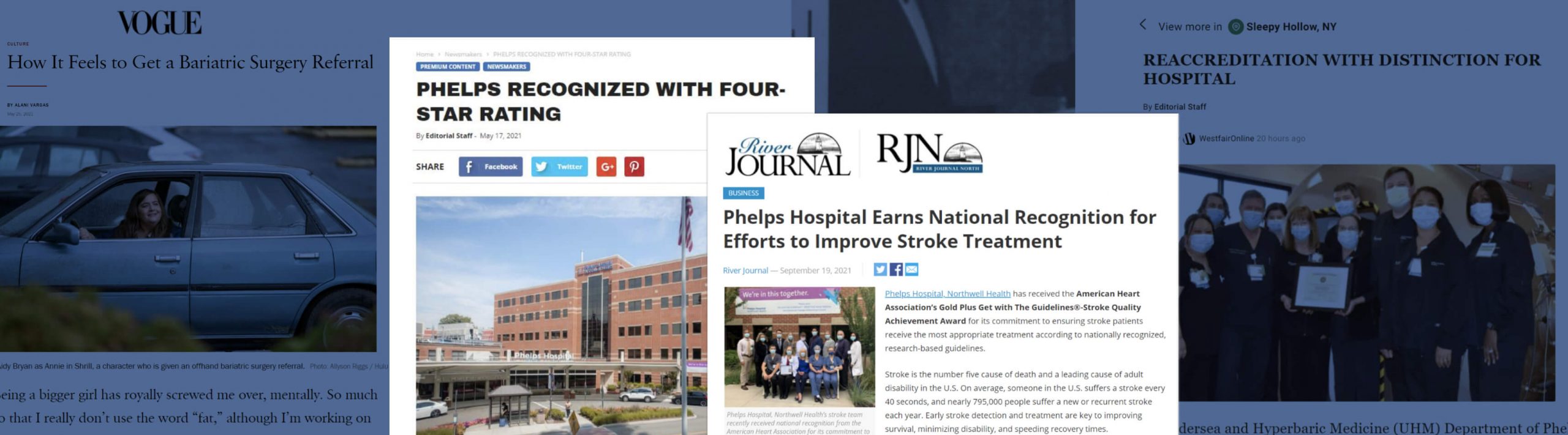
For Phelps Hospital, the agency pulled stories from across departments, paired physicians with reporters and put patients beside the technology. A cancer survivor and her family helped explain an $8.4 million imaging suite. In ten months, the program generated 336 reported print, broadcast and online placements, plus 30 expert-source interviews in outlets ranging from Reuters Health to Vogue and WebMD. The hospital became easier to call because its doctors had become recognizable sources.
Title insurance presented a different problem: a regulated category famous for paperwork and low cocktail-party value. TitleVest had invested in proprietary technology that simplified closings. Co-Communications made that the spine, then joined electronic reports to a “Grow Paperless” program with the Arbor Day Foundation. The work secured trade and mainstream coverage and won a Gold Mercury Award. The lesson is refreshingly reusable: if the category is dull, do not paint it brighter. Locate the friction it removes.
03 · A generalist with chosen neighborhoods
Where the agency fits
The firm sits between two familiar alternatives. One is the large integrated agency with national scale and layers of specialists. The other is the single-sector boutique that already knows every trade editor in a narrow market. Co-Communications makes a case for the middle: an integrated team with repeated experience in a handful of institution-heavy sectors, working across White Plains, New York City and West Hartford.
Its business is custom professional service, sold through projects and continuing relationships rather than a packaged subscription. The menu spans research and competitive analysis, message development, media relations, community outreach, branding, websites, content, social, events and executive visibility. That breadth matters when the assignment changes shape. A media brief may expose a positioning problem; a rebrand may require stakeholder research; a civic campaign may need both a town hall and a live feed.
The approach works best when an organization has real evidence, accessible experts and a goal that can be observed. Fordham’s Real Estate Institute wanted awareness and enrollment, not mere mentions. After three months of public relations, graduate enrollment had risen by more than 300 percent, according to the agency. Propark Mobility wanted authority around parking, acquisitions and municipal transportation. An opinion piece in Crain’s New York Business led Bloomberg to request interviews within 48 hours, creating a second wave of coverage.
Write the desired behavior at the top of the brief. Then choose one protagonist, one piece of proof and one action the audience can take. Only after that should anyone debate platforms.
There are limits. Earned media cannot manufacture a credible expert, repair a product that disappoints, or substitute for leadership willing to speak plainly. Community campaigns weaken when participation is performative. And a long-burn reputation program is a poor match for a client demanding guaranteed headlines next Tuesday. Even Co-Communications tells prospective clients that marketing is a long-term investment, with measurable impact sometimes appearing within six months.
04 · Clarity as an operating rule
The headline after the headline
Co-Communications uses the line “Make Yourself Perfectly Clear.” It could have been empty agency polish. The case work gives it sharper meaning. Clarity is not simply shorter copy or a handsome logo. It is agreement about which change matters, who can make it happen and what proof will move them.
That is why a bridge campaign can be understood alongside a guide-dog program. For the coalition supporting a replacement for the Tappan Zee Bridge, the agency built a community representing more than 300,000 employees and 15,000 employers, held town halls, live-tweeted information and created an online petition. The 18-month effort reported more than 500 placements and a potential audience above 40 million. Different client, same architecture: make the constituency visible, give it a role, keep the story supplied with people and facts.
The broader communications market often encourages a confusion between exposure and effect. Co-Communications is most interesting where it refuses that confusion. A sponsor calling after coverage is effect. A student enrolling is effect. A reporter returning to the same doctor is effect. A unanimous vote is effect. The headline is merely the first knock on the door.