A cow’s burp is an odd place to begin a business plan. It has poor manners, no obvious retail appeal and a tendency to vanish before anyone can invoice it. Dr. Tom Williams sees something more useful: feed energy leaving the animal before the farmer has had the benefit of it. His company, Number 8 Bio, is built around the possibility of keeping more of that energy at work.
Williams is a synthetic biologist who grew up in the Waikato, New Zealand’s dairy-farming country. He now leads a Sydney company developing livestock products called BetterFeed. The intended bargain is straightforward: reduce methane while helping animals use their feed more efficiently. Making that bargain hold on an actual farm has involved years of research, a change in technical approach and a delivery problem that begins when a cow walks away from a feed trough.
The interesting thing about Williams is how closely those problems connect his earlier and present lives. He spent his academic career working on microbial metabolism. He has made a business out of asking what microbes do with the energy passing through them. The setting has changed; the underlying curiosity has travelled remarkably well.
A piece of wire, a working philosophy
Number 8 Bio’s name carries a little of New Zealand with it. Williams has explained it through the country’s number 8 wire tradition: the resourcefulness associated with farmers finding uses for eight-gauge fencing wire. The wire is versatile. So, ideally, are the people using it. A laboratory company named after a farm repair material comes with a pleasing obligation to be useful.
That choice makes sense for a founder whose childhood surroundings already contained the problem he would later tackle. Williams recalls growing up in a small New Zealand town where dairying was the principal industry and livestock methane was part of the national conversation. Long before he had a company, the relationship between farming and emissions was familiar territory.
His route into science also has a specific starting point. At about 15, he encountered a biology textbook diagram linking biotechnology’s inputs to its applications. The drawing helped him see a field he wanted to enter. There is something wonderfully economical about that memory: a page showing how pieces connect, followed by a career spent trying to make the connections work.
“I’m rapidly sponging as much information as I can.”
Tom Williams, on becoming a CEO
He is candid about the learning involved in changing roles. Becoming a chief executive added a new set of questions to a scientist’s existing workload. A good explanation of biology could take him only part of the way. The company would also have to explain how it could produce something, deliver it and make the sums work for somebody else.
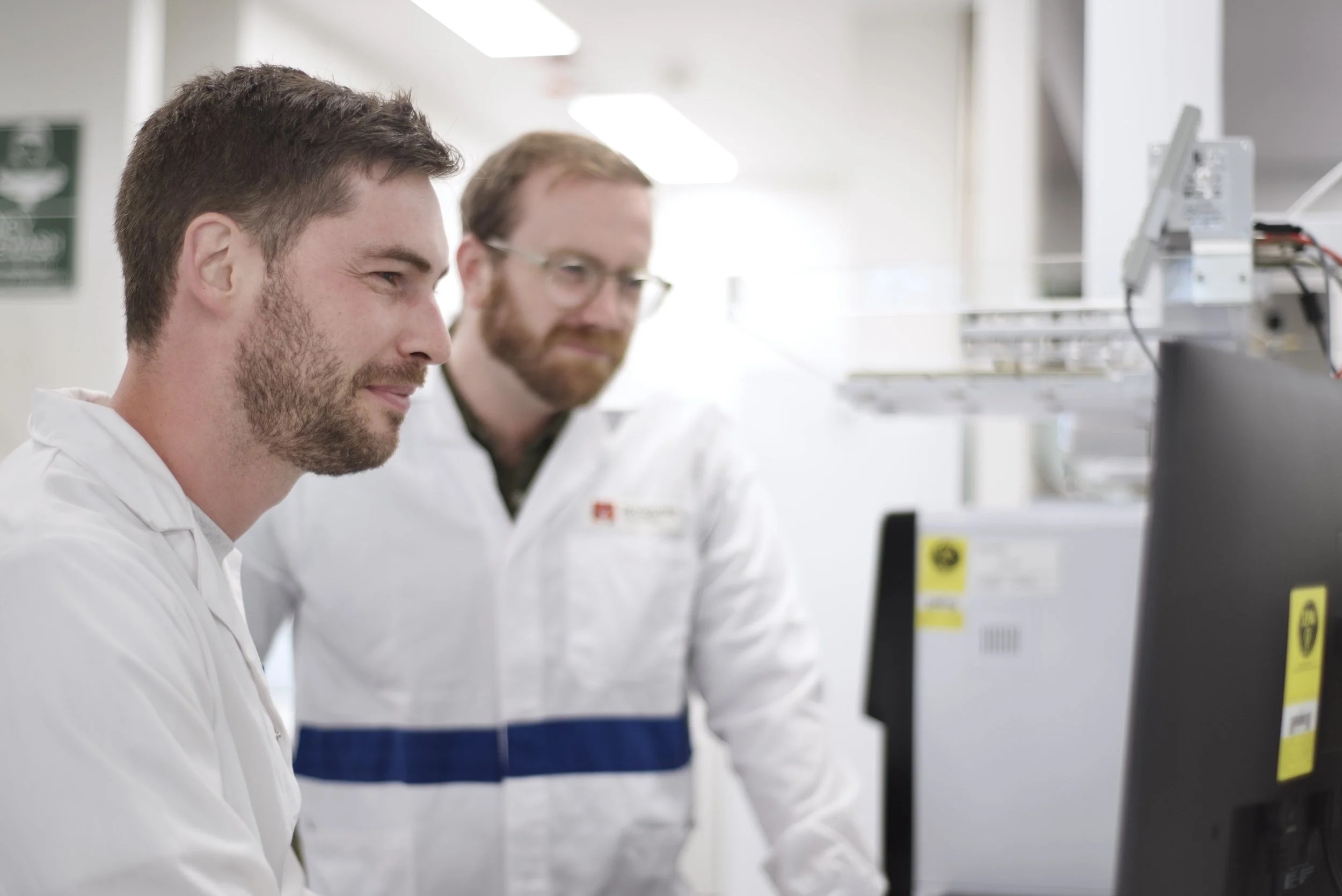
Learning to rearrange the invisible
Williams studied biochemistry at the University of Waikato, then microbiology at master’s level. His doctorate took him to the University of Queensland, where his research concerned yeast physiology and metabolism. By 2015 he was at Macquarie University, working on Yeast 2.0, an international effort to build a synthetic yeast genome.
At Queensland, his supervisors included Claudia Vickers, Lars Nielsen and Jens Kromer. At Macquarie, he worked under the mentorship of Sakkie Pretorius and Ian Paulsen. His projects ranged across one-carbon metabolism, minimal genomes, directed evolution and biosensor engineering. Those subjects place his later startup in context: he arrived at agriculture with experience in altering what microorganisms can do.
Metabolism can sound like an abstract word until somebody attaches a useful question to it. Where does carbon go? What happens to energy? Can an organism be encouraged to make a different product? Williams’s research occupied that territory. It offered a way to think about a cow’s digestion as a system with flows that might be redirected.
His working relationship with Alex Carpenter began in academic research in 2017. By 2019 they were developing the company idea and meeting investors. They joined the UNSW SynBio 10x accelerator in 2022, the year Number 8 Bio launched. Carpenter became chief scientific officer; Williams became CEO. Their shared scientific background gave the partnership a starting language. Building a company required several more.
Yeast 2.0
takes shape
launches
continue
The accelerator offered contact with people who had already taken scientific ideas into businesses. In that setting, the problem expands. Evidence has to persuade people with different kinds of responsibility. A research collaborator wants to understand the experiment. An investor asks about the enterprise. A producer needs to understand what happens to costs and output.
The cow sets the terms
The early Number 8 Bio approach drew on research into methane-inhibiting compounds found in seaweed. Williams and Carpenter investigated making relevant compounds through engineered yeast. Yeast was familiar scientific ground, with established industrial uses. It was a reasonable place for them to start. The company’s subsequent history shows the difference between a starting point and a settled product.
The team moved away from that approach as the economics became clearer. By 2026, BetterFeed was described as a family of proprietary organic small molecules, free of bromoform. The company uses green chemistry for manufacturing. Williams’s scientific training remained relevant even though the route to the product changed. Understanding the biological problem did not oblige him to keep the first production method.
In an Ash Cloud podcast discussion in May 2026, the company’s development was described through an automated laboratory rumen-screening system processing about 100 tests a week. The purpose was to search broadly, then learn which candidates deserved further work. A rumen contains interacting microorganisms; changing one part of that activity demands attention to what happens elsewhere.
“Every burp represents lost nutrition.”
Tom Williams
Williams’s explanation keeps returning to the farmer’s arithmetic. Feed energy that becomes methane cannot also become useful production. Recovering some of that loss could give a producer an economic reason to adopt an emissions-reducing product. It is an attractive proposition precisely because it asks the customer to consider an ordinary business concern: what return comes from an input already being purchased or grown?
The measurements require care. Different product formats and feeding systems have produced different reported methane reductions. The company reported up to 50 per cent in early beef-cattle bolus trials in April 2026. Earlier work on other BetterFeed applications reported higher reductions. A percentage belongs with its trial conditions. It should travel with them whenever it leaves the laboratory.
That caution matters to Williams’s commercial argument. A producer buying an efficiency tool needs a result that holds under the conditions in which it will be used. The next useful number might be a cost per animal, a change in feed conversion or a result across a longer trial. The headline percentage starts a conversation; farm performance has to carry it.
A product that has to follow the grass
A grazing animal presents a particular delivery challenge. It spends much of its life consuming pasture rather than a ration mixed every day by somebody who can add an ingredient. The chemistry therefore shares the stage with a less glamorous question: how does the product keep reaching the animal?
Number 8 Bio is developing a slow-release bolus, designed to remain in the rumen and release its ingredient over months. The intended duration is up to six months. That format is central to the grazing proposition. It attempts to give a producer a way to use the product without turning pasture farming into a daily feeding operation.
Energy enters the rumen.
BetterFeed aims to reduce energy lost as methane.
More of the existing feed supports the animal’s output.
In June 2026, the team announced a trial with Meridian Agriculture and Warooka Pastoral Co. The six-month project involved Merino ewe lambs at the Melville Forest property in Victoria’s Southern Grampians. EpiVets supported the work, with part of its funding coming through Victoria’s On-Farm Emissions Action Plan Pilot. The company said results would be shared after completion.
That is the sort of detail that makes the business tangible. A flock, a property, a defined period and collaborators responsible for the work give the proposition somewhere to be tested. The scientific question acquires weather, pasture and a farm calendar. An ingredient needs a way to fit into that calendar as well as a mechanism that works inside an animal.
Beyond the laboratory door
The financing has grown alongside the testing. Number 8 Bio raised an A$7 million seed round in 2024. Breakthrough Victoria invested A$1.7 million as part of that round, alongside Main Sequence and The March Group. The investment included plans for trials at Agriculture Victoria’s Ellinbank SmartFarm and a research collaboration with Monash University.
In 2025, an A$11 million Series A led by Icehouse Ventures added resources for larger animal trials, international regulatory work and an Australian carbon-insetting programme. Insetting would let emissions reductions be accounted for within a supply chain. For Williams, expansion consequently involves more than selling a product: the result must also be demonstrable to the organisations buying livestock products downstream.
Led by Icehouse Ventures, with trials and international regulatory work among the planned uses.
June 2026 brought a different kind of opening. Williams accepted Number 8 Bio’s win in the DFI Sustainability Innovation Challenge in Hong Kong. The competition drew more than 40 submissions. The company received HK$120,000 and an opportunity to pursue pilots across DFI’s beef and dairy supply chains, including pathways involving Mengniu Dairy and CPF.
Williams’s influence also reaches back into research. His move into a startup helped inspire scientists behind Newera Bio to pursue their own venture. The Lund iGEM team published his offer to help young scientists. Meanwhile, he has spoken about valuing Number 8 Bio’s teamwork alongside its climate ambition. The founder’s story contains a network of people learning from one another, as well as a product moving toward market.
The next chapter is already being tested in commercial settings. A laboratory can identify an opportunity; adoption requires it to become dependable, affordable and convenient. Williams’s company name keeps that standard pleasantly close at hand. Eight-gauge wire earns its place by doing a job. BetterFeed will have to earn its place the same way, one farm decision at a time.