Thomas Nies wanted to sell something his former employer gave away. In the late 1960s, IBM bundled software with its computers. Nies believed software could support a business of its own. This presented a small difficulty: he wanted a software job in Cincinnati, and could not find the company that would employ him. So he helped create one. Entrepreneurship arrived wearing the rather practical clothes of a job search.
On September 29, 1968, Nies, Tom Richley and Claude Bogardus gathered around a card table in his basement. They had $600 and experience at IBM. Nies took sales and marketing; his colleagues brought technical expertise. His wife, Suzanne, answered the telephone and typed correspondence. The enterprise that became Cincom Systems began with consulting work, an arrangement in which every new assignment also used up the people available to do the next one.
The card table makes an appealing origin story. The harder question was what these three could offer a customer already receiving software with an expensive machine. Free is a formidable competitor, particularly when it arrives with a familiar name on the invoice.
A Cincinnati boy considers his options
Long before the basement meeting, Nies had imagined himself at Procter & Gamble. He received an offer and talked about it enthusiastically enough for a classmate to challenge him to try IBM. He later admitted that he had never heard of the company. His first encounter with the computer business was therefore less a childhood calling than a useful interruption of his plans.
He had studied marketing and finance at the University of Cincinnati, earning undergraduate and graduate degrees. A cooperative schedule let him alternate study with work. Caddying helped pay for his education. One of six children, he understood that choosing a university also meant choosing an arrangement the family could afford.
His earlier schooling had put Latin, ethics and theology beside mathematics and science. His father, Matt, stressed duty and honoring commitments; his mother urged him to make something of himself so he could help his family and community. Those expectations later appeared in Cincom’s management language. The company’s insistence on promises had roots older than its software.
IBM offered another education: sales, service and the experience of working among capable peers. Leaving it meant surrendering a place in a company he had admired. Nies carried several of its habits into the business he built.
The machine waits for its instructions
At ARMCO Steel, Nies became involved in a software development effort for an early online IBM System/360 installation. The machinery could occupy an impressive room. Until the programs worked, it could not perform the job it had been bought to do. The experience changed what he thought customers were really purchasing.
The distinction remained vivid in his later recollections. IBM’s hardware carried the revenue; software looked like an expensive obligation. To Nies, the obligation suggested a market. A persistent problem, multiplied across customers, could become the reason for a separate company to exist.
In a 2006 interview, he described his attachment to software as “an affair of the heart.” This is unusually romantic language for enterprise computing. Yet it explains something about the decision. He expected software to matter more, and wanted his career attached to that expectation. His enthusiasm was directed toward the work itself, before the work had an established business category.
He also resisted a career that would repeatedly relocate his family. Staying in Cincinnati and pursuing software became compatible ambitions through the company he helped found.
One answer, sold more than once
Cincom’s early consulting assignments revealed recurring data problems. The eventual product, TOTAL, gave the company a database management system it could sell to multiple organizations. A reusable package changed the economics: another sale could mean another copy of a developed product, rather than another programmer assigned for another stretch of time.
Consider an inventory record used by purchasing, production and sales. Separate copies invite disagreement whenever one department updates its version and another continues with an older one. A shared database offers a common record. The explanatory diagram below shows the idea, rather than the internal architecture of TOTAL.
TOTAL helped make independently sold database software a business. Nies’s contribution included recognizing repeatable demand and finding buyers for the response. Richley and Bogardus supplied complementary technical abilities. The founding partnership matters: a person who could describe the opportunity needed colleagues who could turn it into something customers could use.
The headquarters stayed; the market travelled
Nies’s attachment to Cincinnati did not confine his commercial ambitions. Cincom established a Toronto location in 1970 and operations in Europe in 1972. His account of the expansion describes a company seeking international experience while it was still young, rather than waiting to finish growing at home.
He called its sales approach “penetrate and radiate.” Work successfully with one location or division, then seek introductions to others. A customer with international operations could offer routes into several markets. The phrase has a salesman’s briskness, but the mechanism depends on something slower: doing enough useful work to earn a recommendation.
This gave his career an interesting geography. He could remain a Cincinnati businessman while building relationships far beyond Ohio. The company’s name joined Cincinnati and computer; its market soon exceeded the place embedded in that name.
The strategy also helps explain why his public comments return so often to customers. For a company using existing relationships to grow, satisfaction has a second commercial life. A good installation becomes a reason for someone else to take the call.
A president in the picture
In August 1984, Ronald Reagan singled out Nies and Cincom at a Cincinnati rally. Reagan used their beginnings to illustrate entrepreneurship and the potential of a changing economy. By then the $600 beginning had become material for a presidential speech. Few pieces of basement furniture receive that sort of promotion.
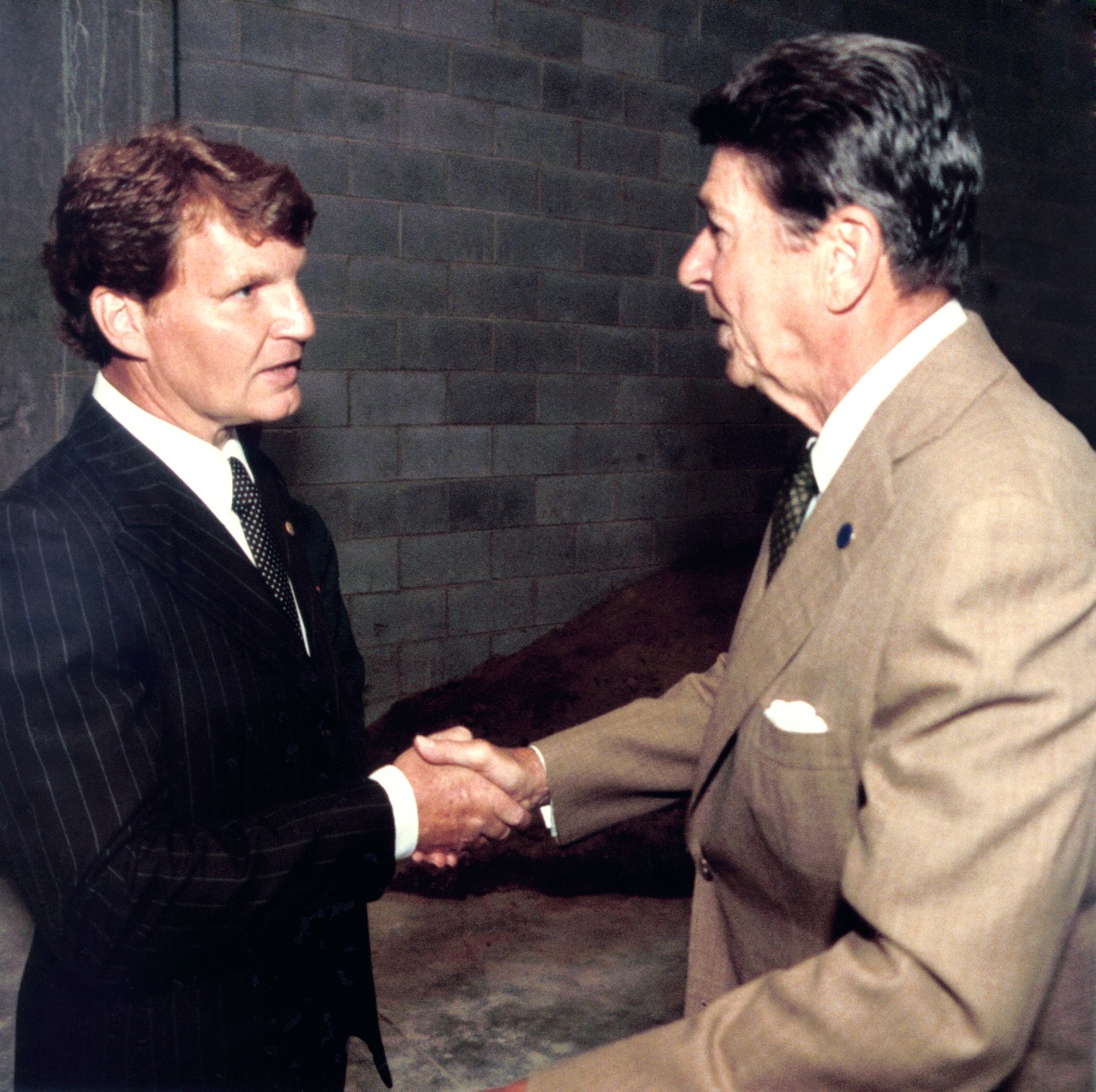
Recognition accumulated over the following decades. The Smithsonian recorded Nies’s oral history in 1995. Ernst & Young recognized him in 2004, and an International Stevie Award followed in 2005. These are separate forms of recognition: the museum preserved an account of an industry’s beginnings; business awards acknowledged the executive running a continuing company.
A Cincom account of its fiscal 2003 performance reported a 47 percent increase in new sales. The timing matters. This was an established software business finding sales after the technology downturn, rather than a founder being honored only for having arrived early.
Freedom, with the bills attached
Remaining private was a deliberate part of Nies’s approach. In his essay on the subject, he explained that Cincom had financed itself through cash flow and, when needed, bank debt, rather than venture capital or outside equity investors. He acknowledged the disadvantage of competing against companies with more funding and better known brands.
He valued the room private ownership gave management to make longer decisions, invest in development and respond to customers and staff. His argument also included family life and community involvement. A company’s financing structure, in this view, reaches into ordinary working days.
There is a price to that freedom. Cash flow requires someone to buy, pay and remain a customer. Bank debt brings obligations of its own. The essay’s appeal lies partly in its admission that independence made competition harder. He wanted discretion enough to accept the commercial constraints that came with it.
Cincom’s persistence as a private business gave him time to practice this philosophy across changing software markets. It also makes the eventual sale a consequential ending to his operating career.
Ideas should survive the organization chart
Nies’s writing about employees reveals a related concern: a company can become too orderly to recognize an opportunity. In his 2011 essay on intrapreneurship, he argued that ideas deserved consideration wherever their authors appeared on the organization chart. Approval should be efficient, and worthwhile proposals should receive support.
He allowed for projects that failed despite competent execution. That qualification matters. He was asking leaders to distinguish an uncertain venture from poorly planned work, and to avoid punishing people simply because a sound attempt did not succeed.
He also insisted on sharing credit. Encouraging ideas loses its appeal if the person at the top subsequently claims them. His phrase “Leadership is always plural” fits the original division of work among Cincom’s founders as well as the larger organization he later led.
“Leadership is always plural.”Thomas M. Nies
For a founder with decades of authority, this is a demanding prescription. It requires making room for other people’s judgment inside a business strongly associated with your own name.
The customer gets a vote
Nies could be combative when discussing competitors. In a 2004 conversation with Alexander Haig, he welcomed the opportunity to compete against large vendors that dictated terms to customers. His recurring challenge was the assumption that a large supplier must necessarily be a good supplier.
His preferred commercial argument involved the customer’s total costs, implementation time and risk. The purchase price alone tells only part of an enterprise software story. Installation and continued use can determine whether the product earns its keep. This emphasis connected the salesperson he had been with the executive he became.
At Cincom’s fiftieth anniversary in 2018, he emphasized its ability to move between products and markets while continuing to offer customer value. The continuity was a way of judging the work, even when the work changed.
That makes his long tenure more interesting than a count of years. An early database business had to keep adapting. Remaining present gave him repeated opportunities to test whether his founding idea still helped explain what customers needed.
A company beyond its founder
Nies handed over the presidency to Greg Mills in 2017. His CEO tenure continued until his retirement in 2024, when PartnerOne acquired Cincom. The acquisition announcement named Brian Bish, previously managing director and a veteran of more than thirty years at the company, as CEO.
The business entering that new ownership offered configure-price-quote software, customer communications management, and application and development solutions. Those categories are some distance from three former IBM employees selling consulting work. They still concern the practical business of helping organizations get useful work from their computing.
Nies’s story begins with the awkward economics of charging for something available free and ends with a company able to continue under another owner. Between those points sit technical partnerships, sales calls, family help, arguments about money and a habit of taking commitments seriously.
The card table was sufficient for a beginning. What followed required other people, paying customers and many revisions to the work. Software gave Nies a reason to leave a comfortable career. Building an employer gave that conviction somewhere to go.