October 2008 was an awkward month to become a chief executive. Thomas Hartland-Mackie was 20, two years into a training programme that was supposed to last five. His grandfather asked him to take charge of City Electric Supply’s American business. The financial crisis was gathering force. The apprenticeship had acquired a rather unforgiving final exam.
He had left university after his freshman year to learn the family business from the inside. The plan was practical: move through its departments, understand its branches, spend time in manufacturing, accounting and finance. By December, he was dealing with closures and layoffs. There is a considerable difference between studying a profit-and-loss statement and having to act on one.
His story begins with an inherited opportunity. What makes it interesting is the work that followed: learning to run a business in his own voice, expanding its reach, and finding uses for family capital beyond the electrical counter. In Dallas, those uses have included an office tower, a restaurant and a collection of contemporary art. Some of the art proved inconveniently large. Eventually, that inconvenience helped lead him toward an institution.
A family business, with an exit available
The family’s electrical business began with Tom Mackie in Coventry in 1951. The American operation followed in 1983. Hartland-Mackie’s training took him to branches in the United States, Spain and Britain, as well as into the less visible machinery of the company. Learning distribution meant seeing the accounts and the factory, along with the place where a customer actually collected an order.
His mother offered another example. She had pursued her own career outside the family business. He has described that independence as evidence that he could choose his path. A large family company exerts a certain gravitational pull; knowing there is an alternative changes what it means to join.
For his first three or four years in charge, he tried to run the company as he imagined his grandfather would. He later recognised that he needed to lead according to his own beliefs. That admission gives the succession a human scale. A new title can arrive in a day. Permission to use your own judgment may take rather longer.
His route to Dallas was equally unceremonious. In 2005, he followed a girlfriend from Colorado to Southern Methodist University. The relationship ended; his attachment to the city lasted. Dallas offered people he liked, an art scene that interested him and an airport that made an international business manageable. A personal detour became a professional base.
The person across the counter
Electrical distribution rewards attention to ordinary things. The customer needs the right material, useful advice and a dependable place to return. A branch manager understands the local trade in a way a distant office cannot. Hartland-Mackie’s account of the business places considerable responsibility with those managers, including autonomy and a share in profits.
He calls branches “the heartbeat of the business.” It is a useful description for a company whose geography can otherwise make it seem abstract. A network consists of individual encounters, repeated until familiarity becomes commercially valuable.
“The heartbeat of the business.”
Thomas Hartland-Mackie on branch locations
His explanation of employee retention is similarly everyday. He has compared a familiar employee at a branch to the barista who remembers a regular customer’s order. Continuity makes people feel welcome. When employee feedback indicated a need for more training, CES responded; a published account reported a 50 percent reduction in new-hire turnover. Listening had produced an operational change with a measurable result.
Growth brought its own demands. In a later interview, he described the expansion of distribution centres alongside the branch network. Large facilities and local service had to work together. The customer’s useful, familiar counter still needed a supply system behind it capable of handling more orders. Scale had to support the relationship that made a branch worth visiting.
Buying a tower was not on the syllabus
By the middle of the next decade, the American business was substantially larger. North American revenue rose from $494 million in 2009 to $1.02 billion in 2015. Its headquarters needed more room. A friend in commercial property suggested the former Belo tower near Union Station. Hartland-Mackie had not set out to buy a high-rise, and initially did not even recognise the building.
North American revenue. Historical figures; the bars compare these two years only.
The renovation of 400 Record gave him a different kind of project. The 17-storey building stood near parks, the Omni Hotel and Union Station. CES planned to occupy roughly half and lease the rest. Gensler worked on the design. Plans included art, a gym, conference space and a sky garden. An electrical wholesaler’s search for desk space had become an exercise in how an office building could meet the city.
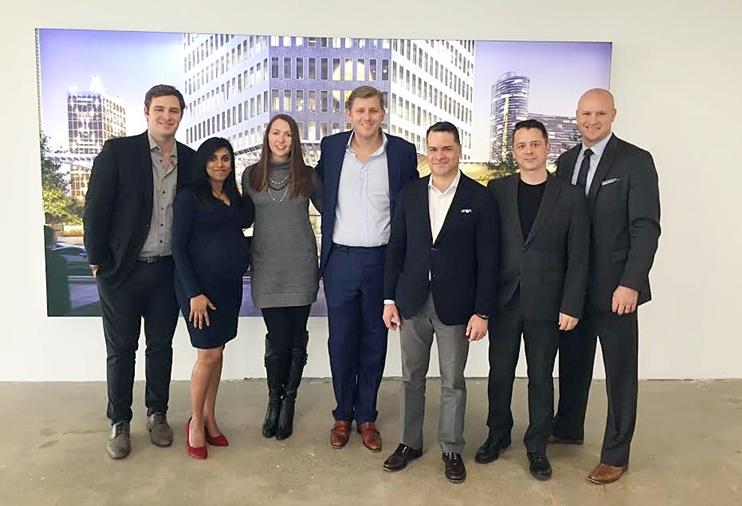
Bullion, the restaurant developed with chef Bruno Davaillon, took that ambition quite literally. It was raised above the street so people could pass underneath. The arrangement opened the building toward pedestrians rather than treating the pavement as the edge of its responsibility. Inside, a sculpture by Jean-Michel Othoniel occupied the staircase. Dinner came with architectural decisions.
At the opening celebration, Hartland-Mackie spoke of contributing a small part to downtown Dallas’s momentum. The phrasing was modest for a project involving a tower and a gilded restaurant. It also placed the building within a larger city story: something to participate in, rather than merely possess.
Learning to hand over the keys
In 2014, he established Labora to oversee the family’s wider business and philanthropic activities. The interests extended beyond electrical distribution into investments and real estate. Its structure gave these pursuits a common home while allowing the operating companies to retain their own work and identities.
Labora describes its investment approach through permanent capital and a willingness to invest patiently across asset classes. The language carries a practical consequence: the family can consider a longer horizon. Its familiar financial motto is “Save a little, spend a little, give a little.” The three verbs make room for prudence, enjoyment and responsibility in the same sentence.
The family expanded into solar distribution in 2021 through Segen and Soligent. These businesses brought another set of customers and markets into the group. In July 2024, David Rice became global CEO of the solar businesses, and Hartland-Mackie returned from the interim chief executive position to group chairman. Supporting another leader became part of the job.
There had already been a similar handover at City. In 2023, after 15 years as CES chief executive, Hartland-Mackie moved into the executive chairman role for CES and CEF while remaining Labora’s CEO. John Gray and Andrew Dawes became CES co-CEOs. Both had begun as drivers and spent decades working through the organisation. The succession put the company’s preference for promoting from within into practice.
His own development has included outside help. At Labora, he worked with leadership coach Rhonda, describing the effect on a newly formed leadership team and the continuing relationship across the operating companies. It is a small but revealing detail: a family enterprise can preserve its character while inviting someone from outside to help its leaders work together.
The collection outgrew the living room
Contemporary art gave Hartland-Mackie another apprenticeship. His friendship with collector Howard Rachofsky developed over meals, travel and Sunday evenings playing cards. The age difference between them spans roughly four decades. Rachofsky became a guide to collecting and to the people who make museums and exhibitions possible.
In 2016, the family bought Anicka Yi’s When Species Meet Part 1 (Shine or Go Crazy), a work Hartland-Mackie describes as a fur cage. Its size and materials made a domestic or office setting difficult. The acquisition shifted the collection toward challenging works by artists responding to contemporary life and technology. Finding a convenient wall was no longer a sufficient criterion.
By October 2024, the Hartland & Mackie / Labora Collection comprised about 300 contemporary works. Hartland-Mackie and Rachofsky announced the Warehouse Dallas Art Foundation, giving their collections a shared exhibition setting. Hartland-Mackie had moved to Costa Rica with his family by then, but the collaboration kept a substantial cultural commitment in Dallas.
He has spoken about his disappointment at owning works that remained in storage, sometimes since their purchase. Among the pieces he looked forward to showing was a Philippe Parreno Christmas tree. It is an appealingly specific problem: even a collector with considerable resources may find that the Christmas tree requires an institution.
What happens when two collections meet
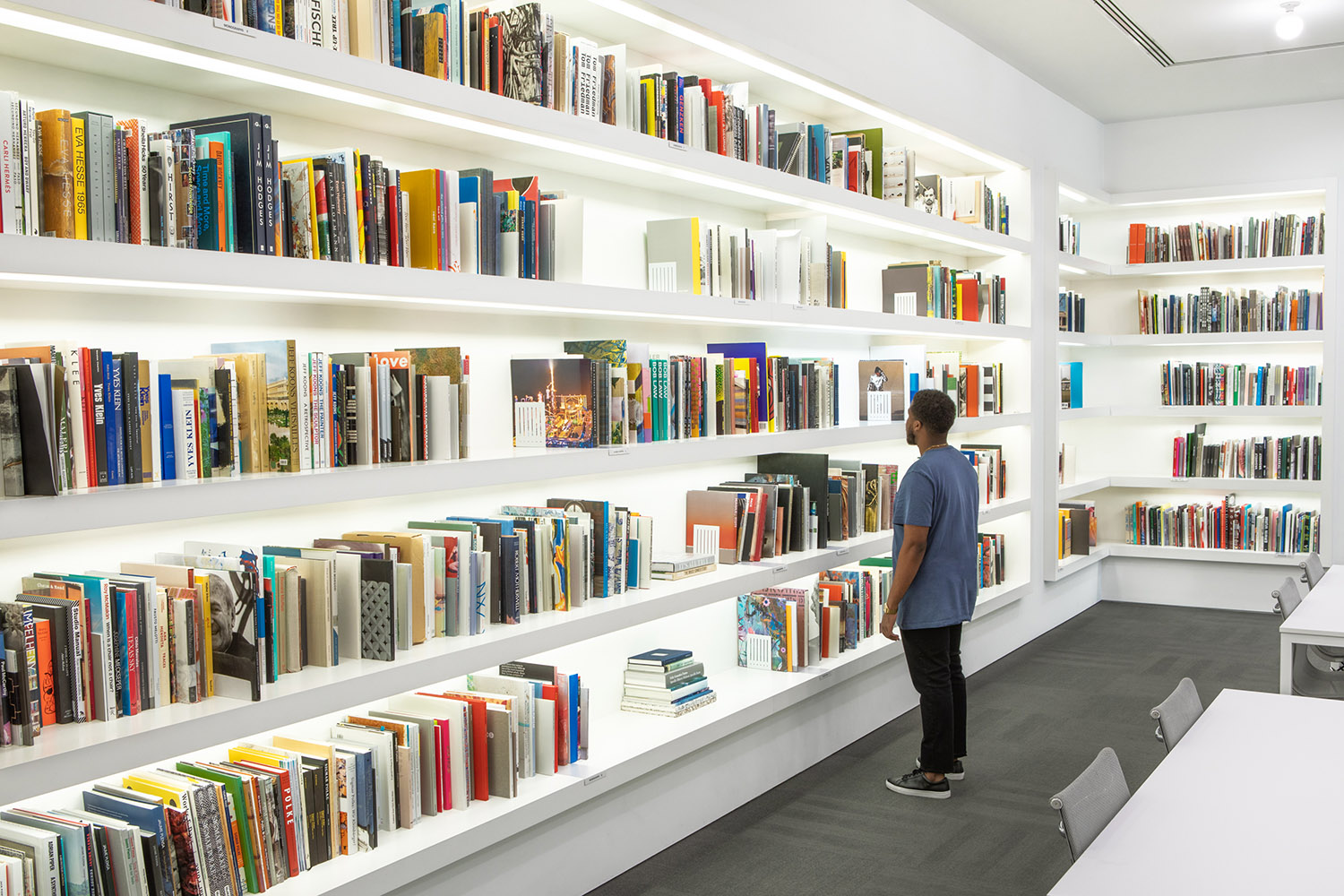
The foundation’s inaugural exhibition, Double Vision, opened on February 15, 2025, and ran through June 28. Curators Thomas Feulmer and Benjamin Godsill brought together more than 80 works by 42 artists. Two collections formed across different periods could occupy the same rooms without becoming interchangeable.
Shared interests included Carroll Dunham, Wade Guyton, Marguerite Humeau, Calvin Marcus and Dana Schutz. Collecting several works by an artist lets an exhibition explore a practice over time. The show gave visitors access to those commitments and to the unexpected conversations between them.
The installation also allowed for a less solemn encounter. Works ranged from substantial sculptures to Charles Long’s Buloop, Buloop, a water cooler equipped with headphones. Contemporary art can make a visitor pause before a machine normally encountered beside office gossip. Scale and strangeness both had a place.
The Warehouse’s mission includes free exhibitions, public hours and educational programmes for students, educators and other visitors. Guest curators bring fresh readings of the collections. The partnership carries forward a space that has presented exhibitions since 2012, with a new foundation formed in 2024 to support its continuation.
That is a satisfying destination for Hartland-Mackie’s unusual education. He learned inside a family business, took responsibility early, and later found another mentor in art. The work now reaches beyond the owner’s experience. An electrician can return to a familiar branch. A visitor can walk into a gallery and encounter something unfamiliar. Both need someone to open the doors.
Follow the threads
- LaboraOperating companies, investments and the family’s approach
- Thomas Hartland-Mackie on LinkedInProfessional profile and personal posts
- The Warehouse DallasExhibitions, public hours and educational programmes
- At the Helm: Thomas Hartland-MackieFamily Business Magazine / 2020 interview
- A conversation with Hartland-Mackie and RachofskyCULTURED / 20 March 2025
- Lunch with Thomas Hartland-MackieD Magazine / 2016
- The City leadership transitionCES company announcement / 23 August 2023
- Watch: Beyond Emissions, episode 55Soligent / a video conversation with Hartland-Mackie
- His CES blog author archiveCompany stories and employee profiles