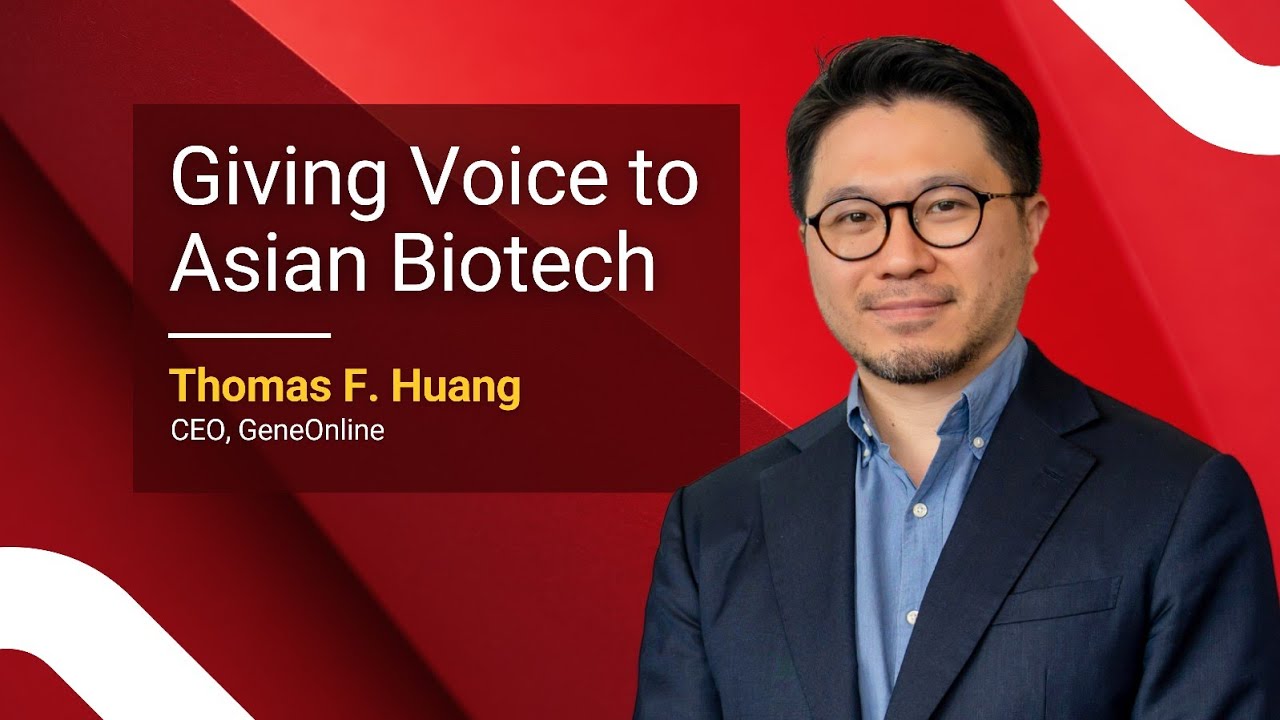
At a Christmas gathering in 2015, Thomas F. Huang had something to explain. GeneOnline, the company he had founded that year, brought together people from universities, businesses, research institutions and the press. Its purpose was an information problem: Asia needed more specialist Chinese-language coverage of genetics and biotechnology. Huang wanted a place where research, policy and industry developments could meet a reader.
It was a modestly unusual answer to the question of what a trained researcher should build. A publication. A place to ask questions. A reason to gather people who might otherwise pass one another on the way to separate meetings. Science supplied the subject; getting people into the same conversation supplied the business.
That gathering offers a useful place to begin his story. Long before the databases and accelerator programs, Huang was describing an exchange. The word matters. A news article travels in one direction, from writer to reader. An exchange leaves room for something to come back: an introduction, a question, a possible partnership. Over the following years, his work would keep returning to that second movement.
“An information exchange platform.”
Thomas F. Huang · 2015 founding purpose
Translated excerpt
A scientist changes the unit of attention
Huang studied genetics at the University of Wisconsin-Madison and earned a master’s degree in biology at California State University, Los Angeles. His early work included laboratory research, followed by a researcher role at Thermo Fisher Scientific from 2011 to 2014. GeneOnline began in 2015; he also served as a managing partner at SelectBio between 2015 and 2019.
Those jobs place a laboratory, an events business and a publication inside one career. Each works with specialist knowledge, but the audience changes. A research result has to survive scrutiny. A conference needs people willing to turn up. A publication needs somebody willing to read the next sentence. Possessing information and persuading someone to spend time with it are separate accomplishments.
Huang’s publishing work included the interview itself. He was credited alongside Parker Yang on a 2018 interview with intellectual-property researcher Jen-Ping Chang. The piece examined patents and market positioning. It put him close to the practical questions around an invention: how to describe it, protect it and give it a chance beyond the room in which it was developed.
In that role, the founder also did the asking. There is a useful humility built into an interview. However impressive the title on your own business card, somebody else gets to know more than you for a while. For a publisher building a specialist audience, that arrangement has obvious advantages. The interviewee brings expertise; the questions determine how much of it a reader can use.
- 2011-14Researcher
Thermo Fisher Scientific - 2015Founded
GeneOnline - 2019GeneOnline expands
to North America - 2023Presents
BioNest
An ocean is a poor excuse for a missed introduction
GeneOnline started in Taipei in 2015 and established a North American headquarters in 2019. The company’s English and Chinese platforms gave the business two routes into its subject. Today, the company has its headquarters in Pasadena, California, alongside a Taipei office. Huang is based in the Los Angeles metropolitan area.
The geography fits the editorial proposition. A company can be familiar in one market and nearly invisible in another. Translating the language helps. Explaining the company’s context, the people around it and the kind of partnership it wants requires another layer of work. That is where a specialist publisher earns the attention that a translated announcement alone may struggle to hold.
At the 2022 BIO International Convention in San Diego, Huang interviewed Yoshiaki Tsukamoto, an executive director of the Japan Bioindustry Association. Their conversation covered Japan’s bioeconomy strategy and the Greater Tokyo Biocommunity. Here was a Taiwan-founded publisher, interviewing a Japanese industry representative, at an American convention. The map was doing quite a lot of work.
The interview concerned networks, industry clusters and international links. Its setting made the same point without a slide deck. A conversation at one convention could carry another region’s plans to people elsewhere. Huang’s role was to ask the questions that would make those plans legible beyond the delegation already familiar with them. For the reader, the result is a conversation that crosses several borders.
The publisher steps onto the pitch stage
By SparkLabs Taiwan’s eighth Demo Day in 2023, Huang had another product to describe. Alongside GeneOnline’s publishing business, he presented BioNest, a subscription database for industry business development. It organized information about companies, product pipelines, development stages, fundraising and licensing partnerships. The proposed customer was someone trying to find a useful commercial match.
The shift was revealing. An article helps someone understand a development. A database lets that person return with a narrower question and search across many developments. Which company belongs on a shortlist? Who might be a partner? Where should a business development team spend its next hour? The reader becomes a user with a task to finish.
At an April 2023 product event, Huang demonstrated BioNest and described the difficulty of obtaining organized industry information despite abundant resources and growing interest. It was a familiar complaint with an expensive consequence: someone still has to assemble the picture. A business can have more documents than it knows what to do with and still lack the answer it needs.
By May 2025, Huang was discussing BIODND, an AI-driven business intelligence database. He said it had collected more than 500,000 industry information records. The number described entries, with a date attached. Its practical promise was more focused: help companies judge opportunities and make decisions efficiently. A large filing cabinet becomes useful when the right drawer opens.
Industry information records, as reported by Huang at his May 2025 presentation.
He keeps returning to the room
The database did not remove Huang from public events. At BIO Asia-Taiwan in 2023, GeneOnline and Ching Cheng Attorneys at Law jointly organized a forum on AI and connections to international capital. Huang joined a panel about fundraising conditions and listing markets with investment professionals and attorney James Hou. The discussion included the difficulties facing entrepreneurs in a tougher funding environment.
There is a recurring shape to these appearances. A publication can report on the conversation, an organizer can assemble it and a database can help someone prepare for the next one. Huang’s business has worked across all three. The combination puts the founder in a position to move between interviewing industry participants and sitting beside them on a panel.
He was also among the speakers at Nucleate Taiwan’s launch in Taipei on October 5, 2023. More than 100 people attended, representing eight academic institutions. Fellow speakers included MIT doctoral student Liyam Chitayat Levi, investor Kelvin Sun, CellTech Innovation chief operating officer James Tsai and Academia Sinica research fellow Steven Lin.
The evening’s theme was “Unleashing Your Potential in Biotech.” For students and trainees, a speaker lineup spanning research, investment, company operations and publishing offered several possible futures in one room. Huang’s presence added a career in which asking, explaining and connecting had become the work itself. The laboratory could be a starting point for more than one kind of professional life.
A useful audience beats a crowded one
In a May 2024 industry presentation, Huang argued that companies and individuals should understand the basics of digital marketing, choose suitable platforms and reach beyond their existing circles. He discussed combining online exposure with physical events. For somebody whose business includes both publishing and gatherings, the argument has a practical symmetry.
A crowded event can produce an excellent photograph. Whether it produces a useful introduction is a different question. Likewise, a widely circulated article may reach many readers without reaching the reader a company most needs. Huang’s emphasis on choosing platforms and crossing familiar circles brings the question back to the audience: who is being reached, and why would that person care?
In 2025, he became the first guest on Victor Lee’s Biotech Orbit podcast. The conversation moved from building GeneOnline to exhibitions, roundtables, partnership searches and its CSR accelerator program. The interviewer’s introduction also promised an answer to a rather more accessible networking question: what food to offer Thomas at a conference.
It is a pleasingly human footnote to a discussion of business platforms. The industry conversation may involve databases, investment searches and international expansion. The person taking part still has to be approached. A snack occupies considerably less space than a corporate presentation, and may be a more agreeable opening move. Even the most carefully organized network eventually comes down to people deciding to talk.
the context
a conversation
build a shortlist
An editorial view of GeneOnline’s complementary formats.
The next question is still about access
By September 2026, GeneOnline’s business combined B2B media and brand marketing with the BIODND subscription platform. Its overseas development included Japan and the United States. The pairing brought the publication and the searchable business information into the same description.
For Huang, the continuity is more interesting than the product count. The early publisher wanted information to circulate. The interviewer helped people explain what they were doing. The event participant joined discussions about capital and opportunity. The database put company information into a form that somebody could search. Each activity addresses a different point at which a potentially useful connection can fail to happen.
There is no need to make the Christmas gathering of 2015 look like a fully drawn business plan for everything that followed. It already contained a sufficiently concrete idea: bring people and information together. The later work gives that idea more formats, from bilingual articles to a subscription platform. Huang’s career asks how much can change when knowing something is followed by knowing whom to tell.