Long before Mandy Teefey ran a media startup, she noticed couches. Los Angeles residents would replace a sofa and leave the old one at the curb, a small civic ritual that struck the Texas transplant as funny and oddly photogenic. She floated the idea of a coffee-table book. Her family laughed. Then a newspaper published a spread about the very same phenomenon. Teefey clipped it, brandished the evidence, and eventually named her production company Kicked to the Curb. It is an unusually honest name for a Hollywood shop: part private joke, part vindication, part promise to look twice at whatever everyone else has passed.
That instinct has followed her through a career with no tidy opening scene. Born Amanda Dawn Cornett in Dallas in 1976 and raised in Grand Prairie, she came into adulthood far from the usual conveyor belt of film school, agency mailroom, and studio job. She became a mother at 16. Years later, while her older daughter Selena Gomez pursued acting, Teefey learned the business as both parent and professional. The arrangement was intimate, practical, and complicated in the way family businesses usually are. In public, Teefey has reduced the motive to one clear sentence: “I wanted to make sure she had the opportunities and that I supported Selena as a mother for her dreams.”
The floor was the classroom
Teefey’s production education was tactile. She has said she worked her way through almost every position short of studio executive: set work, post-production operations, post management, and consulting for people who wanted to establish production companies. At one point she was scrubbing floors. Her first chance to produce arrived as a baseball-team commercial with a $5,000 budget. She went on to make more than 60 commercials and music videos before Los Angeles turned the apprenticeship into a different game.
This is the sort of résumé that teaches a producer to respect the handoff. The glamorous version of production is taste plus authority. The lived version is a relay race involving budgets, schedules, call sheets, late approvals, and the person who knows where the extension cable went. Teefey learned from the relay. “I worked my way up from absolutely nothing,” she said in 2018, “and I’ve been in every position you can possibly be in except a studio executive.” The quote is proud, but its real value is operational: she knew what a request looked like from the other end.
The book that refused to leave
Her signature producer story began in a bookstore. Teefey encountered Jay Asher’s young-adult novel Thirteen Reasons Why and saw screen potential. The project spent years changing shape. A feature version could not comfortably contain the perspectives of its many characters; television eventually offered more room. Universal acquired film rights in 2011, and Netflix announced a series in 2015. When it arrived in 2017, Teefey was an executive producer beside Gomez and a long list of experienced producers. She remained credited across all four seasons.
Development is a polite word for prolonged uncertainty. An idea can be alive without looking alive: optioned, rewritten, reconsidered, repackaged. Teefey’s contribution was not merely finding material. It was continuing to recognize the same useful core as the container changed. The practical lesson is sharper than the usual sermon about perseverance. Protect the center of an idea, but do not confuse the center with its first format.
One career, five changing containers
The series brought attention and controversy in equal measure. Teefey’s later projects showed the breadth she wanted Kicked to the Curb to have. She executive-produced the 2019 Netflix documentary series Living Undocumented, which followed families navigating the United States immigration system. In 2020, she was an executive producer on The Broken Hearts Gallery, a romantic comedy built around a young woman’s museum of objects left behind by old relationships. Even the title sounds faintly at home in Teefey’s world: discarded things, recatalogued until they tell a different story.
From projects to a platform
Wondermind changed the unit of work. Co-founded by Teefey, Gomez, and media entrepreneur Daniella Pierson, it launched as a digital media company built to make difficult conversations feel more accessible. Articles, newsletters, podcasts, interviews, worksheets, and live panels replaced the finite rhythm of a film set. A movie wraps. A publication wakes up tomorrow and needs another edition.
The origin was itself a conversation. Pierson interviewed Teefey and Gomez, and the exchange convinced the three women that candor could become a format rather than a one-off disclosure. Wondermind was announced in 2021 and launched in 2022. That year it raised $5 million in a Series A round led by Serena Ventures, with a reported valuation of $100 million. Pierson left in January 2023, and Teefey became sole CEO. The producer who had once protected a single adaptation was now responsible for an always-on company.
Keep the odd detail
The couch, the clipping, the bookstore find. Taste begins with attention before it becomes strategy.
Understand the handoff
Knowing adjacent jobs makes a leader’s requests clearer and the schedule more honest.
Protect the core
A story can move from film to television without losing the reason it mattered.
Fund the cadence
A platform has no wrap party. Recurring work needs recurring revenue and durable systems.
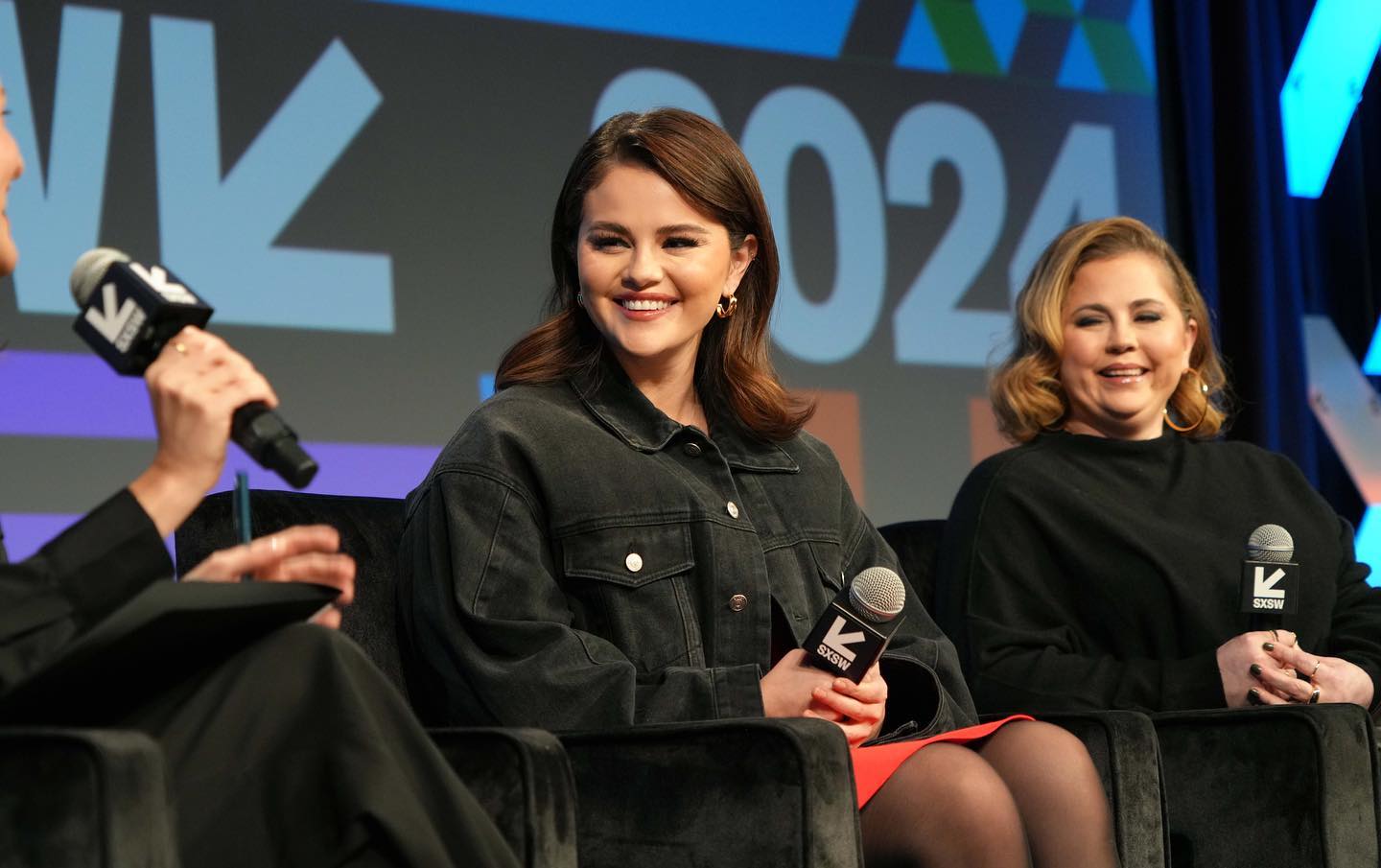
Onstage at SXSW in March 2024, Teefey and Gomez joined an athlete and two clinical professionals for a Wondermind panel about candor, self-talk, and the pressure of polished public lives. The setting neatly joined Teefey’s two professional languages. It had the programmed beats of production and the live unpredictability of community media. Gomez described the company’s spark as the moment when two people related to each other and wondered how to extend that feeling outward.
Teefey’s public personality resists total corporate polish. She has described keeping 237 journals, filling them with free-form “brain dumps.” She goes glamping alone outside Santa Barbara. She checks an astrology app partly because its rude little notifications make her laugh. She once tried goat yoga and reported that the goat wanted nothing to do with her. These are not executive principles, thank goodness. They are the texture that explains why her media instincts tend toward the conversational rather than the clinical. She likes the detail that makes a person recognizably peculiar.
The difficult chapter
Conviction did not spare Wondermind from the arithmetic of running a startup. In spring 2025, the company missed payroll, owed money to freelancers and vendors, and then cut nearly two-thirds of its staff. Teefey told employees she had borrowed against her home to help cover outstanding obligations. A company statement said the payroll situation had been rectified and described the business as entering a new chapter. The episode exposed a hard distinction: keeping a creative project alive and building a durable company demand overlapping skills, but they are not the same job.
In August 2026, investors filed a federal lawsuit in Delaware against Wondermind, Teefey, Gomez, and Pierson. The complaint alleges securities fraud, breach of contract, and other claims connected to the company’s representations and operations. The case is pending. Allegations in a complaint are claims, not findings. For any current profile of Teefey, however, the legal and financial strain belongs in the frame. A founder’s story cannot stop at the funding announcement simply because that is where the photograph looks nicest.
The tension does not erase the earlier work. It clarifies it. Teefey is a producer by formation: attracted to stories, practiced in assembling people around them, willing to stay through development. Wondermind asked her to become something adjacent and more relentless - an operator of systems whose failures arrive every two weeks, not at a premiere. The transferable insight is not that creative founders should stay in their lane. It is that every new lane has its own physics, and enthusiasm does not repeal them.
What remains on the desk
Teefey has said she would like to write a memoir, though only when she can identify the message that deserves a whole book. That hesitation is revealing. She is not short of material: teenage motherhood, production floors, a daughter’s rise, management, Hollywood development, Netflix credits, a funded startup, and now public corporate conflict. Yet material is not the same as a story. Producers know the difference because they live in the gap between the two.
Her best metaphor may still be sitting on a Los Angeles sidewalk. A couch at the curb is trash to one passerby, furniture to another, and a visual essay to the person paying attention. Teefey made a company name from that ambiguity. She also made a career from it. The years ahead will decide how the Wondermind chapter is resolved, in court and beyond it. The body of work already offers a less tidy, more useful conclusion: notice boldly, develop patiently, and never mistake a strong instinct for a finished operating plan.