In October 2011, Scot MacGillivray was talking about a piece of plumbing. Cervello had used SnapLogic to connect social-media information with sales analysis in Birst, a cloud business-intelligence platform. The attraction was speed and reuse: connecting one system to another without beginning the engineering all over again. In a business fond of announcing the future, here was a founder pleased that something could be made to work.
That small episode is a useful entrance to his career. MacGillivray co-founded Cervello in 2009 and was its CEO when A.T. Kearney acquired it in January 2019. His professional territory includes the awkward space between a business question and a usable answer. The question may take a minute to ask. Making the underlying systems cooperate can occupy rather more of the calendar.
Follow his work through cloud integration, corporate planning, data strategy and artificial intelligence, and a recurring concern appears: what happens after the promising idea? It is a good question for a technology consultant. It is also a fairly merciless question. A demonstration can choose its moment. A working system has to turn up again tomorrow.
Before the cloud, there were balance sheets
MacGillivray attended the University of Virginia from 1985 to 1989. His career record places him at Chase Manhattan as an associate from 1989 to 1991, then at Tucker Anthony as a vice president during the 1990s. In 1997, he became a co-founder and managing director of Painted Word. A senior vice president role at Palladium Group followed in 2005, before Cervello in 2009.
The sequence puts finance, entrepreneurship and consulting in the same working life. It would be easy to turn that into a tidy conversion story, complete with a moment of revelation. The career itself offers something more useful: experience on several sides of the relationship between information and business decisions. Financial work concerns what numbers mean. Implementation concerns how those numbers become available, consistent and usable.
Painted Word also makes Cervello a second founding chapter. MacGillivray had already worked inside an organization he helped start before taking on another. There is a particular sort of repetition in that choice. A founder can change the company name and still find the familiar questions waiting: who will join, what clients need, and how to deliver work well enough that they ask you back.
A connector earns its keep
The 2011 Birst project gives that progression a concrete example. Cervello was working with reusable integration components to bring together information from different applications. Social activity and sales results could be examined together. The technology partnership mattered because it shortened the work between a proposed analysis and something a client could actually examine.
MacGillivray’s enthusiasm then was directed at the ability to build new connections quickly. That is a modest-sounding ambition with substantial consequences. Every bespoke connection adds something someone must understand, maintain and eventually change. Reuse offers a way to keep useful work from becoming a collection of elaborate one-offs. Enterprise computing has enough heirlooms already.
Cervello’s scope extended across performance management, business intelligence, customer relationships and data management. Those specialties meet in ordinary questions: how the business is performing, what customers are doing, and what should happen next. Their proximity helps explain the company’s appeal. A client’s question does not politely observe the boundaries between software categories.
Bring systems together→Interpret
Give the data meaning→Operate
Keep the solution useful
The acquisition had a second act
By the acquisition, Cervello had roughly 120 data engineers, scientists and developers. Its offices stretched from Boston, New York and Dallas to London and Bengaluru. That combination of specialist skills and an international footprint gave the deal a tangible shape. Kearney was adding people who could build and support the systems behind its clients’ plans.
MacGillivray described wider international reach as one of the benefits. He also emphasized the fit between Cervello’s technical capabilities and Kearney’s industry knowledge. Taken together, those arguments reveal the ambition behind the transaction: put implementation closer to the business problem, with a larger organization opening more doors.
“First, we will dramatically increase our global reach.”
Scot MacGillivray, January 2019
The work after a sale can be less photogenic than the announcement. People have to learn how decisions are made in their new organization. Relationships need time. MacGillivray later singled out Ben T. Smith IV as an early Kearney contact who helped influence both Cervello’s decision and its integration plan. He also credited David Hanfland’s contribution to the acquisition and integration.
Those acknowledgments put names against an otherwise abstract corporate process. An acquisition may be described as a combination of capabilities, but somebody has to make the combination hospitable enough to use. MacGillivray’s later comments suggest he remembered the people who helped with that work. The transaction was a beginning with colleagues, responsibilities and practical arrangements attached.
The questions grew more interesting
His subsequent writing moved into the organizational problems surrounding data. He coauthored The Future of Data: The Quest to Maximize Value, which considered ownership, talent and the relationship between business teams and technical specialists. Its concerns included the difficulty of finding people who understand both business problems and data science. Hiring a clever specialist does not automatically supply the translation.
In a 2021 roundtable recap, MacGillivray and his coauthors examined challenges facing data and analytics leaders across industries. The setting was a conversation among practitioners, which suits this stage of his career. There is room in such discussions for the inconvenient detail that disappears from a finished presentation: who is responsible, what employees can use, and where an investment is failing to become a habit.
Then came a March 2022 paper about first-party data, the information companies collect through their own customer interactions. MacGillivray was one of six authors. The argument included restraint: establish the business purpose, determine what information is needed, and build the organization around making use of it. Collecting more can create more obligations without producing a better decision.
That discussion also favored beginning with a manageable project and building on demonstrated success. A large technical ambition can arrive before a convincing use case. The result is a curious corporate possession: a capability in search of an occupation. Starting smaller makes it easier to discover whether people have a reason to use what has been built.
Another 2022 collaboration addressed supply-chain disruption and economic shocks. Here the decisions concerned pricing, changing demand and execution under pressure. The subjects had moved well beyond connecting an analytics application. The underlying issue remained recognizable: information has to reach someone who can make a consequential decision while there is still time to make it.
Teaching the people who advise the people
In 2023, MacGillivray was credited among the colleagues who helped educate Kearney partners about generative AI. The workshop effort included Stuart Klein, Bharath Thota, Pratik Agrawal and Michael Cochrane. Klein described training 60 partners in AI fundamentals, practical uses and client examples, alongside colleagues and University of Chicago Data Science Institute’s Yuri Balasanov.
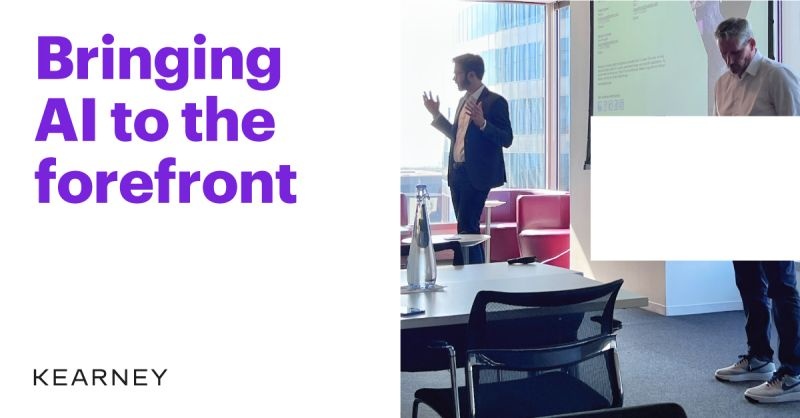
There is an appealing reversal in that assignment. Consultants spend much of their time helping clients understand unfamiliar territory. Here the audience was inside the firm. Giving partners a common foundation is a practical form of expansion: more people can recognize a useful application, ask a better question and understand when an appealing demonstration needs further scrutiny.
Contemporaneous reporting placed MacGillivray alongside Stephan Krubasik at the head of Kearney’s global analytics team. His responsibilities had widened beyond the firm he helped found. The educational work provides a more intimate measure of that development than a title does. Expertise becomes more useful inside an organization when other people can work with it.
A thank-you, with a parenthesis
One of the more revealing moments came when longtime colleague Sandy Estrada announced her departure from Cervello. She described moving through local account work, global engagements, business development and leadership. In thanking the people who built the firm, she named MacGillivray among a wider group. Her account emphasized trust, collaboration and the chance to take on new responsibilities.
MacGillivray replied with thanks for her contributions and for remaining herself. He added that the team had benefited from working with her again. That final qualification is a small detail, but it gives the exchange texture. These were colleagues with a history extending beyond a single spell at one company.
A similar thread appeared in Marc Hochman’s 2025 farewell. Hochman thanked MacGillivray and Cervello’s management team for welcoming him and maintaining their values while they worked through Kearney’s acquisition. MacGillivray responded by thanking him for his partnership and support. In each exchange, the language was about the relationship left after the formal work.
There is a satisfying continuity here. The founder who discussed reusable connections in 2011 later helped navigate a corporate integration, coauthored work about organizational capability and joined colleagues teaching AI. Across those settings, the useful connection changes form: application to application, specialist to executive, acquired team to new partner. MacGillivray’s career gives that work a human scale. Someone still has to help the two sides understand each other.