In April 2016, Thomas Ajspur had a view of the Rocky Mountains and rather less room to admire it than the scenery deserved. His young company, Enavate, was dealing with cash-flow and payroll problems. Outside his Denver office, snow still covered the peaks. Inside, the immediate business of staying in business had become difficult to see past.
With him was Jesper Balser, a Navision co-founder, investor and board member. As Ajspur later recalled, Balser pointed towards the mountains and urged him to concentrate on the summit. The obstacles between the office and that destination needed dealing with, certainly. They also needed to stop occupying the entire horizon.
It is a good image for Ajspur's career because it contains both his appetite for an ambitious destination and his experience of an inconvenient present. A founder can describe a beautiful future. Friday's obligations are seldom impressed by the view. Keeping both in sight would become part of his work.
Denmark, Dynamics, and a December launch
Born and raised in Denmark, Ajspur entered the business-software world early. He has said his involvement in the community now associated with Microsoft Dynamics began at 16. His experience included using enterprise resource planning software, implementing it and running his own business with it. ERP, for the uninitiated, is the software behind such everyday business necessities as finance and inventory. Its glamour is usually most apparent when something stops working.
In 1999, he moved into Dynamics professional services, building organizations in Europe and the United States. His working life took him through Sweden and Britain before America. In recalling his former employer Columbus, he described an intended move to the United States that instead took him to the United Kingdom. The American chapter arrived six years later.
Enavate officially launched in December 2014 through the acquisition and merger of a US business and an Eastern European business. Ajspur was bringing together different companies and cultures while establishing a business of his own. He had experience around acquisitions; now the consequences of combining organizations would come with his name attached.
An invitation to ride the roller coaster
The early company did not greet every grand plan with applause. Ajspur remembers presenting a longer-term vision while colleagues wondered how the next payroll would be met. Their question was reasonable. The business was losing money, and people were unhappy.
His response included pictures of two fairground attractions: a merry-go-round and a roller coaster. He used the first to represent predictability at a large company, the second to describe the ride he was offering. Enavate would have uncomfortable drops as well as climbs. People would also have a chance to influence where it went.
In his fifth-anniversary recollection, he said profitability followed two months after the team created its shared vision. That was his account of the turnaround, rather than a guarantee against every future difficulty. The episode helps explain why sharing information and authority became so central to his argument. Asking colleagues to stay aboard carries an obligation to tell them something about the track ahead.

“This is my calling in life, as the CEO and the founder.”
Thomas Ajspur · reflecting on Enavate
The boss takes the first uncomfortable turn
At a 2017 strategy meeting, Ajspur tried an exercise he described under the cheerfully provocative title “Getting Naked.” Clothing was spared. Executive composure had a more demanding day.
He had rebuilt his leadership team and wanted its members to know one another well enough to disagree usefully. Each person was asked to identify a colleague's contribution to the group, then a characteristic that hindered it. Ajspur went first on the receiving end. Eleven other leaders gave him feedback.
The praise briefly left him with little more than thanks. The criticism, he recalled, hurt in places. He nevertheless wanted colleagues to know they could tell him what needed improving. His account describes a subsequent discussion with more challenge, more candour and more humour.
That willingness to receive an awkward answer matters to his public leadership philosophy. The CEO who requests honesty has to make room for the possibility that someone will supply it. Ajspur was trying to establish that permission in a room where his own conduct could be discussed.
Permission needs a little small print
Ajspur's interest in empowerment grew partly from frustration with the word itself. At a previous job, he had seen it celebrated on posters while finding that everyday decisions still required cumbersome approval. His writing about that mismatch is impatient and amused. A promise of freedom can acquire an astonishing number of signatures.
For Enavate, he studied Ken Blanchard's work, discussed the subject with colleagues and mentors, and brought volunteers into a group to work through its application. At a launch exercise, he asked people who made decisions to move across a room. He then questioned those who stayed behind about choices in their personal lives. People entrusted with houses and families could surely exercise judgment at work.
There were practical catches. In one project, a colleague interpreted responsibility as including the right to replace an external consultant. The leaders had intended a narrower remit. Ajspur put the failure of clarity on leadership: the boundaries had not been properly explained.
His model therefore retained strategic direction with senior leaders while expanding operational decisions within teams. Training and shared business information were part of the arrangement. The authority came with responsibility, and managers had to learn to coach. Even giving power away required some competent management.
Share the information
Give colleagues the business context.
Define the boundaries
Make the scope of decisions clear.
Let teams decide
Support judgment with training and accountability.
Five minutes returned to their owners
Ajspur can be quite particular about the smaller indignities of office life. Meetings running late irritate him. In a piece titled “My Cat Ate My Homework,” he described an Enavate rule: meetings should finish five minutes before their scheduled end. The next appointment deserved a fair chance of starting on time.
He also acknowledged his own shortcomings. His complaint about excuses came with advice to allow more time for delivery, and an exception drawn from travel during Iceland's 2010 volcanic eruption. He recalled leaving a plane before take-off after watching the news, then eventually flying out of Sweden and seeing the volcano from the air. Nature had provided a fairly persuasive scheduling conflict.
For longer meetings, he has described using a simple discussion of what to continue, stop and start. Afterwards comes a review of what could improve and what worked. He credited the exercises to his Vistage peer group and its chair. The practical detail is revealing: a founder arguing for shared authority also wants the meeting to end with named actions. Freedom still has a calendar.
The colleagues an acquisition brought into his life
Enavate's Eastern European beginnings gave Ajspur a connection to Ukraine that lasted beyond the transaction. In an interview recorded at Community Summit North America 2022, he described acquiring a business with 65 team members there. He visited a few months later and developed an attachment to the people and country.
He remembered those colleagues staying through the difficult early years. Their commitment became part of his explanation for his own. After Russia's invasion, he contacted six large competitors to discuss support for the Ukrainian Dynamics community. Commercial rivals could, at least for this purpose, occupy the same side of the table.
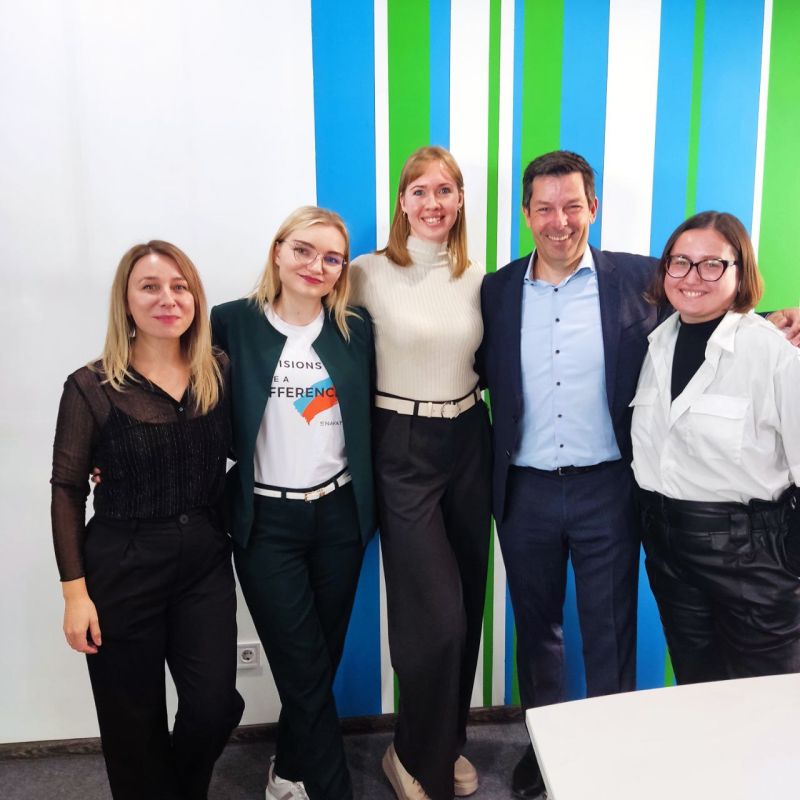
A November 2023 photograph places him alongside colleagues in the Kyiv office. He wrote again about visiting Kyiv in July 2024. These are specific journeys within a longer relationship, rather than a claim that an executive visit resolves the circumstances around it. They show how an acquisition can create obligations that cannot be contained in the purchase agreement. The people who arrive with a business remain people when the spreadsheet has closed.
Growth brings another test of the idea
Recognition and expansion followed those early experiments. Ajspur was named to Colorado's Titan 100 for three consecutive years, qualifying for its inaugural Hall of Fame class in 2022. By August 2024, Enavate described a team of almost 400 serving more than 2,000 clients across North America and Europe. Those are dated company figures, rather than a live headcount.
Its work extended across consulting, software implementation, upgrades, cloud deployments and managed IT services. Behind the service list were businesses needing systems that people could actually use. Ajspur's own starting point as a user gives that concern a personal history. He had encountered ERP from the operating side before making a career of helping others implement it.
In a May 2025 PartnerTalks conversation with Rick McCutcheon, the journey was framed as growth from a one-person migration operation to an employer of more than 370 people. The discussion included making business personal and the human effects of customer-management technology. The scale had changed considerably; the interest in how people experience the work remained a recurring subject.
- 2014Enavate launches in December
- 2022Colorado Titan 100 Hall of Fame class
- 2025Longshore investment announced in December
Another summit on the itinerary
In December 2025, Longshore Capital Partners announced an investment in Enavate. The stated plans included expanding global delivery, developing cloud and AI capabilities, and pursuing acquisitions. Ajspur described the partnership as a way to increase the value delivered to clients and create opportunities for team members.
His Vision 2028 sets an ambition to make Enavate a global ERP leader for small and midsized businesses, powered by Microsoft. It is a destination he has chosen, with work still required to reach it. Capital can help finance expansion; integrating people, services and expectations remains an operating task.
Ajspur has also written about mistakes in hiring people too similar to himself or less capable than himself. He now argues for colleagues who bring different views and challenge his thinking. There is a useful modesty in the premise: one Thomas Ajspur should be sufficient for the organization.
Back in the Denver office, Balser's mountain offered a place to direct attention when immediate difficulties filled the room. Years later, Ajspur is still setting a distant objective. His account of the journey keeps returning to the people beside him - and to how much room he is willing to give them to decide the way forward.