The glove won. That was the trouble. In 2013, at a Berkeley startup competition, Thibault Duchemin helped build a prototype that would turn sign language into words on a screen. His team took the Overall Best prize. Then came the conversations with roughly a hundred potential users, who delivered a less convenient verdict: they wanted help following group discussions. A prize could sit on a shelf. The product would have to change.
Pieter Doevendans, who had joined Duchemin at the competition, later compressed the decision into two words: “We pivoted.” Out went the glove. In came software that could put a conversation on a phone, with different colors identifying different speakers. The project became Transcense, then Ava. Its cofounder and CEO had received an education that no engineering qualification could quite provide: applause and usefulness sometimes leave by different doors.
Duchemin’s subsequent career has kept returning to that awkward gap. He builds communication tools, but the difficult part begins before the software. Someone has to ask what people actually want to do with one another.
A childhood between languages
Duchemin grew up in Paris, in a family whose first language was signing. He describes himself as a CODA, a child of Deaf adults. His parents and sister belonged to the Deaf community; he moved between signing at home and spoken French outside it. In his own account of Ava’s beginnings, his first words were in sign language. Communication was already a practical responsibility long before it became his business.
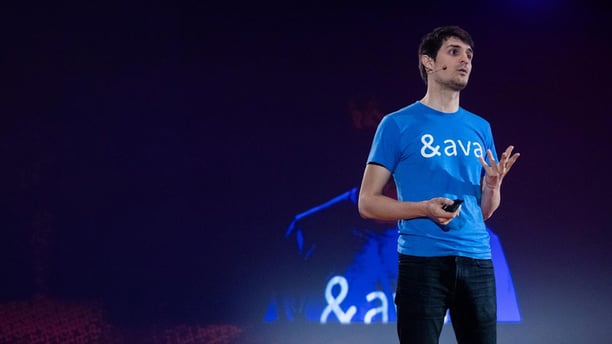
In his TEDxSoMa talk, he remembered a warm childhood full of community gatherings, trips and tennis clubs. He also recalled a childhood sign name that incorporated a shaking head. The detail is rather more revealing than the customary founder biography. Before he had a job title, he had a nickname based on something people had actually noticed.
There were phone calls to interpret and exchanges to help along. The role traveled with him. Moving to the United States made its limits plain: he could not always be present for the people he loved. A system that depended on his availability had a very small service area.
A visit to India gave the frustration a direction. Social entrepreneur Anshu Gupta, founder of Goonj, asked him what made him angry enough to spend years addressing it. Duchemin’s thoughts returned to the barriers facing his sister, Pauline. The question put a time horizon around a familiar irritation. He could imagine working on it for a decade.
Two questions before the code
He arrived with technical training: engineering studies at École des Ponts ParisTech, followed by a Berkeley Master of Engineering, completed in 2014 in industrial engineering and operations research. The qualifications gave him tools. The failed glove supplied a useful warning about choosing where to point them.
Under Steve Blank’s mentorship, the team spent hours talking with hundreds of users and testing different ideas. Duchemin described two questions guiding the search: how urgently was a solution needed, and could solving one problem help remove others? These are uncomfortable questions for an inventor who has already fallen in love with a prototype. They are excellent questions for everyone expected to use it.
The resulting design joined two tasks: recognizing what was said and identifying who said it. Early Ava conversations connected participants’ smartphones, letting each device capture its owner’s contribution. The reader saw a shared conversation, distinguished by speaker. Duchemin also insisted on a simple setup. Every extra instruction was another interruption before anyone could get back to talking.
“We started from the future”
Thibault Duchemin, describing Ava’s design approach in 2016
Three founders, different sides of the table
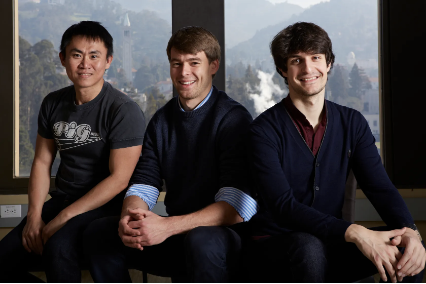
Duchemin’s experience supplied one view of the problem. Skinner Cheng brought another. Cheng, Ava’s cofounder and CTO, grew up in Taiwan as the only Deaf person in his immediate family. Duchemin had grown up as the only hearing person in his. Their family arrangements were almost mirror images, and both understood how much work a conversation could demand before its participants got to enjoy it.
Doevendans completed the founding trio. He and Duchemin met through the Berkeley competition; Cheng brought the programming expertise that helped turn the revised idea into software. Calling this merely a technical partnership would miss the product’s central advantage: people building it were also living with the situations it was supposed to improve.
That relationship continued inside the company. A meeting among the founders was itself a place to discover what the software still needed. The distance between a feature request and the person requesting it could be the width of a desk.
Leaving a place for a person
Ava’s development did not follow the neat plot in which artificial intelligence arrives and everybody else exits. Its Scribe service combines automated transcription with people who correct the text in real time. Software produces the words; a professional can repair the mistakes. For a reader trying to participate while a discussion is still happening, the distinction is practical.
A polished transcript delivered afterward serves a different purpose from words that arrive in time for a reply. The difference helps explain Duchemin’s attention to timing, speaker identification and the mechanics of joining a conversation. The unit of value is a usable exchange. A transcript can be immaculate and still arrive after the joke has expired.
Scribe adds human correction to live captions.
A schematic of the features, not a performance comparison.
The business grew beyond the original mobile application to include desktop and web tools. A $10 million Series A, led by Khosla Ventures in 2022, supported further development. The company described plans to expand its American and European teams. That financing belongs to the company’s history; the more interesting continuity is the work it was intended to support across in-person and online settings.
Recognition had arrived earlier. Duchemin and his cofounders appeared on Forbes’ 2017 Consumer Technology 30 Under 30 list. He was also recognized in the 2017 European Innovators Under 35 program. Awards followed the revised idea this time.
- 2013A winning glove prototype meets an unexpected user verdict.
- 2014Berkeley M.Eng. completed; Ava’s founding year.
- 2017Forbes and European Innovators Under 35 recognition.
- 2022Ava’s $10 million Series A.
- 2024Ava Voice adds new ways to speak through typed text.
A CTO should get to tell his own joke
In May 2024, Duchemin described a recurring problem in online meetings. Cheng could type a response into chat, but someone else often had to read it aloud. A lively discussion did not necessarily pause for that handoff. An engineering update, an opinion or a joke could depend on a colleague remembering to relay it.
Ava Voice lets typed words become speech. Users choose a voice, write their message and send it into the conversation. Duchemin’s explanation made room for Cheng’s humor alongside his leadership. A CTO’s joke deserves its own delivery, just as his engineering update deserves a hearing.
The details required thought. Ava’s mobile engineering lead, Alexandre Bécourt, described helping people choose a voice through descriptions of how it sounds. The interface could not simply assume that everyone would evaluate the options by listening. This is the kind of decision easily missed when a team imagines its users as versions of itself.
Duchemin gave Bécourt public credit for helping bring the feature to life. The acknowledgment fits a story in which progress repeatedly depends on someone else’s observation: a prospective user rejecting the glove, a cofounder struggling with chat, an engineer noticing an assumption inside a selection menu. An idea becomes more useful as more people get to argue with it.
The event needs captions, too
By February 2025, Duchemin was bringing those questions to the AI Action Summit in Paris and its Business Day at Station F. He announced Ava’s role as a communication access partner, providing live captioning and translation. A gathering about artificial intelligence offered an immediate test of what that intelligence could do for people in the room.
The occasion also brought his French and Californian working worlds together. Ava describes a team spread between San Francisco and Paris. Duchemin’s own career connects the French engineering school with Berkeley’s culture of experimentation, but his public comments have become increasingly concerned with the work around the technology: adoption, organizational habits and who gets to participate.
He has taken that experience back to prospective founders. In an EELISA interview connected with its 2024 One Night to Innovate event, he spoke about wanting more students to become entrepreneurs. He also warned about spending two or three difficult years pursuing the wrong idea. The old glove has become useful teaching material.
There is optimism in his account of innovation, paired with a fairly unsentimental instruction to test things. He wants to help new entrepreneurs spot pitfalls and identify what deserves an experiment. Winning a competition, his own beginning suggests, is a perfectly good reason to celebrate. Then comes Monday.
Pauline gets on with her work
The personal measure remains close to home. In July 2024, Duchemin described his sister using Ava in her professional life: “She became a lawyer and uses it when she goes to trial.” The childhood concern had acquired an adult answer. Pauline had her own work to do.
His aspiration is still broad: communication access available throughout ordinary life. Yet the moments he talks about are specific enough to resist becoming a slogan. A family conversation. A meeting. A colleague’s reply. A sister conducting her career without arranging everything around her brother’s presence.
The glove would have made a memorable demonstration. Ava gave Duchemin a longer assignment: keep asking where an exchange breaks down, then make it easier for the people involved to continue. The answer has changed since Berkeley. His willingness to hear an inconvenient answer remains a useful part of the equipment.
Keep the conversation going
Explore the work, hear Duchemin tell the story, or follow his public updates.