Igor Jablokov’s route into artificial intelligence began with a relocation that would make a respectable science-fiction opening. Born in Greece to two artist parents, he recalls living in a cave home. At six, he moved with his mother to Philadelphia, where his grandparents lived. She wanted him to participate in the computer age. It was an unusually literal investment in the future: take the child to where the machines are.
The journey through New York after landing at JFK stayed with him. The buildings reminded him of Blade Runner; he felt he had arrived on a “different planet.” In his telling, the contrast was between nature and a technological cityscape. Years later, he would be building another kind of crossing, between the way people speak and the way computers process information. The scenery changed. The problem of making unfamiliar worlds intelligible remained.
His formal training joined engineering to business. He earned a computer-engineering bachelor’s degree at Penn State in 1997 and an MBA at UNC Charlotte in 2000. Penn State recognized him as an Outstanding Engineering Alumnus in 2013. The combination makes sense for a career spent trying to bring research into use: a working invention needs someone who understands both its circuits and the reasons another person might buy it.
The laboratory had a door
At IBM, Jablokov worked on natural-language technology and eventually became a program director. His teams’ work included an early multimodal web browser and technology described in his public biographies as a precursor to Watson. Multimodal is an ungainly word for an appealing idea: people should have more than one way to communicate with a machine. Speech could join what was happening on a screen.
The obstacle that pushed him toward entrepreneurship was the distance between an invention and its commercialization. He left IBM and founded Yap in 2006. This is an essential distinction in his career. A laboratory can show that something works. A company must make it work for someone else, repeatedly, under conditions the inventor does not get to choose. That second task appealed to him enough to leave the first institution behind.
Yap, which he founded with his brother Victor, offered cloud-based speech-to-text transcription. Microsoft was among its customers. The architecture moved work away from the handset and into a remote service. A voice could become usable text without asking a small device to carry the whole computational burden. The idea now sounds familiar enough to disappear into the background. At the time, it gave the brothers a company to build.
- 2006Yap begins
- 2011Amazon acquires Yap
- 2017Pryon begins
- 2023$100M Series B
A flip phone, then Alexa
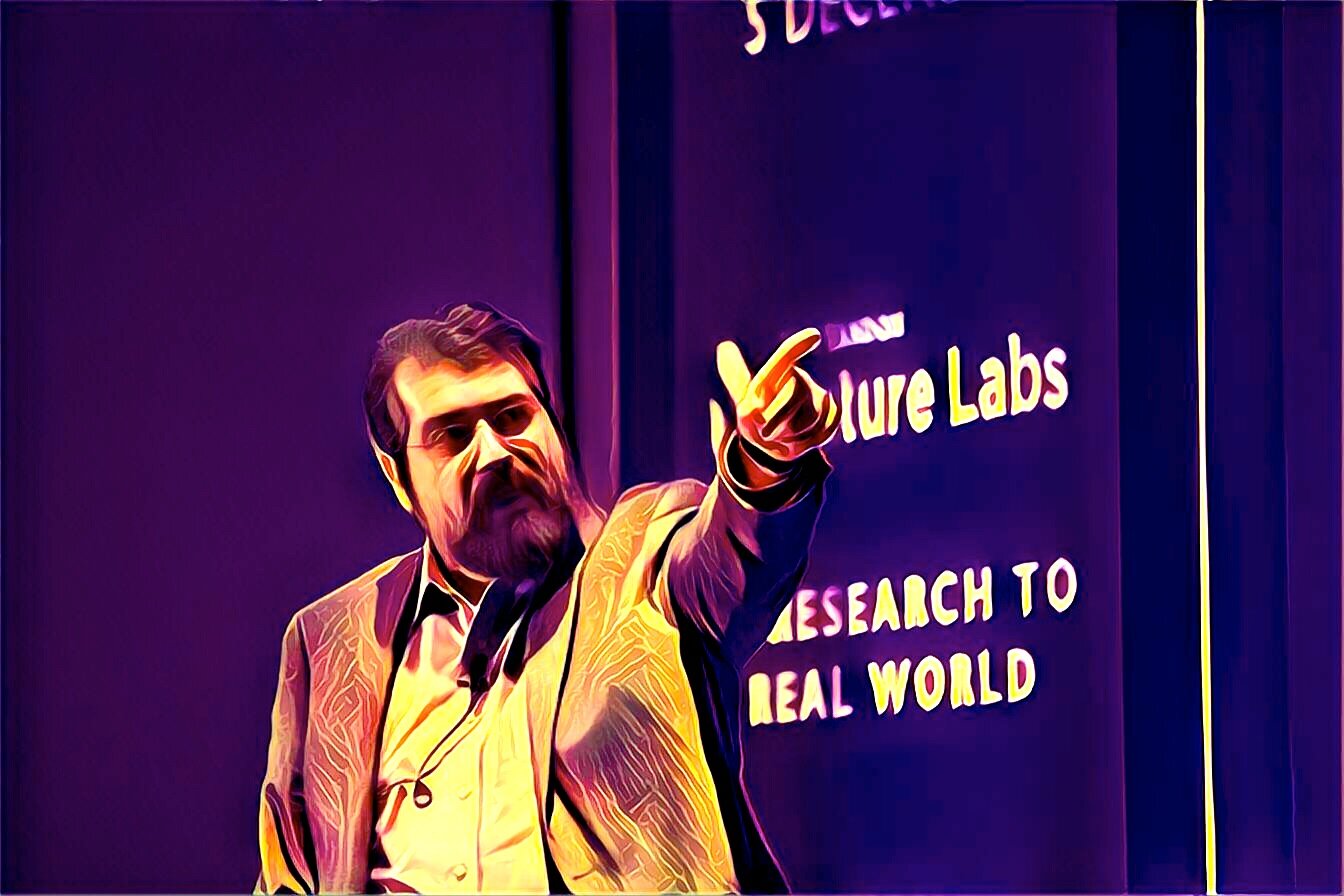
In his later account of a 2007 conference demonstration, Jablokov remembers taking a flip phone out of his jacket and speaking into it. His words were transcribed; a spoken response followed. The audience, he recalled, did not grasp what he was showing. Technological foresight has an awkward social phase: you have prepared a demonstration of tomorrow and everybody else has arrived with today’s expectations.
Amazon acquired Yap in 2011. Its technology helped form the foundation for Alexa and subsequent voice products. That lineage matters, and so does the teamwork inside it. Yap was an ingredient in a larger development effort, rather than a reason to assign a household product to one inventor. Jablokov’s contribution was building a company and technology that could become part of that effort.
The engineering record is less theatrical than the stage demonstration. A US patent for a hosted voice-recognition system names Victor Jablokov, Igor Jablokov and Marc White as inventors, with a filing date of April 5, 2007. Its description connects a mobile device, a network and a backend server to turn an utterance into text. Behind the apparent ease of talking to a machine lies a carefully divided set of jobs. Convenience is often complicated work delivered politely.
The answer was somewhere in the office
Jablokov founded Pryon in 2017 around a gap he had seen between consumer experiences and institutional work. People could ask a device a question at home. Inside a company or government organization, the information needed to answer a practical question might sit across archives, documents and several unrelated systems. The knowledge existed. Reaching it was the daily nuisance.
He calls that nuisance knowledge friction. Pryon’s purpose is to connect people with information in their own organization, while preserving the privacy and traceability that business use requires. Think of the difference between having a library and being able to find the passage you need before your meeting starts. That is an illustration of the problem, rather than a claim about any particular customer’s day.
The name carries a souvenir of the earlier venture. Pryon refers to the codename associated with the speech technology behind Alexa. In 2020, discussing messy enterprise data, Jablokov offered a less solemn description of his approach: “We just Hoover it up like an anteater and start chatting.” An anteater is an unusual mascot for enterprise software. It does, however, convey an appetite for information more economically than a slide full of arrows.
Who gets to see the answer?
Pryon’s technical approach brings together ingestion, retrieval and generation. The input can include text, images, audio and video from existing repositories. Retrieval locates relevant material; a generative component can help turn it into an answer. In Jablokov’s account, joining these stages lets an organization use its accumulated content through a common system rather than assembling the experience from disconnected parts.
Permissions belong inside that system. Pryon describes document-level access controls, answers attributed to underlying material and options for deployment on premises. These are product design claims, with a practical purpose: an answer should respect who is allowed to read the document behind it. A beautifully phrased response is a poor office companion if it shares the wrong file with the wrong colleague.
Jablokov’s public argument also gives the customer control over the information admitted to the system. He distinguishes public, licensed, proprietary and personal content. The distinction brings authorship into the engineering discussion. Who created a piece of knowledge, who owns it and who may use it are questions that remain attached to the material when software makes it easier to retrieve. The interface should not quietly erase them.
Ingest
Read content in existing systems.
Documents · Images · Audio · VideoRetrieve
Find material relevant to the question.
Relevant passages + permissionsRespond
Use retrieved material to support an answer.
An answer with attributionA cheque with a long memory
In September 2023, Pryon closed a $100 million Series B led by Thomas Tull’s US Innovative Technology Fund. The announced purposes included expanding the team, reaching international markets and developing partnerships. The sum put considerable resources behind a business built on the unglamorous difficulty of finding information. Funding bought room to develop and distribute the product; it did not answer the customer’s question for them.
Jablokov’s ambition is broad. In 2023, he said he wanted every Fortune 500 company to become a customer. He also emphasized continuity: “We’ve never pivoted.” The aspiration and the claim should be read together. His proposed market is large, but the underlying problem has remained specific. He wants institutions to get useful, trustworthy answers from knowledge they already possess.
His network extends through the North Carolina technology community and beyond it. After Yap, he served as an entrepreneur-in-residence with the Blackstone Entrepreneurs Network North Carolina. He has mentored in the Techstars Alexa Accelerator and founded the Raleigh chapter of the World Economic Forum’s Global Shapers. UNC Charlotte’s Distinguished Alumni Award recognizes that wider career. The connection to younger founders is especially apt: an experienced inventor can explain how much work happens after the first convincing demonstration.
Pryon’s announced round, led by US Innovative Technology Fund, funded plans for team growth, international expansion and partnerships.
Science fiction, with operating instructions
Jablokov has written about Isaac Asimov’s influence on his thinking. His argument is that AI creators should define ethical principles before deployment and build systems around them. Controlled inputs and attribution are part of that prescription. The appeal of science fiction, in this account, includes its rules: imagining a powerful machine also means considering how people will live alongside it.
His view of work is similarly centered on people using technology. In a 2023 interview, he argued that AI could increase what individuals accomplish and that new technologies create new kinds of employment. These are his expectations, rather than settled forecasts. They help explain his preference for augmented intelligence and his interest in making organizational knowledge available to the person who needs it.
That interest has taken him into policy conversations. On January 22, 2026, he was a speaker at a Potomac Institute session on securing trust in AI. Its published themes included resilience, human involvement and the physical infrastructure beneath digital systems. The discussion broadens the picture: reliable AI depends on electricity, facilities and hardware as well as software. The future still has to plug into something.
“Start small but think big.”
Igor Jablokov, on beginning a career
Keep the hype outside
There is a pleasingly earthbound instruction in Jablokov’s personal inventory. Asked for the best advice he had received, he cited a former IBM boss: “Keep things real and don’t believe your own hype.” He named Vangelis as his favorite musician and said he would never again take a helicopter over a volcano. Apparently even a taste for futuristic machinery has a sensible altitude limit.
He is still taking the argument into rooms where other people can question it. The October 2, 2026 agenda for Penn State’s innovation event listed a fireside chat with him, moderated by Katie Teuber. The public schedule placed a long career in computing back in a university setting, alongside discussions of intellectual property and governance. These are fitting subjects for a founder whose inventions have had lives inside larger organizations.
The thread through IBM, Yap and Pryon is the work of making knowledge easier to use. First a computer needed to accept the words. Then a service needed to carry them. Now an institution needs to know whether the answer belongs to the right material and can be trusted in the task at hand. Jablokov has spent his career reducing the effort on the user’s side of that exchange. There is plenty of engineering left behind the simple question.