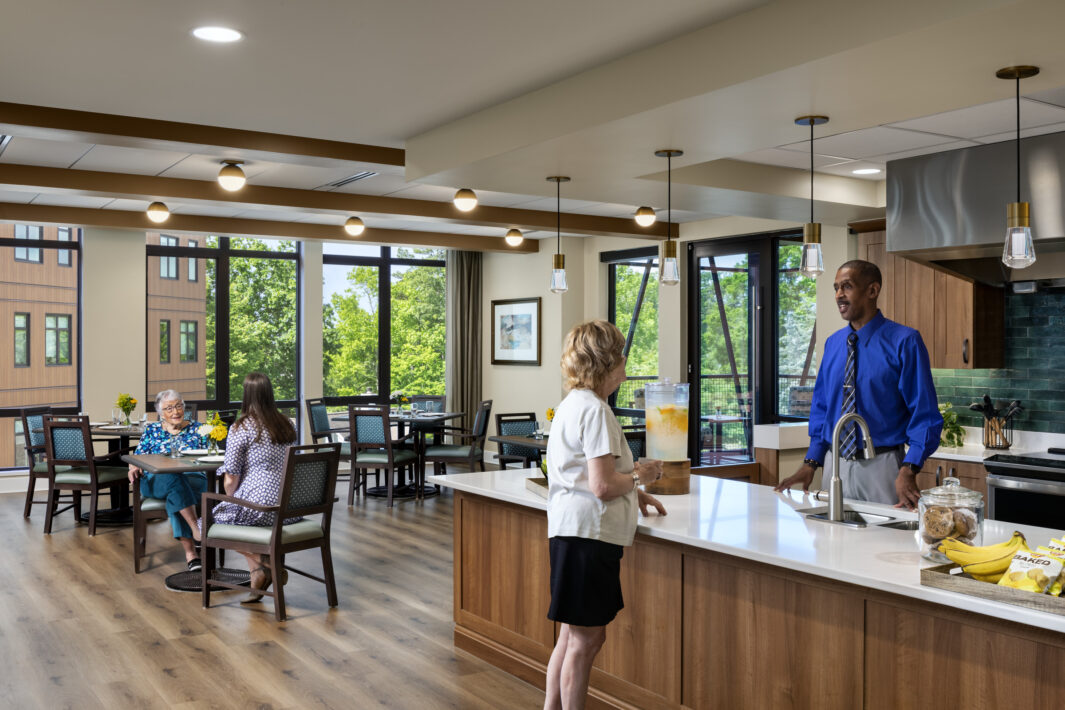
Consider the kitchen. In a private home, it is where someone puts the kettle on, where conversation starts without an appointment, where the day acquires its shape. In a care facility, the kitchen can be somewhere else entirely. Food arrives; the machinery that produces it remains out of sight. The Forest at Duke has made that distinction a design problem.
Its health center arranges 90 residents into nine households of ten. Each household has domestic spaces for eating, sitting, and spending time together. Two neighboring households share permanently assigned staff. The arithmetic is straightforward. The ambition is more interesting: needing help should not require surrendering the familiar scale of a home.
- Nine ten-person households put daily care on a domestic scale.
- Learning, independent living, and higher care share one campus.
- Entrance fees and expansion debt make the financial details matter.
A neighborhood before it was a business
The Forest is a nonprofit continuing care retirement community in Durham, North Carolina. People can enter independent living, with assisted living and skilled nursing available on the same campus as their needs change. Its customers are older adults buying both a place to live now and a plan for later.
The idea came from Duke-area faculty and neighbors. James and Kathy Crapo helped lead the founding effort; the nonprofit organized in 1988 and welcomed its first residents in September 1992. The group sought advice from Duke’s aging specialists and visited other retirement communities. This was a neighborhood trying to invent its own next address.
That origin helps explain the emphasis on intellectual life. Residents were never simply an audience for entertainment. Early residents led activities themselves. Today the organization advertises more than 400 monthly opportunities, from classes and concerts to outings around the Triangle. The quantity matters less than the permission it gives people to remain participants.
The care center gets a smaller unit of measure
The new health center opened in February 2023 and was dedicated as the Cohen Center for Health in 2025. Architect Perkins Eastman describes a building organized around households, with a shared central core. Private residences gather around a kitchen, dining area, living room, den, and screened porch. The point is to make everyday encounters easier.
The Forest’s own account describes a secure memory-care household with an outdoor garden, plus shared art and community rooms. Care and ordinary life occupy the same setting. A person can need substantial support and still have somewhere to paint, watch cooking, or spend time outside.
The design intention deserves a careful reading. A domestic floor plan cannot establish a clinical outcome by itself. What it can do is change the setting in which care happens. Familiar staff and smaller groups create opportunities for recognition. Making good use of those opportunities remains an operating job, every shift.
Each tile is a household. Each dot is a resident.
Paired households have permanently assigned staff.
Curiosity has a membership fee
The nearby university is more than scenery. The Forest works with the Osher Lifelong Learning Institute at Duke, whose offerings span roughly 200 courses a year. A resident could pursue a subject rather than merely attend another scheduled diversion. There is a useful difference between having your afternoon filled and choosing what to learn.
A pilot program reimburses the OLLI membership fee for residents and Early Acceptance Program members, with registration coordinated through Community Life. That is a small, copyable idea: remove a specific obstacle between people and something they already want to do. The published offer concerns membership; it should not be read as a promise that every course is free.
One account of prospective residents makes the decision unusually concrete. A couple living in Fearrington worried about approaching their nineties without available care or transportation. An OLLI course introduced them to housing alternatives. They toured communities and chose The Forest, citing its scale, friendliness, and proximity to universities and medical centers. Their circumstances changed the calculation.
“Keep Growing”The Forest at Duke’s two-word invitation
The bill behind the balcony
The business combines an entrance payment with recurring monthly charges. It sits in the full-service retirement market, competing with other life-plan communities and with the option of staying home while arranging services separately. The Forest’s particular combination is university-town learning, residential choice, and a household approach to higher levels of care.
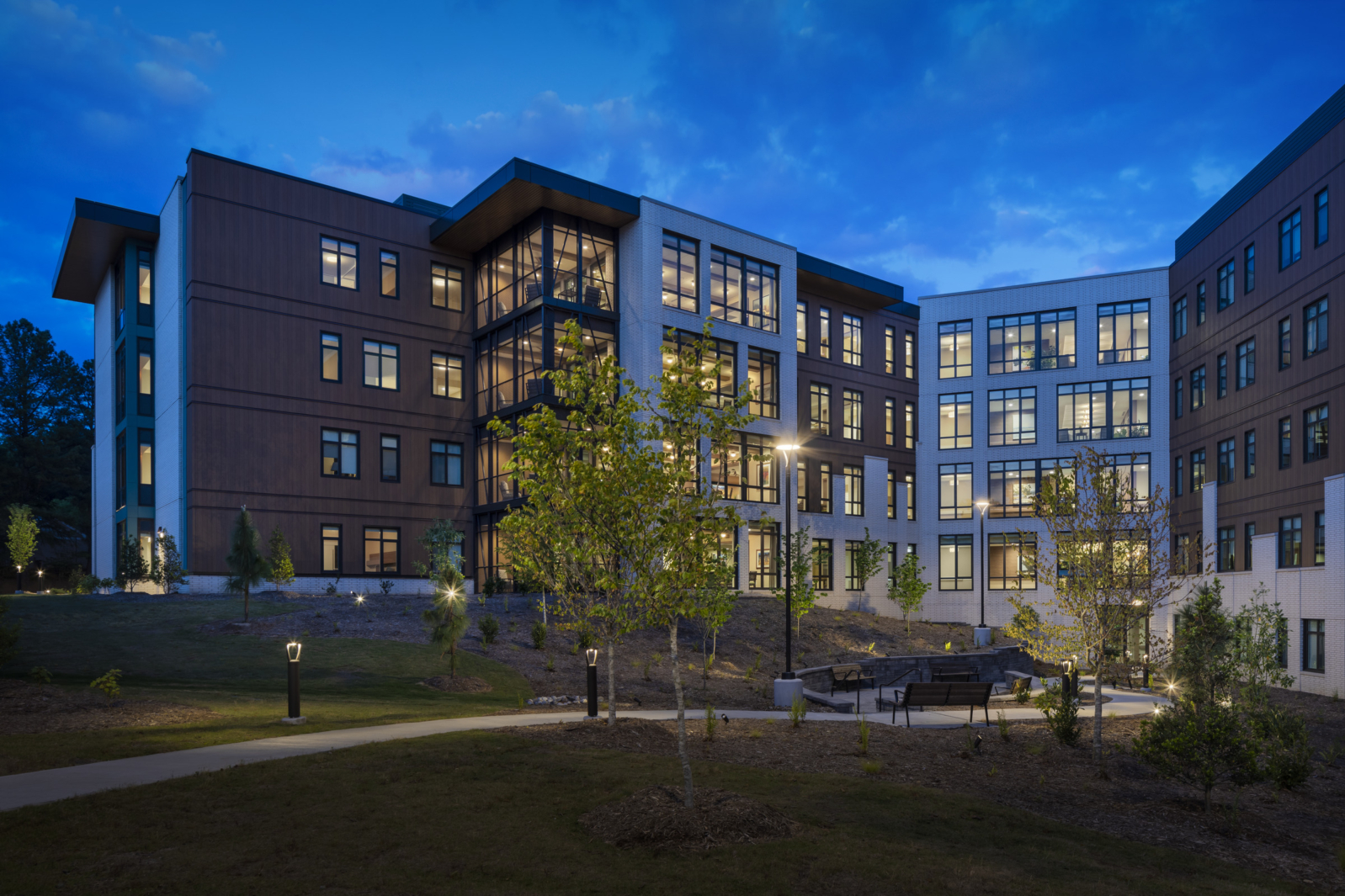
The Terraces added 71 independent-living apartments and welcomed its first residents in fall 2025. Its ten floor plans range from 1,140 to 1,665 square feet, with screened balconies and connections to campus amenities through climate-controlled hallways. The apartment is one part of a larger service relationship.
The 2025 disclosure projected single-occupant Terraces entrance fees of about $416,000 to $589,000 under a nonrefundable amortized plan, plus roughly $6,188 to $6,930 monthly. Those are historical planning figures, with increases anticipated, rather than a current quote. They make the market position plain: this requires substantial resources. Assisted living also has an entry payment and monthly charge; its published offer includes memory support without an additional charge.
Demand does not cancel the debt
The expansion followed a deliberate sequence. Build the replacement health center, move residents, then use the old center’s site for independent apartments. Ziegler closed $95.57 million in Series 2022A bond financing for that second phase. More than 95 percent of the new apartments were presold at closing. The transaction was debt financing.
The difficult part was the financial cushion. In December 2022, Fitch downgraded the issuer and rated 2021 bonds to BBB-, with a stable outlook, citing added leverage. It reported that inflation had lifted anticipated Terraces project costs by approximately $10 million. Strong demand coexisted with a balance sheet that had less room for trouble.
There is a practical lesson here for anyone evaluating a retirement community. Look at the household and the contract. Ask how staff assignments work, what the entrance payment buys, and how later care is charged. A handsome building answers only some of those questions. A household model needs consistent staffing; a capital-heavy expansion needs move-ins and financial reserves.
The Forest’s most portable idea remains modest in scale. Start with something people recognize: a kitchen, a familiar face, a class they chose themselves. Then organize the institution so those things survive a change in health. Ten people around a shared table is a useful place to begin.