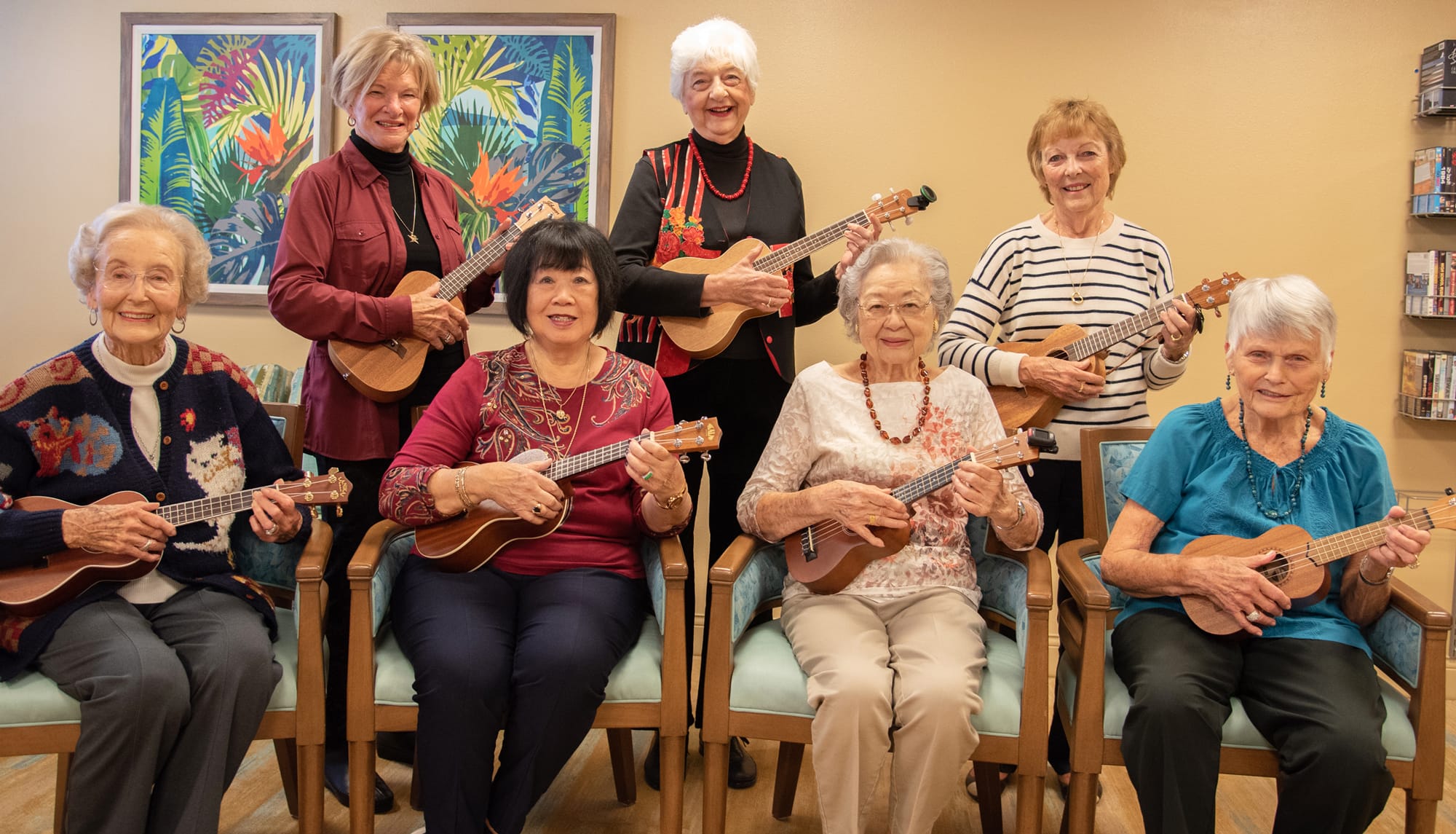
Seven women, seven ukuleles, and scarcely an inch of spare room between them. In a photograph in The Covington’s gallery, the instruments sit across their owners’ laps like invitations. A retirement community can show you a kitchen or a swimming pool. This picture makes a different offer: there might be a part here for you to play.
That possibility helps explain an observation from Sarah H., a resident whose account appears on the community’s website. She could live independently. What she was missing, she said, were the outings she loved: music, theater, trips and travel. Moving gave those activities a place in her life again. The distinction matters. Being capable of staying home does not necessarily make staying home the most appealing choice.
The Covington, operated by Episcopal Communities & Services, occupies twelve acres in Aliso Viejo. It combines independent residences with access to more help as needs change. That puts it in the Life Plan community market, where a prospective resident chooses both a place to live today and an arrangement for later. The difficult part is evaluating the two together.
A home assembled around the next change
When DPR Construction built the original campus, the plan put independent apartments, cottages, assisted living and a skilled-nursing facility into one development. The design team was The Steinberg Group. The campus opened in 2004. Care was part of the physical plan from the start.
Today’s offering is described through Choice Custom Care. Independent living sits alongside assisted living, the Courtyards memory-care neighborhood and Care Suites for short or longer stays. Some assistance can come to an independent living residence. CareOne adds personalized support through employees or preferred providers.
For a couple or a family, the appeal is coordination. A change in someone’s needs can otherwise set off another search: another provider, another introduction, another explanation of preferences. Bringing services together can reduce that work. It does not make every service part of the monthly price, nor does it promise that every resident can remain in the same apartment indefinitely.
Options, not a mandatory sequence. Individual needs and contract terms govern care.
The residences themselves leave room for familiar habits. Published floor plans run from the 833-square-foot Dover apartment to the 2,191-square-foot Carleton cottage. Cottages have separate entrances and private garages. Patios or balconies, housekeeping, maintenance and utilities feature in the residential offering. A person can keep a front door of their own while handing over some of the work behind it.
The fee has more than one line
There is an entrance fee, a recurring monthly charge and the possibility of additional care costs. Each belongs in the same conversation. The community’s October 2025 disclosure listed entrance fees from $323,700 to $1,487,500. It identified a fee-for-service arrangement and stated that health-care benefits were not included in the contract.
As checked in September 2026, the main website advertises a starting monthly price of $6,545 with an entrance-fee contract. Its cost calculator displays $5,950 under its own estimating conditions. Those figures are different; neither should be treated as a personalized offer. The calculator also says additional care and services cost extra.
Main website, checked September 2026.
Entrance fee required. Additional care costs extra.
The calculator’s useful idea is to gather expenses that homeownership scatters: food, utilities, repairs, housekeeping and recreation. Its comparison still requires the resident’s own numbers. A paid-off house, a modest maintenance bill and an active local support network produce a different calculation from a large property with expensive upkeep.
ECS says a majority of the entrance fee can be reimbursed to the resident or estate when the residence is reoccupied. The timing condition matters as much as the percentage. The practical task is to examine the specific contract’s refund arrangement and the cost of care alongside the monthly service package. A pleasant tour cannot settle those questions.
The neighbors help write the syllabus
The Creative Living Academy has a detail more interesting than the word “creative”: resident advisors help shape it, and residents are encouraged to teach and facilitate. A new arrival brings experience the community can use. Participation can mean explaining something, organizing something or helping a neighbor discover an interest.
The listed partners include Laguna Art Museum, Soka University, LOCA Arts Education and the Pacific Marine Mammal Center. Painting, writing, language lessons, book clubs and talks appear in the program. The combination gives a campus an outward connection to the region around it.
That arrangement is worth copying. Organizations often ask people what they would like to receive. The Covington also leaves room to ask what they would like to contribute. A resident-led class gives the teacher a role and the listeners a reason to return. The idea is simple enough to use in a library, an apartment building or a neighborhood group.
“I knew this was a happy place.”
Mary Lam / resident testimonial published by The Covington
Meals offer another recurring opportunity to meet. The Grandview provides restaurant dining, The Cove is the bistro, and the Grandview Lounge serves cocktails and lighter food. The culinary program includes demonstrations and events; meals can be adapted to dietary needs. These are ordinary pleasures, which is precisely why they matter. A retirement decision will eventually become an ordinary Tuesday.
Elsewhere on campus, the amenity list includes an art studio, indoor pool, community garden and Schumacher Concert Hall. Such spaces create possibilities. A visitor can learn more by looking at how a space is used than by counting how many rooms appear in the brochure.
A charitable family tree, a premium address
The Covington’s history contains two clocks. Its own starts in 2004. The parent organization’s starts in 1923, when Deaconess Sophie Miller helped establish the first Episcopal Home in Alhambra for widows of Episcopal priests, collecting donations a dime at a time. Attributing that earlier date to the Aliso Viejo campus would erase eighty-one years of the story.
The parent later adopted the name Episcopal Communities & Services as its work broadened. Today, it welcomes people of all faiths. Its stated mission includes residents’ pride in where they live, families’ confidence, meaningful work for employees and ties to the surrounding community.
Nonprofit ownership shapes where resources can go. ECS describes reinvesting in its communities without shareholder distributions. It also publishes audited financial statements and continuing-care reports. This is still a premium residential purchase. The charitable history and the substantial entrance fee describe different aspects of the same organization.
When seven simple tasks stopped being simple
One recent example of the parent’s care education is unusually concrete. In October 2025, ECS used a dementia-training simulation involving altered vision, distracting sound and reduced tactile sensation. Participants received seven everyday tasks. Its year-end account said most could barely complete two.
The exercise challenged the assumption that an instruction is easy because it sounds easy to the speaker. The lesson emphasized breaking communication into one task at a time. This was a staff exercise, rather than a measurement of resident outcomes. Its usefulness lies in the changed perspective it was designed to produce.
Another ECS program, By Your Side, has trained volunteers since 2011 to accompany people through illness, difficult transitions and the end of life. Since 2013, that training has included residents, employees and neighbors of its senior communities. It makes room for a kind of support that cannot be reduced to a floor plan: someone prepared to sit with another person through a hard moment.
The Covington’s offer will make most sense to someone who wants a shared daily life, can support the financial commitment and values having several forms of assistance nearby. Someone who prefers a dispersed circle of friends, wants care purchased entirely separately or needs a lower upfront commitment may reach another conclusion. The revealing question on a visit is quite personal: can you imagine your Tuesday here - and the Tuesday when you need more help?
Take a closer look
Explore the homes, meet the community and read the terms behind the tour.
Visit The Covington ↗Explore floor plans ↗Financial reports & disclosures ↗Community stories ↗Instagram ↗Facebook ↗LinkedIn directory profile ↗Watch the resident video ↗