A retirement community is a peculiar sort of promise. It offers a home, certainly, but also a future tense: the assurance that tomorrow can remain interesting, sociable and recognizably one's own. The brochures tend to show gardens, dining rooms and pools. The promise itself is made elsewhere - in staffing plans, committee meetings, budgets, inspections and a thousand decisions too ordinary to photograph.
Gregory J. Garrett has spent more than 25 years in that elsewhere. In April 2026, he became President and Chief Executive Officer of The Forest at Duke, a nonprofit continuing care community on 47 acres in Durham, North Carolina. About 500 residents live there. Nearly 400 team members make the place run. Garrett arrived after almost two decades at Peconic Landing, another nonprofit community, this one perched beside Long Island Sound in Greenport, New York.
It was a substantial change of latitude, scenery and title. It was not a change of subject. At both institutions, the question is the same: how does a complex organization preserve the everyday liberty of the people who live inside it? Garrett's career offers a practical answer. You build the machinery carefully, then resist the temptation to make the machinery the point.
The education of an operator
Garrett began with economics, earning a bachelor's degree before completing a master's in health service administration at the University of Massachusetts Lowell. The pairing is apt. Senior living is an economy of finite space, finite time and needs that refuse to line up neatly. Yet its decisive currency is trust. A dining schedule, transportation route or maintenance request can seem small from an office and enormous from a living room.
His early work included revenue operations at Partners HealthCare International and an administrator's role at St. Mary's Healthcare System for Children. By 2006, he had reached Peconic Landing. He would remain there until 2026, moving through health-services leadership to become Chief Operating Officer and Administrator. Long tenure is unfashionable in executive biographies, which often read like airport departure boards. In Garrett's case, staying became an education of its own. He saw plans survive contact with daily life.
Revenue operations at Partners HealthCare International.
Licensed nursing home administration at St. Mary's Healthcare System for Children.
Two decades at Peconic Landing, culminating as COO and Administrator.
President and CEO of The Forest at Duke in Durham.
Peconic Landing offered a full test of the operator's craft. Garrett oversaw a continuum that included independent living, assisted living, skilled nursing and home services. He helped lead a $44 million expansion completed in 2016, adding a fitness center, art studio, education technology space, short-term rehabilitation and a new residential neighborhood. Buildings are the easy part to list. The difficult part begins when the ribbon falls: hiring, programming, coordination and the patient conversion of square footage into useful life.
“This award is a direct reflection of all the hard work and pride our team puts into our services every day.”Greg Garrett, accepting a 2019 leadership honor
Eight trophies, one pronoun
The most conspicuous line on Garrett's record is also the one he consistently made plural. Between 2013 and 2024, he received the American College of Health Care Administrators' Eli Pick Facility Leadership Award eight times. The award is not bestowed for a dazzling conference talk. It draws on years of survey results, quality measures and operating performance. In 2024, only 39 administrators in 18 states cleared every requirement.
When Garrett accepted the honor in 2019, his sentence began with “this award” and ended with “our team.” It is a small grammatical choice with a large management philosophy behind it. Quality in a community is a chain of human actions. No executive can inspect every room, answer every call or notice every subtle change. The leader's work is to make attention contagious.
That instinct appeared in less formal recognition too. Garrett is a past recipient of the Thomas Clarke Young Administrator of the Year award, has served in LeadingAge New York leadership and sat on its Services Board. Colleagues described him as thoughtful and collaborative. His public comments tend to migrate quickly from institutions toward people: members, friends, loved ones, teams. Even his syntax has an operating model.
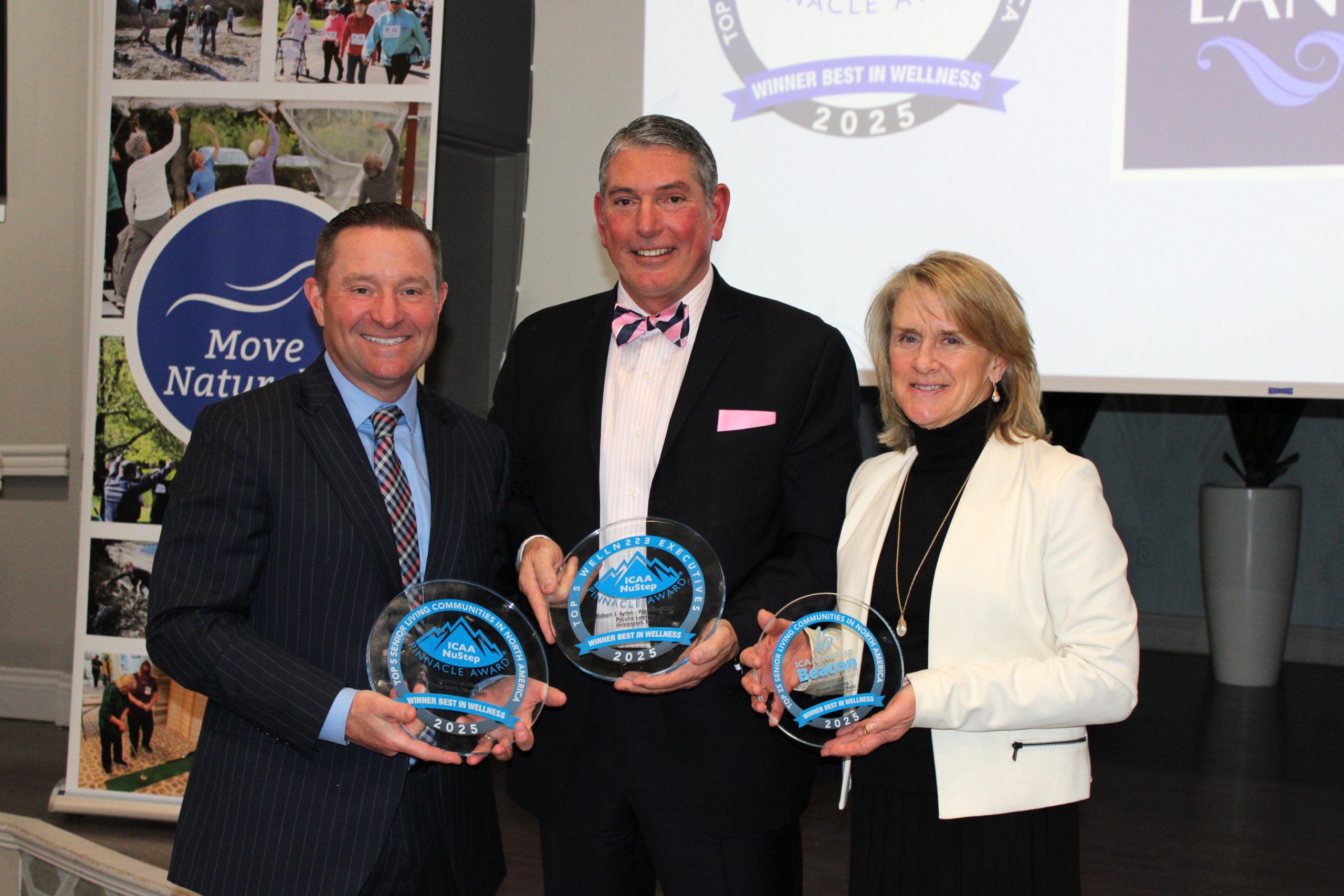
A community is not an amenity list
At Peconic Landing, wellness was organized less as a department than as permission. Residents taught classes, volunteered, traveled and served on committees. More than 30 clubs and committees created a civic life within the campus; several put residents and management at the same table to discuss matters from dining to finance. The arrangement recognized a stubborn truth: moving into a community does not cancel a person's appetite for influence.
Garrett helped extend that idea beyond the campus. When Peconic Landing partnered with Stony Brook Medicine on an expanded Center for Well-Being in 2022, his framing was revealing. The planning began by asking what the whole East End needed, not merely what was convenient for the institution. Six new exam rooms and additional space were the physical result. The larger act was redrawing the boundary around whom the campus might serve.
Later, as chair of a successful-living committee, Garrett described the goal as meaningful engagement through movement, learning or social interaction. The words are deliberately broad. A sensible community leaves room for the resident who wants a class, the one who wants a committee and the one who would prefer to go fly-fishing. Garrett's own off-duty note is fitting: after one birthday, he spent several days backpacking on the Appalachian Trail. Purpose need not arrive wearing a name badge.
A good community does not hand people a script for later life. It keeps the stage open, the doors working and the rehearsal schedule flexible.
The move to Durham
The Forest at Duke shares Peconic Landing's nonprofit structure and its emphasis on continued learning, but it is not a franchise awaiting the approved Garrett method. Its residents include professors, gardeners, authors, engineers, artists and former executives. Its campus sits beside Duke University and its medical center. It has its own traditions, institutional memory and well-developed opinions. A new CEO who arrives with only answers would quickly become a very lonely man with a calendar full of meetings.
Garrett's published brief is more restrained: build on the existing foundation, support meaningful connections and maintain a high quality of life. There is wisdom in the modest verbs. “Build on” requires knowing what is already load-bearing. “Support” accepts that the liveliest parts of a community often originate outside the executive suite. Leadership here is closer to gardening than architecture, though both require a budget.
His arrival also comes at a moment when The Forest has visible momentum. The community opened contemporary apartment designs as part of a residential expansion in 2025. Its small-house approach has exchanged institutional scale for more domestic settings. National rankings have placed the community among recognized continuing care destinations. Such laurels are useful, but they are rented, not owned. Tomorrow morning still has to work.
That is where Garrett's long apprenticeship matters. He has lived through the distance between a project rendering and a functioning building, between a new program and the hundredth time it runs, between a quality target and the habits that sustain it. He knows that culture is not declared. It is scheduled, staffed, listened to and repaired.
What the arithmetic leaves out
An operator naturally counts: occupancy, response times, staffing, capital costs, survey results. Garrett's awards demonstrate that the numbers have been kind to him. But a community finally succeeds in units no dashboard quite captures. A neighbor knocks. A class fills. Someone tries sailing late in life and discovers that competence was never the only pleasure available.
The executive's paradox is to take measurement seriously without confusing it for meaning. Garrett appears comfortable with that tension. His record is quantitative enough to satisfy an inspector and human enough to leave room for surprise. This may explain the durability of his career in one corner of one industry. Senior living is not a side project to him. It is a long argument that age need not shrink the field of choice.
Now the argument continues in Durham. The scenery has changed from Long Island Sound to Carolina pines. The residents have different stories; the campus has different rhythms. Garrett's task is to learn them before the neat abstractions of management sand off their edges. Then comes the familiar arithmetic: listen closely, count honestly, adapt carefully, repeat. If the sum is right, people do not experience an operation. They experience a place that still feels like their own.