At a senior living community in Ohio, lunch had a nine-step itinerary. The request began on paper, passed through hands and departments, and ended, eventually, with a meal at a resident’s door. Cubigo’s founder Geert Houben later described reducing that process to two digital steps. The figure is the company’s account of one pilot, not a universal benchmark. Still, it captures the peculiar opportunity Cubigo found: the cost of a bad interface is sometimes measured in errands rather than clicks.
- Cubigo gives residents one place to request meals, rides, repairs and activities while staff manage the work behind each request.
- Its customers are senior living operators; residents and families use the service their community provides.
- The method began with observation: a colleague lived in a Brookdale community for roughly a year, and Brookdale later rolled out functions gradually.
- The business is subscription software. Its public materials do not post a list price; the reported cost to build and expand includes a $4.5 million 2018 financing round.
Most software asks people to change their habits. Cubigo had to understand habits that had already hardened into a building’s daily rhythm. A resident could phone the front desk about a ride. A staff member could pin a maintenance note to a board. A dining team could reconcile meal orders from slips. None of these small systems looked broken on its own. Together, they made a maze, with residents and staff serving as the connecting tissue.
paper-based steps before
digital steps after
Somebody had to move in
Cubigo began in 2011 as a University of Hasselt spin-off founded by Houben, an information technology specialist, and Dr. Peter Willems, a general practitioner. The company says Houben’s wish to improve his grandmother’s life helped inspire it. Its early description was broad: a platform to help older people live independently, whether at home or in a care setting. That ambition had the generosity of a family wish and the ambiguity of a large market.
The sharper product came from getting close to a particular buyer. In 2016, Cubigo’s Bart Schaerlaekens moved into a Brookdale Senior Living community for roughly a year. He spoke with residents and staff, watched their routines, and helped turn what he saw into product work. The company called it an entrepreneur-in-residence program. This was customer research with a rent bill and no convenient escape at five o’clock.

At Brookdale Redwood City, the resulting platform was tailored to the community’s brand and routines. Staff used it to create and track transportation, dining, activities and maintenance requests. They started before residents did. Functions arrived over time rather than in one grand opening. Cubigo also held “Cubigo Cafe” sessions to introduce residents to the service, which a Brookdale staff member eventually took over. The first thing likely to fail in this kind of deployment is a handoff: a digital request that reaches no one, or a staff member who still has to write it down. Training the people who fulfill requests was a practical answer.
“We have moved from paper to online, and from multiple slips that had to be sorted to one simple platform.”Jessica, activities director at Brookdale Redwood City
A button is a small promise
A resident sees what Cubigo calls a “cube”: tap dining, transport, maintenance or activities. The resident can order a meal, book a ride, sign up for an event or report a problem. Family members can receive updates and, in some deployments, help arrange a service. Staff see the other half of the transaction: a request to assign, track, complete and learn from. That dual view is the company’s real product. A button without a dependable work queue would merely give a complaint a new address.
The menu has grown. The Engagement suite includes activity calendars, attendance tracking, news, reminders, digital signage and a resident directory. Hospitality covers dining point of sale, table reservations, kiosks, menu management, concierge services and a resident wallet. Visitor Management handles sign-ins and notifications. Insights adds dashboards at community and service levels and a Resident 360 profile that combines preferences and engagement data. On a resident’s device these may look like adjacent icons; to an operator they connect teams with different budgets, schedules and definitions of a completed task.
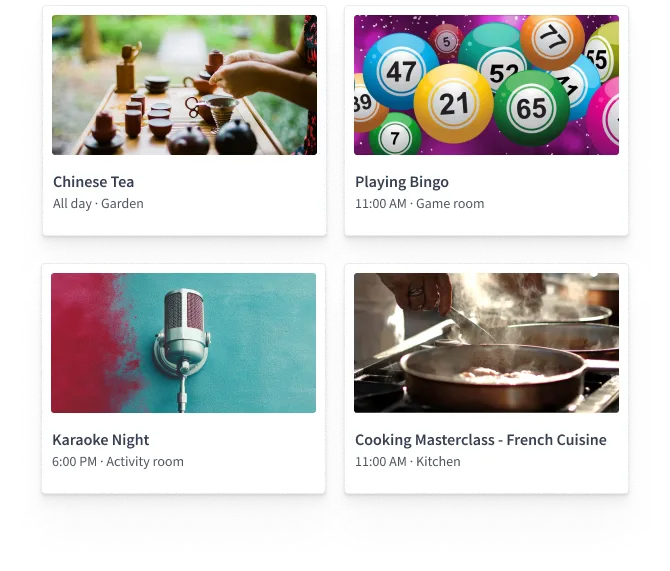
Cubigo sells this as business-to-business software to operators, not as a download a resident buys independently. It offers configurable modules and integrations with systems already in a community. The published integration list includes PointClickCare for clinical information, Yardi for billing and profile data, Apple TV for in-suite displays, and maintenance tools such as TELS and TheWorxHub. Its advantage is an entry point across otherwise separate applications. Its competition, often enough, is a bundle of point solutions that each does one job well but makes someone reconcile the whole.
The price of joining the dots
What did this approach cost? Cubigo announced a $4.5 million Series A in 2018, led by Belgian investor Urbain Vandeurzen with Transvision participating, to expand in the United States. Belgian reporting later described a €2 million capital round involving LRM and existing backers in 2019. Those are company financing events, not customer prices. Operators are directed to request a demo, and public list pricing is absent. The harder costs for a customer are visible in the Brookdale story: mapping work, preparing staff, moving data and persuading residents that a new channel will actually answer.
An Ascent Living Communities case study shows the business case Cubigo now prefers to make. Ascent had separate tools for engagement, visitor management and dining. It consolidated parts of that stack on Cubigo, and the company reports more than $1,000 in additional monthly revenue per community from more accurate charge collection, alongside 77% or higher resident engagement. These are customer-case figures, with no public controlled comparison. They do make a useful point: operational software can create value by catching charges and requests that a fragmented process lets drift away.
The company’s scale claims vary by source and date. Its current about page says more than 500 communities in six countries and more than 500,000 users. Its LinkedIn description says more than 600 communities and 250,000 active users. Those numbers use different definitions and snapshots; neither is a reason to combine them into a single precise total. The more durable observation is that Cubigo’s market is international and its buyers operate communities, while the people judging the product each morning live and work inside them.
What the data can notice
In 2025 Cubigo introduced Nova, an AI engine meant to turn routine platform data into prompts, summaries and recommendations. A dining preference or activity sign-up can help personalize a resident profile. A change in habits may give staff a reason to check in. In April 2026 the company announced a forthcoming text and voice Nova Assistant for questions and service bookings. “Forthcoming” matters: an announcement is not evidence that every community has deployed it.
There is a productive modesty in the best use case. A missed lunch does not diagnose illness. It might, however, be one more detail that helps a person notice another person. Cubigo’s February 2025 project with Dutch partner Datacation offers a similar pattern for admissions: an AI-assisted transcript can draft a resident profile, which a care professional reviews. The software handles repetition; the person keeps responsibility for the interpretation.
The resident sees one request. The institution has to make good on it.
The copyable lesson is not “build an app for older adults.” It is to spend time where the work happens, find one high-friction service, make the staff workflow reliable, and widen the menu only when the first promise is kept. The approach depends on a community willing to train staff, maintain accurate service information and follow through on requests. If those conditions are missing, even an elegant interface can become a beautifully organized place to be ignored.
Cubigo’s founders set out to make aging easier. The company found a less romantic, more useful unit of progress: lunch gets there, the repair is logged, the ride is confirmed, and somebody knows what happened. Software rarely deserves applause for doing the ordinary. In senior living, doing the ordinary reliably is quite a feat.