The modern homeowner association runs on a peculiar mix of neighborhood politics and corporate finance. Somebody has to collect dues, code invoices, reconcile bank accounts, chase violations, assemble board packets, reserve the pickleball court and answer the resident who cannot find last year's meeting minutes. Multiply that by hundreds of communities and the humble management company starts to resemble a small bank, call center, accounting firm and local government sharing one password.
CINC Systems built a business inside that tangle. Founded in 2005 in suburban Atlanta by Bill Blanton, a third-generation banker with real estate experience, the company began with a pointed observation: association managers were moving between property software and bank systems that did not understand one another. CINC joined them in the cloud. The company says its product was the industry's first internet-based, all-in-one accounting and association management system; it connected its first bank in 2006.
That origin matters because it explains both CINC's staying power and its current AI pitch. Plenty of software can draft an email. Far fewer products already hold the ledger, invoice, resident record, governing document, violation history and bank transaction that make the draft useful. CINC spent 20 years collecting context before asking a machine to act on it.
The wedge was a bank account, not a mood board
The customer is usually not a volunteer board managing one subdivision. It is a professional management company responsible for many HOAs and condominium associations. Its employees may oversee separate ledgers, operating accounts, reserve accounts, vendors, board calendars and resident communications for every community. Re-entering the same information is annoying; misplacing it can become a financial or governance problem.
CINC's initial move was classic vertical SaaS: solve an industry-specific headache that broad accounting packages handled awkwardly. Direct bank integrations pulled transfers, statements, check images and reconciliation into the accounting workflow. In 2026, CINC reported 38 direct bank integrations. Those relationships also created distribution and switching costs. Once the books and banking sit together, moving away is not a casual Friday project.
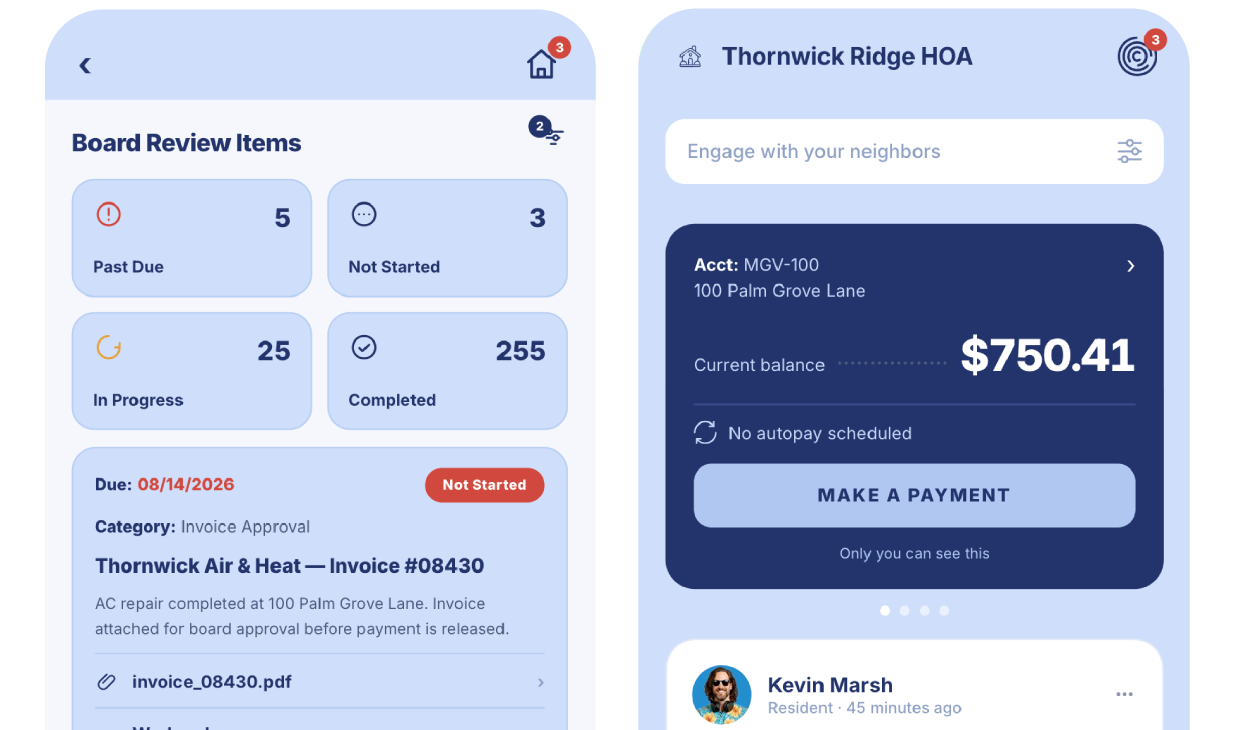
From there, CINC widened the circle. Managers received mobile tools for inspections, work orders and violations. Boards and homeowners got an app. The company acquired HOAst to bring online voting into the same login, then bought ONR Applications in 2025 to add a more polished resident layer: community feeds, amenity reservations, concierge services, payments and package tracking. TresRE, launched in 2023, took the original bank-software connection into other real estate verticals. An API program lets clients attach specialist tools rather than wait for CINC to build every feature itself.
AI arrives after the filing cabinet is full
CINC began deploying generative AI in 2023 under the name Cephai, pronounced “see-fee-eye.” By 2026 it was positioning Cephai as the operating layer across the product, not a chatbot tucked into a corner. The system includes bounded “skills” that ingest and code invoices, match recurring electronic transactions, draft budgets, prepare board packets, identify possible violations from photos, prioritize messages and help process architectural requests.
The jobs are deliberately mundane. That is the point. Management companies do not need software to write a sonnet about the pool rules; they need it to find the correct rule, attach the correct photo, draft a notice and leave a human responsible for the decision. CINC says Cephai keeps people in control, an important qualifier when the work touches money, property restrictions and board governance.
“One login. One navigation. One platform.”Ryan Davis, chief executive officer
The early outcome claims are unusually concrete. RISE Association Management Group reportedly cut a budget draft from five to ten hours to about one minute. DTA Community Management moved board-packet assembly from days to minutes. GUD Community Management said invoice processing fell from roughly ten minutes to thirty seconds across about 15,000 invoices each quarter. Vine Management reported saving 35 hours in one budget season.
These are customer examples published by CINC, not a controlled benchmark. Still, they reveal a smart adoption pattern: begin with repeatable work that has a visible before-and-after, a defined input and a human reviewer. By August 2025, more than 100 management companies representing over 10,000 associations had subscribed to Cephai+, and early adopters had processed more than 31,000 invoices.

What it costs - and what fails first
CINC does not publish an official rate card. Its site asks prospects to book a demo and request a personalized quote. Public software directories list a starting figure of $250 a month, but buyers should treat that as a clue, not a contract. The real number can depend on portfolio size, enabled modules, migration, implementation, payment processing, training and service. An all-in-one platform should be priced against the labor and extra systems it replaces, not against a single lightweight app.
The first failure is unlikely to be a missing AI adjective. It is more often the handoff from the old system: messy owner records, inconsistent account structures, staff learning a new workflow, a report that behaves differently or a support ticket that outlives the patience of the person who filed it. On G2, reviewers broadly praise CINC's efficiency and integrated scope, while the review summary also surfaces complaints about support speed, missing features, customization and learning difficulty. Capterra's public rating sits at 4.3 out of 5, with customer service below its ease-of-use and value scores.
That is also the risk of the “operating system” ambition. The more CINC handles, the more every weak seam matters. A beautiful resident app does not excuse a frustrating ledger workflow. A fast invoice agent does not help if coding rules are wrong. Security claims matter - CINC reports SOC 2 Type II certification and Veracode Verified status - but permission design, auditability and disciplined human review still determine whether automation is safe in practice.
The playbook worth stealing
First, choose a niche where fragmented records create recurring labor. Second, become the system of record for the least optional workflow - in CINC's case, accounting and banking. Third, use partnerships as product infrastructure and distribution. Fourth, move outward to adjacent stakeholders, from managers to boards to residents. Fifth, buy capabilities when integration matters more than building from zero. Only then add AI to tasks already occurring inside the product.
There is another lesson in CINC's restraint. The best automation stories use units a customer understands: minutes per invoice, hours per budget, days per packet. A founder can copy that tomorrow. Pick one workflow, time it honestly, automate a bounded part, preserve a review step and measure it again. “AI transformation” is fog. Thirty seconds instead of ten minutes is a budget line.
Works best when
- A professional manager runs many associations.
- Accounting, banking and resident work need one record.
- The team can standardize data and train users.
- Automation keeps a clear human approval step.
May not work when
- A small self-managed HOA needs one simple tool.
- The buyer expects public, plug-and-play pricing.
- Every community insists on a unique workflow.
- Poor source data makes automated output unreliable.
CINC now sits in a crowded property-technology market beside association specialists such as Vantaca, Enumerate, TOPS and FRONTSTEPS, and broader property platforms such as AppFolio and Buildium. Its argument is depth: accounting, operations, resident engagement, banks, payments and AI in one connected environment. A specialist point solution may be easier for a small portfolio. CINC is betting that professional managers at scale prefer fewer seams.
Growth investors agree with the shape of that bet. Spectrum Equity invested in 2020. Hg joined in early 2024 alongside Spectrum, Blanton and management; financial terms were not disclosed. The capital supported a familiar private-software agenda: leadership, product expansion, acquisitions and a larger go-to-market operation. By 2026, CINC said more than 1,000 management companies were using the platform across more than six million doors.
The company is still wrestling with the tradeoff every ambitious vertical platform eventually meets. Integration creates convenience and a defensible data layer, but it also creates responsibility for a sprawling surface area. CINC's next chapter will be judged less by how many AI skills it announces than by whether managers trust those skills on a bad Tuesday - when the ledger is messy, the board packet is late and a resident is waiting. That is where boring software earns its keep.