There is a small grammatical difference between designing for a learner and designing with one. Lisa Marsh Ryerson has built a presidency inside that difference. The first construction is tidy. Experts gather, plans acquire bullet points, and the learner arrives at the end as the grateful object of everybody else's intelligence. The second is messier. It requires questions, revisions and the possibility that the institution is wrong. Ryerson, who became Southern New Hampshire University's sixth president in July 2024, prefers the mess.
This is an intriguing choice at a university of more than 200,000 learners, many of them online and scattered far beyond New Hampshire. Scale is excellent at turning people into totals. Ryerson keeps returning to the stubborn particular: the working parent, the first-generation student, the veteran, the career changer. They do not experience a university as a strategy. They experience it as the Tuesday-night login, the transfer credit that counted, the adviser who called back, or the form that made no sense.
Ryerson knows the first-generation passage personally. Her parents did not attend college, but made education an expectation for their children. At Wells College in Aurora, New York, she studied English with honors and held two work-study jobs. Those jobs nudged her toward teaching. She later taught fifth and eighth grade, a useful apprenticeship for anyone who imagines authority and attention are the same thing.
“I'm a lifetime learner and a lifetime teacher.”Lisa Marsh Ryerson
The 28-year education
Wells became more than an alma mater. It became a long education in how an institution behaves. Ryerson joined its admissions office in 1984, became dean of students in 1991, moved through vice-presidential posts, and was named president in 1995. By the time she left in 2013, she had spent 28 years there, 18 of them as president and CEO.
Longevity can produce complacency or fluency. Her results point to the latter. Wells reported a 45 percent increase in enrollment during her presidency, opened an endowed Center for Business and Entrepreneurship, and took part in revitalizing the surrounding community. A small liberal arts college is an intimate place to learn consequences. A decision about enrollment lands in a classroom, a residence hall, a local shop and a family conversation. Nothing remains abstract for long.
Then came a striking turn. Ryerson left higher education for AARP Foundation, where the subject was not a semester or a degree but economic opportunity across a lifetime. She led the foundation for nearly nine years. During the last three-year plan of her tenure, its work generated more than $5 billion in income for older adults. It was an education in scale of another kind: partnerships, measurable outcomes and the distance between a well-intentioned program and a useful result.
One career, four scales of service
Fifth- and eighth-grade classrooms made teaching the first craft.
Wells College, from admissions to an 18-year presidency.
AARP Foundation and a national focus on economic opportunity.
SNHU provost, then president of a global learning community.
A procession that took 21 years
Ryerson's first encounter with SNHU came in ceremonial dress. She marched in the academic procession for Paul LeBlanc's installation as president and brought her three daughters for the weekend. That was 2003. What looked like a visit became, in her telling, a 21-year journey.
She joined SNHU's Board of Trustees in 2016 and served there for six years. In 2022 she returned to higher education as provost. The job brought campus and online academic programs together with admissions, advising and financial aid in a single learner-centered academic experience team. The wiring diagram of a university can look dull from outside. To a student bounced among offices, it is destiny.
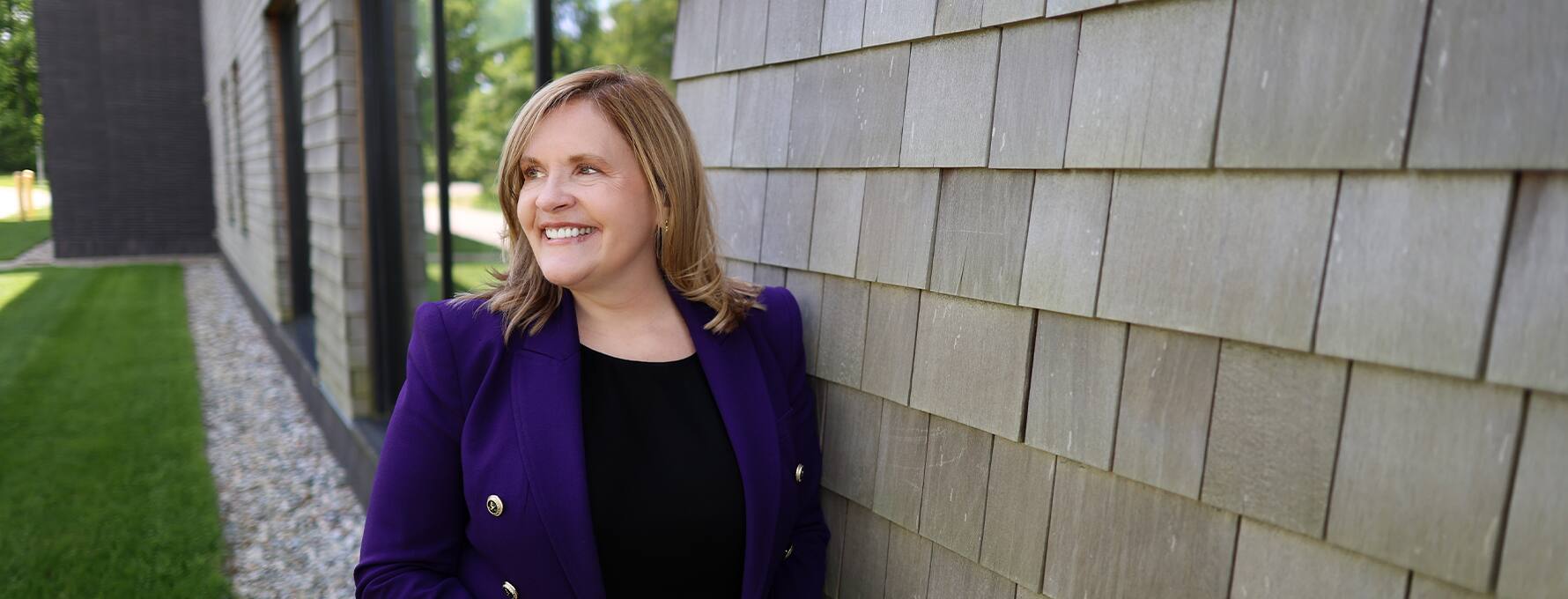
When LeBlanc announced his departure after two decades in office, SNHU did not stage a dramatic rupture. Ryerson's six-month transition unfolded with the two leaders down the hall from each other. She could ask why old decisions had been made. She listened to students, faculty and staff and appeared beside a predecessor loved by the community. It was succession treated less like a coronation than a seminar.
The board initially gave her a two-year term. That brevity concentrated the mind. She later said she felt an obligation to make the most of 24 months during a turbulent period for higher education. One year in, the board extended her contract through June 2030. Her reaction was not delivered in the marble vocabulary of institutional leadership. She did a “full-on happy dance.”
The intimacy problem
Ryerson describes SNHU as “nationwide,” a word she distinguishes from merely national. The difference is local presence: learners living real lives in many places rather than dots on a market map. The phrase contains her central operating puzzle. How can a vast online institution behave as though proximity matters?
Her answer begins with listening infrastructure. She introduced “Ask Lisa,” an anonymous channel where employees can send candid feedback. The university also holds city-based social gatherings for a distributed workforce and shares qualitative and quantitative updates. None of this is glamorous. Glamour is frequently what an organization applies when it would rather not read the comments.
The method has four parts: relationships, collaboration, evidence and attention to the learner. Ryerson speaks of blind spots without the usual executive urge to pretend they belong to somebody else. Data matters because anecdotes can mislead. Stories matter because averages can conceal. The useful decision is made where the two correct each other.
“Flexibility is not a feature - it is a necessity.”Lisa Marsh Ryerson
That maxim is easy to place in a brochure and harder to honor in operations. Flexibility means recognizing learning acquired before enrollment. It means credentials smaller than a degree when those fit the goal. It means career relevance, support at odd hours and systems designed around people who cannot rearrange work and family to flatter a university calendar. Under Ryerson, SNHU launched a professional-skills site with an approved credit-for-prior-learning microcredential and continued expanding recognition of prior learning.
The door is not the destination
“Access” is one of higher education's favorite nouns. Ryerson complicates it with a verb: complete. An open door is morally pleasing, but it is not an outcome. Did the learner finish? Did the credential create mobility? Did the program deliver what that person came to achieve?
This insistence also shapes her approach to technology. In 2026, as artificial intelligence rushed into institutional plans and classroom products, she argued that college leaders must guide the tools rather than be guided by them. AI could help advisers respond and help institutions see patterns. It could also deepen barriers or drain human connection from the moments when a learner most needs it. For Ryerson, novelty does not get a free pass. It must answer to mission.
The distinction matters because SNHU is exactly the sort of institution where an efficient tool can produce consequences at speed. A minor improvement can spare thousands of people a needless obstacle. A bad assumption can inconvenience just as many before lunch. Ryerson's preference for disciplined evidence is therefore less a managerial affect than a form of caution. Test the idea. Ask who benefits. Ask whose experience is missing. Then keep listening after launch, when the polished presentation has met the untidy world. Scale magnifies good intentions only when the underlying decision is sound.
Her public agenda reaches beyond one university. She has advocated for learners in Washington, joined national conversations about college completion and called for policy designed around the people actually navigating higher education. She serves across higher-education boards and councils, with the same refrain: better systems require institutions, employers, policymakers and communities to work together.
Mysteries, evidence and joy
The private details that Ryerson volunteers are pleasingly unoptimized. She swaps book titles, returns to Arthur Conan Doyle, seeks out new mysteries, takes long walks, listens widely and loves a family dance party. She lives in Manchester with her husband, George; together they have a blended family of four children and two grandchildren.
There is something apt about the mysteries. Institutional leadership is detection work. The obvious suspect is rarely the whole explanation. A completion problem may hide in a transfer policy. A technology problem may really be a trust problem. The president's task is not to arrive with every answer but to make it safer for the clues to travel upward.
Ryerson's career has crossed ages, sectors and wildly different scales, yet the posture remains that of a teacher: begin with the learner, pay attention, test what works, revise. At SNHU the classroom has become enormous. Her wager is that it need not become impersonal. More than 200,000 people are not one audience. They are more than 200,000 reasons to listen.