The first customer did not arrive through an advertisement. He arrived at breakfast, or perhaps in the back seat on the way to school. He was Hugh Yao's young son, newly at home in Singapore and rapidly becoming at home in English. This was good news, until it acquired a shadow. The boy began struggling with complex conversations in Chinese. His parents spoke to him in one language; he increasingly answered in another. A family can be together at the table and still feel a door beginning to close.
Yao had moved his family from Beijing to Singapore in 2012 for a role at Oracle. The city promised an education amid Eastern and Western cultures. His son, then three, adapted with the terrifying efficiency of small children. English became natural. Opportunities to practice Chinese at an international school did not. Yao and his wife searched for lessons, but much of what they found leaned on rote instruction, old materials, awkward schedules, or some unhappy combination of the three.
So Yao tried the obvious parental solution: he would teach the boy himself. It lasted two lessons. Being a native speaker, he discovered, was no guarantee of being an able teacher. His available time came in scraps; everybody finished tired; very little Chinese survived the exercise. It is a compact and almost comic origin story. The future founder of a global education company began by proving himself unqualified for the job he was trying to do.
The useful failureA problem small enough to sit beside you
By then Yao knew large organizations. He had studied engineering physics at Tsinghua University, followed by a master's degree in management science and engineering. His career took him through IBM, Oracle, and Salesforce in Asia-Pacific leadership roles. He could analyze markets, manage supply, hire teams, and build a commercial function. None of that made a bored child look up from the desk.
The gap between a corporate plan and a child's attention became the opening. In 2017, Yao founded LingoAce in Singapore to teach Mandarin online through live instructors, stories, animation, interaction, and games. His son took the first classes. This gave Yao what founders politely call customer insight and parents call watching closely: he could see which moments invited curiosity and which sent it wandering out of the room.
“I encouraged myself to make the big jump.”Hugh Yao on leaving corporate life
There was another test at home. When Yao's daughter later joined the program, he did not tell the team or her teachers whose child she was. He wanted the service an ordinary family received, not the polished performance reserved for the boss. The choice was a quiet audit of the institution he was building. A school is only as good as the class delivered when nobody important appears to be watching.
Yao has said he still looks at lessons through two identities: the parent asking whether a child is enjoying and progressing, and the entrepreneur asking whether the system can serve many more children. Those views sometimes cooperate and sometimes quarrel. The parent sees one wandering gaze. The operator sees curriculum, teacher training, scheduling, product design, and data. The useful company must answer both.
The unfashionable moveFirst, refuse to hurry
LingoAce began with a global ambition and a conspicuously local laboratory. Singapore's international-school families included first-generation Chinese immigrants, long-established Chinese communities, and families with no Chinese heritage. Their expectations differed. That variety allowed the young company to test programs for learners whose needs resembled families in Australia, Britain, and the United States.
Then Yao applied the brake. During the first two years, LingoAce served only a few hundred customers. The team listened to them and revised the experience every week or two. The company built slowly while the usual startup verbs - blitz, capture, dominate - waited outside with their coats on. Patience here was not dreamy. It was a production method. Each small cohort exposed another rough edge before distance and volume could magnify it.
Oracle relocates Yao and his family from Beijing to Singapore.
LingoAce begins; Yao's son becomes its first student.
A few hundred families help the team refine live, gamified lessons.
The company closes $160 million across Series B and C rounds.
LingoAce expands its multi-subject work through ACE Academy and AI-supported tools.
That restraint made the later speed less mysterious. When the pandemic pushed education onto screens, LingoAce was already designed for the screen. The company reported that global bookings rose nearly 4,000 percent from the end of 2019. It entered more than 100 countries and, by 2022, employed thousands of teachers and staff across several markets. In 2021 it closed a $55 million Series B and a $105 million Series C, reporting $180 million in total funding.
The numbers are dramatic; the mechanism was domestic. Parents told other parents. By 2022, Yao said referrals supplied 60 percent of new customers each month. LingoAce formalized the behavior with sharing tools and incentives, but the exchange remained personal. A parent buying a lesson is entrusting somebody with a child's finite attention. Recommendations travel because the risk does too.
How new customers arrived in 2022
The system behind the gameFun has serious machinery
Gamification can sound like sugar scattered over homework. Yao's model is more mechanical. Young students may begin with a minute or two of animation, enough to gather attention before a live teacher takes over. Practice follows the lesson, and games make necessary repetition less punishing. Assessments and placement tests help learning advisers recommend a path. Data on answers, pace, and difficulty informs both individual guidance and revisions to the curriculum.
The pieces matter together: teacher, curriculum, animation, game, assessment, parent. Remove the teacher and the experience loses judgment and relationship. Remove repetition and the language does not stick. Remove delight and repetition becomes drudgery in a brighter costume. Yao's engineering habit appears in the arrangement, but so does the memory of a father whose own improvised lessons exhausted everyone.
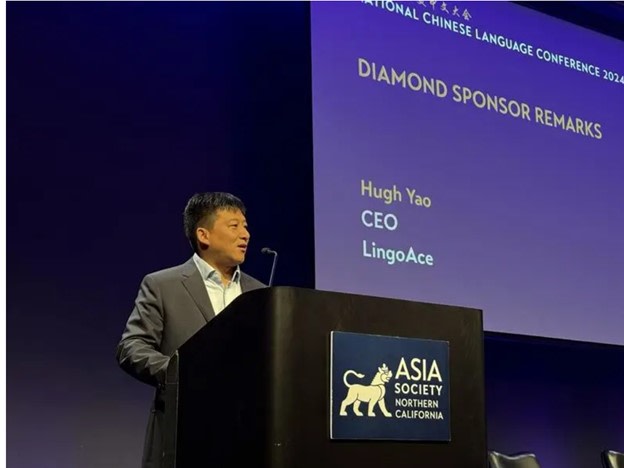
Language, for Yao, has never been merely a collection of correct answers. He started learning English as a second language at 12 and remembers the method as boring. Yet bilingualism carried him into an international career and taught him to work across cultural expectations. He later described language as a starting point: the deeper value lies in understanding the logic, assumptions, and people on the other side of it.
This helps explain why his view of artificial intelligence is enthusiastic but bounded. He sees AI helping with pronunciation, real-time practice, content production, assessment, and personalized recommendations. He does not see it replacing the human teacher's cultural awareness or relationship with a child. In Yao's formulation, technology takes repetitive burdens and gives teachers better information. The teacher remains the person in the room, even when the room is a screen.
Scale without theatreThe small-success doctrine
Rapid expansion created a different classroom: the company itself. LingoAce grew from roughly 100 people to thousands of employees and teachers during the pandemic, spread across countries and languages. Yao's response was not to make every quarterly objective heroic. He argued that small successes build culture, so the company set realistic three-month goals, reviewed them weekly, and celebrated progress.
He paired cadence with candor. Multilingual all-hands calls connected teams that could not meet in one room. Yao described telling employees when he had made a decision with incomplete information and why, months later, it needed adjustment. Admitting error is a familiar management slogan and an uncommon management performance. It becomes more persuasive when the person admitting it controls the payroll.
The approach has a useful tension. Yao is ambitious about direction and conservative about the next measurable promise. A company can want the horizon without pretending it will arrive by Friday. The same discipline shaped LingoAce's product: global from the beginning, narrow in its first market, patient in its first years, then prepared when circumstances abruptly favored what it had built.
More recently, the company has carried its model beyond Mandarin. It added English and math, opened physical learning centers, and introduced ACE Academy as a multi-subject platform spanning Mandarin Chinese, mathematics, and English Language Arts. Yao has presented AI as a co-pilot for teachers, helping identify gaps and personalize instruction while standards keep that personalization pointed somewhere useful.
For LingoAce's ninth anniversary in 2026, Yao shared company totals of more than 730,000 learners, 27 million lessons, 19 million learning hours, 9,000 teachers, and seven in-person centers, with families reached across 214 countries and regions. Such figures are large enough to become abstract. The story remains clearest when returned to its original scale: one boy, one fading language, one father discovering that concern is not a curriculum.
“Learning a language is just a starting point.”Hugh Yao
Yao's most interesting wager was not that screens could teach Chinese. It was that a technology company could scale without treating teachers as inconvenient machinery, and that a founder could move quickly later by moving carefully first. Nine years on, his company teaches more subjects in more places, online and in person. The first problem has not disappeared. Children still get bored. Parents still worry. Languages still slip quietly from family life.
But a closed door can be reopened. Sometimes it takes animation, a teacher with good timing, a well-designed exercise, and a parent willing to admit after two lessons that he needs help. Yao built from that admission. It may be the least glamorous ingredient in entrepreneurship, which is one reason it is worth remembering.