At 39, Shuai Ke was thinking about rain. Not the mild sort that asks for an umbrella, but rain in a jungle: heavy, physical, the kind that tells a soldier he is back where decisions carry consequences. Twelve years earlier, he had asked a successful elder why anyone with money and standing would choose to build another company. The answer was that even an accomplished general might still want to pick up a rifle, return to the trees and feel drops strike his shoulders.
In April 2024, Shuai borrowed that image to announce his own return. He was leaving Yuanfudao, the Chinese education company he had helped build from its early question-bank days into a sprawling suite of learning products. His new venture was ClassUp, an American K-12 platform later renamed Cosmo. “I am setting out again, to cross the cycle,” he wrote, ending with a line better suited to a poem than a corporate launch: “May I be a moon that sails out to sea, not a cloud returning to the mountain.”
Founders are fond of declaring new chapters. Shuai had earned the metaphor. The first chapter ran through an improbable set of rooms: a medical-insurance program at Jiangsu University, the marketing and sales operation at Colgate, the newsroom at NetEase, then the unruly front edge of online education in China. The second began in Silicon Valley with the same old question wearing new clothes: what would it take to give one learner the right help at the right moment?
Before the algorithm, the audience
Shuai came from Yunyang County in Chongqing and graduated from Jiangsu University in 2006 with a bachelor’s degree in medical insurance. He did not become a doctor, an actuary or a software engineer. He joined Colgate and learned to sell to consumers. A year or two later, he moved to NetEase and entered technology media while the Chinese internet was remaking daily life at speed. A hometown account would later describe him as the youngest editor-in-chief in NetEase’s history.
The route looks crooked only if one assumes founders are trained in straight lines. Consumer sales teaches attention. Editing teaches selection. A homepage has limited space; so does a lesson. Both jobs require a theory of what the person on the other side needs next.
A medical-insurance graduate begins in marketing and sales.
Technology media becomes an education in users, stories and a fast-changing internet.
Practice tools grow into search, teaching and a broad education platform.
ClassUp becomes Cosmo; Gakku extends the work into AI-native learning.
In 2012, Shuai joined the founding team of Fenbi, the venture from which Yuanfudao emerged. Its early appeal was not a celebrity teacher or a grand theory. It was practice. YuanTiKu used data to recommend questions, allowing a student to work on a weak spot instead of trudging through the same sheet as everyone else. Later came photo-based problem search, teacher tools and online classes.
There was a personal splinter inside the product thesis. Shuai has said he was an uneven student whose mathematics marks could stall in the 80s. Speaking in 2015, he connected that memory to the company’s purpose: help children like him “fall in love with learning and practice again.” It was a modest confession beside a fast-growing company, and a revealing one. Personalization was not merely efficient. It offered relief from the dull humiliation of being repeatedly handed the wrong problem.
“We hope to help all children like this fall in love with learning and practice again.”Shuai Ke, on the impulse behind YuanTiKu
Five million at the door
Adaptive questions could diagnose a learner, but they could not complete the whole job. Yuanfudao first treated live classes as a marketplace connecting teachers and students. Complaints followed, because a platform could arrange the meeting without controlling the experience. Shuai stated the lesson without decoration: education products involved content and service. In 2016 the company began hiring full-time teachers and bringing courses in-house.
That shift was an operator’s education. Software could distribute a class, but distribution did not make the class good. The business had to care about the explanation, the teacher, the timetable, the follow-up and the parent who wanted to know what happened. Scale made service more necessary, not less.
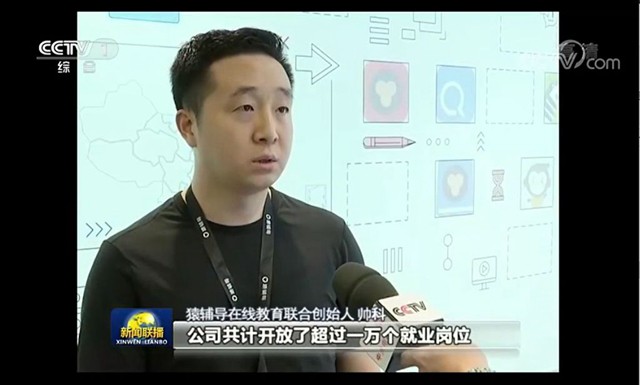
On February 3, 2020, scale became brutally literal. Schools were closed and Yuanfudao had prepared free live courses. The company expected a surge. It did not expect five million people to enter simultaneously on the first day, several times the normal concurrent class load. The servers ran out of capacity. Shuai later recounted the failure on television with a disarming matter-of-factness. Emergency expansion cost more than RMB 100 million.
The numbers around that moment were startling. YuanTiKu added roughly 25 million users in February. Students completed more than 700 million questions that month. Across eight years, the broader platform had recorded more than 400 million cumulative user visits. These figures describe reach, but the server crash tells the better story. A system designed for abundance had briefly run into the physical limits of machines.
There is comedy in the old promise that the internet makes everything weightless. Five million children can turn a cloud into a very expensive piece of weather.
Starting again, one student at a time
When Shuai announced ClassUp four years later, he was not abandoning scale. He was changing the unit. The company was registered in the United States as Algorithm of Learning and built from the start across Silicon Valley, Austin, Phoenix, Beijing and Manila. Co-founders Annie Chen and Jessica Zou, both Princeton alumnae, had created the business around live online classes for American students. Shuai became its chief executive as the operation separated from Yuanfudao.
ClassUp became Cosmo. Its model pairs K-12 students with a consistent American teacher for one-to-one math and English instruction, a personalized plan and a learning partner who keeps parents informed. An AI study companion continues the work between classes. This is less spectacular than five million people arriving at once. It is also harder to fake. One child and one teacher leave nowhere for averages to hide.
In 2026, the company added Gakku, an AI-native companion intended to help people think, write and express ideas more clearly in English. Algorithm of Learning announced a $16 million Series A+ round, taking its disclosed Series A and A+ funding to $51 million. Cosmo also announced school-level WASC accreditation and took its teacher-plus-AI pitch to SXSW EDU in Austin. By summer, reports said the business had achieved first-order profitability for several consecutive months while Gakku began wider promotion.
The easy story would be that AI is replacing the teacher. The actual design is more interesting. At Cosmo, the teacher remains the weekly anchor and the machine supplies continuity after the call ends. At Gakku, the conversation itself becomes the practice. The bet is not simply that a model can answer a question. Education has rarely suffered from a shortage of answers. The scarce things are attention, sequence, confidence and the judgment to know which difficulty should come next.
A question bank can find a weak spot. A teacher can see the person attached to it. AI may be most useful in the hours between.The design logic across Shuai Ke’s two acts
The rain is the point
Shuai’s public record is more product decisions than personal mythology. That suits him. He has been willing to describe the unglamorous facts: the marketplace that could not guarantee quality, the servers that failed, the capacity bill that followed. Even his romantic jungle image ends not with conquest but with weather on a shoulder. The attraction is contact with reality.
His career now forms a neat triptych. The first interface was the question bank, quietly adapting itself to the learner. The second was the live classroom, where content acquired a teacher and a service operation. The third is conversation with an artificial intelligence, available whenever the learner needs to test a sentence or clarify a thought. Each step narrows the distance between confusion and response.
The danger narrows too. Personalization can become a slogan, AI can become a cheap substitute, and global reach can flatten the differences it claims to serve. Shuai knows at least one version of that lesson already: connecting a student and teacher was not enough. The product had to own the quality of what happened next.
That may be why the second act feels less like a departure than a return. The schoolboy with the middling math score did not need a million-person classroom. He needed the right next problem, a useful explanation and a reason to try once more. After the valuations, the traffic spikes and the move across an ocean, Shuai Ke has come back to that student. This time he has brought a teacher, an algorithm and, apparently, a taste for rain.