A principal lives in the land of next. The assessment is finished; what happens next? A student missed the morning log-in; who calls next? A teacher sees a pattern in the data; what should change next Monday? Molly Dubiel Gortz spent years inside that grammar of urgency. Her current title, Account Director for National Charter & CMO at LinkIt!, sounds more corporate than principal. The work beneath it is familiar: helping school organizations turn a considerable quantity of information into a smaller number of useful moves.
Her route to education technology did not begin with technology. It moved through charter-school hallways in Brooklyn, then a campus in Cleveland, before widening into work with charter networks across the country. The geography matters. So does the sequence. Gortz did not arrive at school data as an abstraction. She arrived after being responsible for the adults who gather it, the children represented by it, and the families who quite reasonably want to know what it means.
She describes the commitment simply: “I have spent my entire career working in charter schools.” There are flashier opening lines. This one has the advantage of explaining the plot.
Principal of Success Bed Stuy 3 during the school's first operating year.
Principal leadership at Village Prep Willard, including the upheaval of remote schooling.
Account Director for charter schools and charter-management organizations at LinkIt!.
The school where the data had a deadline
In March 2017, Gortz took over as principal of Success Bed Stuy 3. The Brooklyn school was new, serving kindergarten and first grade. Its first-year enrollment was 95 students. A first year has no inherited folklore and very little slack. Routines have to be invented while everyone is already using them. Leadership arrives in public, with the wet paint still showing.
The school operated inside a network with a dense assessment rhythm: diagnostic checks, formative work, benchmark tests, weekly review quizzes, monthly mastery quizzes, and data meetings built into the calendar. Teachers tracked interventions for students who needed extra support. Leaders used results to decide what deserved coaching and where instruction should bend. The vocabulary can sound bloodless from outside a school. Inside one, each cell in a report has a name, a parent, a favorite book, and a seat that will be occupied again in the morning.
This is the first useful lens on Gortz's later career. She worked in an environment where data was not the end product. It was raw material for a meeting, a tutoring plan, a revised lesson, or a conversation with a family. Information had to travel all the way to action. Otherwise it was merely well-organized delay.
“I have spent my entire career working in charter schools.”Molly Dubiel Gortz
A school leader also learns the limits of a number. A score can reveal a gap without explaining it. A dashboard can make a pattern visible without supplying the judgment to respond. Good systems do not replace professional judgment. They give it a cleaner place to stand.
Cleveland and the unglamorous verb: log in
Gortz moved from New York charter schools to Village Prep Willard in Cleveland, where she served as a principal. In 2020, the school day escaped the building and reappeared on screens. The managerial problem was suddenly domestic, technical, and educational at once. Families carried more of the day's machinery. Teachers had to create presence through a connection that could vanish with a click.
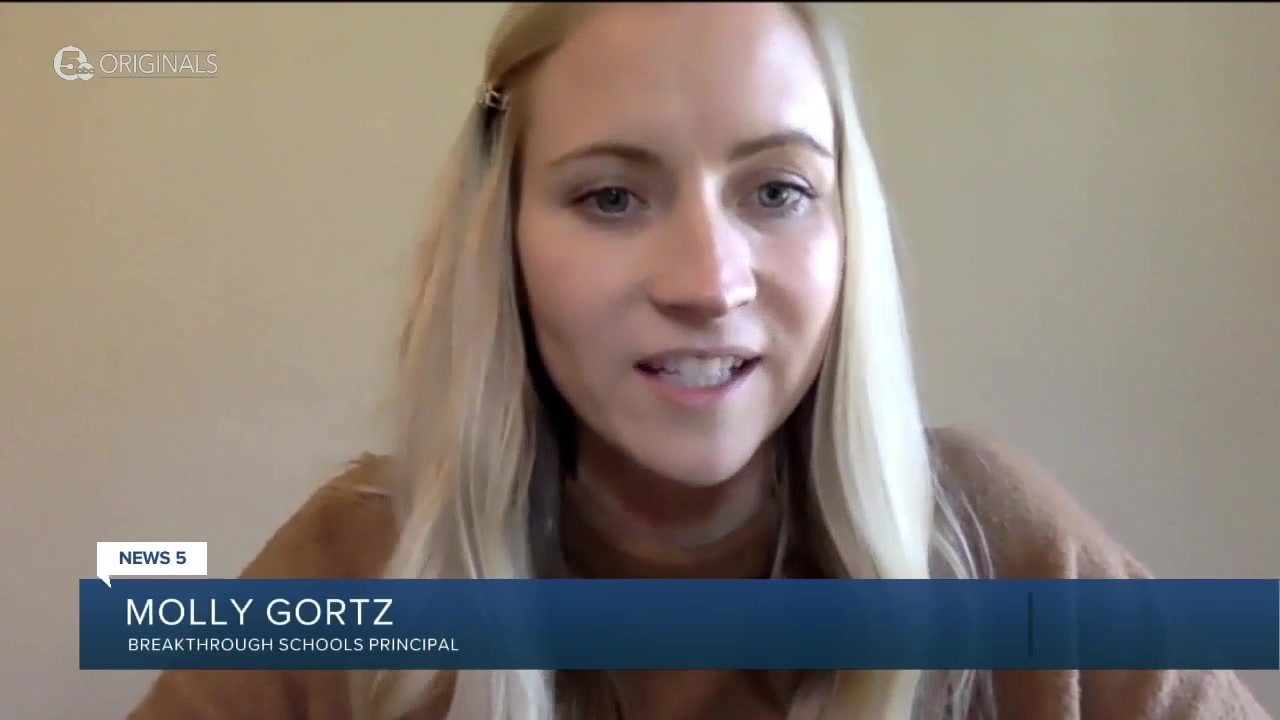
In a television interview that November, Gortz reduced the challenge to its least glamorous essential: “We value education so much like we're here to tell you, please, you got to get signed in and stay in all day.” It is a revealing principal's sentence. The ideal is enormous. The instruction is plain. Sign in. Stay. Make the day hold.
Village Prep Willard and its network created supervised spaces where students could participate in virtual classes when home was not workable. The solution carried a lesson that survives the particular moment: a system becomes real at the point where a family encounters it. A plan that assumes every household has spare time, spare devices, and spare quiet is less a plan than a wish wearing a lanyard.
Gortz's quote was about attendance, but it also captured an operator's instinct. Start with the behavior the system must make possible. Then work backward. The elegance of the presentation comes later, if there is time.
The useful-data loop
The loop is deliberately short. Schools cannot wait for perfect information before acting, and action without another look is only activity.
The principal becomes the translator
At LinkIt!, Gortz's constituency is no longer one building. Her remit covers national charter schools and charter-management organizations. LinkIt! supplies assessment management, reporting, analytics, data warehousing, intervention tools, and professional support to schools and networks. It is the plumbing and the picture: moving information into one place, then helping people see what it says.
The job of an account director in that setting is partly commercial, but “account” is an insufficiently human word. Charter networks vary in size, state rules, curriculum, staffing, and appetite for change. One organization may be drowning in spreadsheets. Another may have plenty of dashboards and no shared habit for reading them. A former principal can hear the operational question hiding inside the feature request.
National work also changes the unit of attention. A principal can walk down the hall and see whether a routine is holding. A network leader has to look across schools that may share a name while differing sharply in schedule, staffing, and local context. The temptation is to standardize whatever can be counted. The harder craft is deciding what must be common and where a campus needs room to respond. Gortz's background places her near that negotiation. She has occupied the building-level seat, where a network decision becomes a Tuesday timetable, and now works with the organizations designing the larger view.
cities of school leadership
Brooklyn and Cleveland gave Gortz experience in different charter-school systems before her work expanded nationally.
That translation runs both ways. School leaders need someone who can convert product capabilities into the sequence of a real week. Product teams need someone who can explain why an apparently small friction becomes large when repeated across every teacher, class, and assessment. The former principal carries a catalog of consequences. She knows that a late report is not simply late. It can miss the meeting where an intervention is decided.
LinkIt! says its customers' voices should be the loudest in the room. For Gortz, that listening has a professional backstory. Principals spend their days hearing multiple versions of reality: the network plan, the teacher's classroom, the family's morning, the student's performance. The job is not to choose the most polished account. It is to assemble a workable truth from all of them.
The title changed from principal to account director. The stubborn question did not: what happens next?
Building schools that can outlast heroics
Gortz recently returned to New York, where she had spent many years in charter schools, for a conversation with school leaders about “building schools that last.” She thanked educator Alicia Harper for leading it. The phrase is modestly radical. Education culture has often rewarded the leader who catches every falling plate. Durability asks a different question: can the plates remain on the shelf when that person leaves the room?
Her note after the gathering began, “Back in NYC,” three ordinary words carrying a full professional loop. The city was not merely a stop on an account director's calendar. It was where she had learned the tempo of charter-school leadership and where, in 2017, she stepped into a young Brooklyn school midyear. Returning with a national role made the meeting both reunion and fieldwork. The people around the table were potential clients, certainly, but also peers in a profession she still claims as her own.
The answer lives in systems, but systems are not the same as software. They are agreements about what people notice, when they talk, who decides, and what happens afterward. Technology can make those agreements easier to keep. It cannot make them on a school's behalf. The distinction is not hostile to edtech. It is what allows the technology to be useful.
In March 2026, Gortz was at the Colorado League of Charter Schools conference, talking with K-12 leaders and other education-technology teams. One fellow exhibitor cheerfully called her a new “booth bestie.” It is a small detail, but account work is made of small details: conversations between sessions, specific problems offered without ceremony, the trust required for a leader to admit that the current process is a mess.
There is no tidy conversion in Gortz's story from educator into technologist. The more accurate reading is continuity. Brooklyn supplied the tempo of assessment and coaching. Cleveland supplied the blunt test of whether a system could reach families through disruption. The national role supplies scale. Each chapter asks how information moves between people, and whether it arrives in time to matter.
Education technology tends to advertise nouns: platform, dashboard, warehouse, assessment. Schools run on verbs: notice, call, teach, adjust, return. Gortz's value sits in the grammar between them. She knows the platform has done its job only when somebody can do theirs.