Charlie Kratsch has a complaint about school that deserves a hearing, partly because he was its valedictorian. “Horrible. Boring. I was not a good student.” It is an awkward review from someone who apparently finished at the top. Schools might reasonably ask what more he wanted. Kratsch has spent much of his working life trying to answer.
He founded Infinite Campus in 1993. Today, the company supplies the student information system behind the school-day business of attendance, grades, schedules and family access. Its current figures put the system in more than 3,400 districts. That gives his old complaint an unusual afterlife: a dissatisfied student became a supplier of the machinery that helps schools run.
The useful tension in his story sits between those two jobs. Keeping a school organized requires consistency. Teaching its students requires attention to differences. Kratsch has built a business in the first territory while repeatedly looking toward the second. Three decades provide ample time for a youthful objection to become either a forgotten opinion or a company’s continuing assignment.
The valedictorian’s complaint
His apprenticeship began while he was still in high school, working at the Minnesota Educational Computing Consortium in the early 1980s. MECC was the organization behind Oregon Trail and Number Munchers. Educational computing was something he could help make before he had finished being educated.
He went directly into business after high school, bypassing college. His early career included technology startups in advertising and telecommunications. By 1993, he had sold his previous company and briefly become a stay-at-home father. Retirement did not hold his attention for long. The next venture would bring him back to education, and back to the district from which he had graduated.
There is a pleasing complication here. Someone impatient with school returned voluntarily and accepted a job inside it. The distance between having an opinion about an institution and taking responsibility for some of its work can be considerable. Kratsch crossed it by becoming Centennial School District’s technology director while he worked out what his new company should do.
A principal’s question, a district’s answer
His stepfather, an elementary school principal, helped prompt the return. The challenge was what to do with the opportunity that business success had created. Making money was already familiar territory. Making a difference offered a reason to start again.
“I wanted to use technology to make schools better,” Kratsch said in 2012. At Centennial, the work supplied a practical definition of better. Schools held quantities of information about enrollment, assessment, courses, attendance and grades. People needed access to it to make decisions. Bringing those records together could help administrators do their jobs and help teachers, students and parents collaborate.
The first idea had been educational content delivered over the web. Daily contact with administration redirected him. The office had its own demands, less likely to look glamorous in a demonstration but difficult to ignore when they were your responsibility. A product intended for schools began to take shape around the people running them.
That choice also explains the scale of the ambition. A shared record can improve an administrative task. Connecting information across a district opens questions about how the district works. Kratsch’s interest in personalized learning grew alongside the more immediate task of getting the information organized. The software had to be useful before it could support a broader argument about education.
A dissatisfied student became a supplier of the machinery that helps schools run.
The overnight success took years
Infinite Campus had a web-based product before districts were particularly eager to buy one. In the early years, explaining the architecture and finding a market were separate pieces of work. A browser was a promising way into a district’s information, provided the district wanted to go there.
The market changed after Y2K. Districts began to see the value in web access and a single system managing data across the district. In 2002, Infinite Campus moved out of Centennial into an office suite in Arden Hills with 15 employees. Developers, support analysts, trainers and administrators joined as the business expanded into districts of different sizes around the country.
Success acquired the customary misleading adjective: overnight. Kratsch’s account of the period remembers the lean years rather more clearly. The joke is familiar to anyone who has watched a long effort become visible all at once. A market’s moment of recognition does not tell you how long the people inside the company have been waiting.
- 1993Company founded
- 200215 employees move to Arden Hills
- 2008Blaine headquarters opens
- 2017Nine-story tower opens
By 2012, the company had 300 employees and served five million students in 43 states. That June, Kratsch received the EY Entrepreneur of the Year award for the Upper Midwest’s education category. The idea developed inside a Minnesota district had become a business with a national footprint. Its founder was still pursuing ways to make education more responsive to individual students.
Please report to the Mothership
Growth created an architectural assignment, which Kratsch approached with visible enthusiasm. Infinite Campus’s Blaine headquarters is called the Mothership. Its inspiration is the Starship Enterprise. The name does a fair amount of work before a visitor reaches reception.
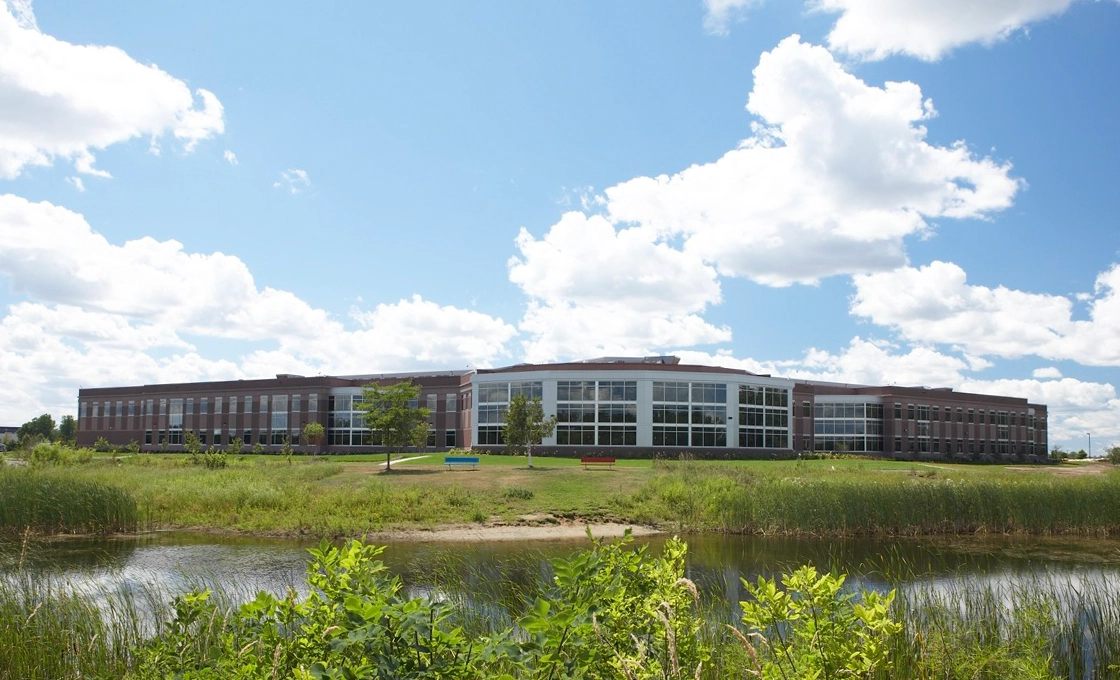
In a 2016 essay about the company’s expansion, Kratsch made the connection explicit: “I am a huge Star Trek fan.” The new nine-story tower drew inspiration from NASA’s Vehicle Assembly Building in Florida, serving as a space dock for the company’s Enterprise. A growing software staff required more room; science fiction supplied the vocabulary.
His argument went beyond the appearance of the buildings. He wanted employees together in one facility, with collaboration, creativity and efficiency shaping the design. He compared constructing a building with implementing enterprise software: plans matter, but so do the people who convert data, manage projects, teach users and keep the finished thing working.
He also spent time on maintenance. Leaks and burned-out bulbs have their equivalents in software. Updates, changing reporting requirements and support deserve attention after the opening ceremony. It is an unexpectedly domestic passage in an essay featuring a space dock. Even the Enterprise needs someone to deal with the lights.
The founder’s job keeps changing
When Kratsch spoke with Allison Kaplan on By All Means in November 2022, he offered advice rooted in his own route into education: get a job in the world you want to enter and learn it first. Interest matters, too, because starting a business will involve aggravation and lost money. His description leaves the motivational poster with some explaining to do.
He described entrepreneurs as generalists who need people with specialized skills around them. The founder forms a vision; other people bring expertise to its different parts. That is a useful way to read the growing list of occupations that followed Infinite Campus out of Centennial. A company serving schools needs more than a person with an idea about schools.
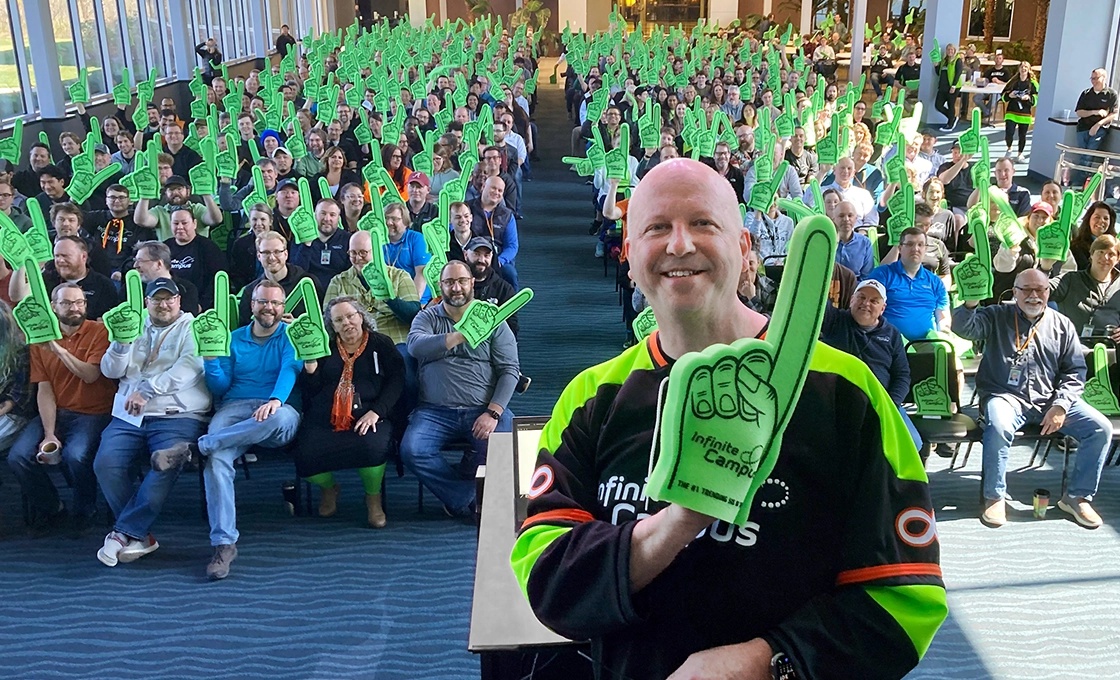
Ownership is part of that picture. Infinite Campus describes its employees as company owners and emphasizes that it has no outside investors. It also says it has never acquired another company. Kratsch’s early career included building businesses and selling them; this one has become a much longer commitment. For school staff who learn a system and rely on it year after year, continuity has practical value.
Scale brings other obligations. In December 2025, Kratsch appeared before North Dakota’s legislative Information Technology Committee during its transition to Infinite Campus. He identified engaging smaller districts as a major statewide implementation challenge. Their numbers made them central to the work. A statewide contract still has to become something each district can use.
In March 2026, he joined K12 Tech Talk to discuss a confirmed incident involving the company’s Salesforce instance. He described attackers obtaining access through a voice phishing campaign and an imitation login domain. The discussion distinguished information in the support and customer-directory system from the Infinite Campus student databases.
He outlined the response, including shutting down access, auditing exports and bringing in outside investigators and the FBI. That conversation belongs in the story of the business alongside the openings and awards. Keeping an institution’s trust involves explaining a failure in the systems around the product, as well as explaining the product itself.
The next assignment
Kratsch’s current product direction includes an admission of limits: districts need specialized tools faster than one vendor can build everything. His answer is an Extension Marketplace containing vetted products from Infinite Campus and partners, while the company concentrates on its core student information platform and the intelligence built above it.
He says the resources freed by that approach will support Agile Flow, the collaborative intelligence system behind the company’s Agile Learning vision. The intended classroom includes competency-based education, small-group instruction and project-based learning. Those are ambitions that will have to prove themselves in the ordinary work of schools.
The valedictorian’s complaint has traveled a considerable distance. There is now a company, a workforce, a Mothership and a national network of customers attached to it. Yet the question remains recognizable: how can school work better for the individual student? Kratsch went back to his old district to find useful work. He found enough to keep him busy.
Continue the conversation
- Infinite Campus - founder’s account
- By All Means - 2022 interview
- K12 Tech Talk - 2026 interview
- K12 Tech Talk - Tyler partnership interview
- Charlie’s current product letter
- North Dakota - December 2025 meeting
- The 2016 essay on buildings and software
- The 2012 entrepreneur profile
Photographs: Infinite Campus. Profile dated 23 October 2026.