A neck can be one size and a chest another. This is an ordinary fact about human beings and an awkward fact for a rack of standardized shirts. Mortimer Levitt encountered it personally: the shirts he bought could pinch his chest or leave his neck swimming. The business he opened in Manhattan in 1937 began with that small disagreement between a body and a size chart.
- The proposition: shirts cut to individual measurements, with extensive styling choices.
- The convenience: saved measurements, online ordering and access to personal clothiers.
- The commitment: premium prices, a quoted six-to-eight-week wait and non-refundable custom orders.
The Custom Shop Clothiers still works on that problem. Its catalog includes dress shirts, suits, slacks, blazers, sport coats and accessories. But the most interesting thing it sells is continuity: the possibility that the next shirt can begin where the last successful fitting ended.
The bargain was in the fit
Levitt’s opening offer was a custom shirt for $2.15, according to the foundation that bears his name. He had experienced the difference that custom clothing made and saw an opening among men whom standard sizes served badly. The insight was practical. A garment could be personal without requiring its owner to belong to a tiny social club.
He also had a wonderfully inconvenient sense of theater. The company’s account of its early shops describes red-and-white awnings and imitation torch lamps glowing yellow. A shirtmaker needed to be seen before it could make anyone else presentable. The awning survives in the brand’s logo.
Levitt sold the business in 1997 and put the proceeds into the Levitt Foundation. His attachment to formal clothes was less easily sold. He tried to persuade corporate leaders to resist Casual Friday. The campaign failed. Even a man who could specify a collar could not specify the American workweek.
“We don't believe we should curate your options but expand them.”
The Custom Shop, describing its fabric selection
The name outlived the stores
The corporate history has a sharp break. A Houston operator paid $15 million for the chain out of Chapter 11, then pursued internet tailoring alongside 52 stores. Sales disappointed. In March 2001, the combined TheCustomShop.com business closed its stores and online operation and entered Chapter 7.
On July 10, 2001, Michael Smith Custom Clothiers bought the principal assets from the bankruptcy trustee. A subsequent domain-name arbitration records the purchase: names, trademarks, logos and website-related technology were among the assets transferred.
That distinction matters. A company can fail while the customer’s problem remains perfectly intact. A short sleeve is still short after the retailer’s balance sheet has been settled. The later business could carry forward a recognizable name and its intellectual property without being the same corporate entity that had collapsed.
A quarter-inch becomes a choice
Open the current shirt configurator and the word “custom” acquires some useful specificity. A buyer can adjust collar height, point length, tie space and stiffness. Cuffs have their own decisions. The measurement form even asks whether a heavy watch lives on the left wrist or the right. The wristwatch, apparently, gets a vote.
There are choices with prices attached. On the pink Royal Oxford cotton/poly shirt checked for this profile, the base price was $195. A tuxedo front added $45; a second pocket added $8; edge stitching added $3. Other catalog examples included $205 pinpoint shirts and $220 two-ply broadcloth shirts. These are examples, rather than a universal quote.
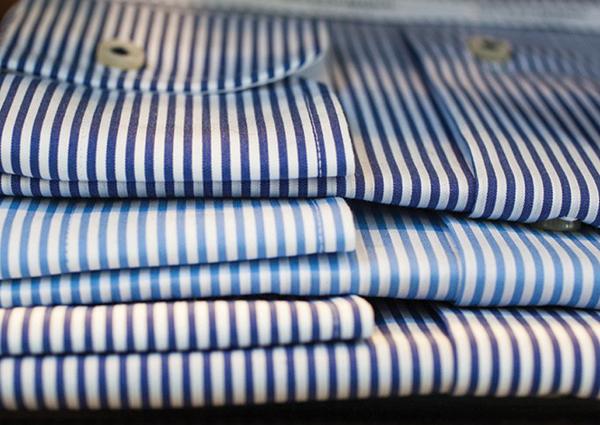
Against a ready-made shirt, the appeal is control over proportions and details. Against another custom seller, the distinction needs more care. Proper Cloth also sells custom shirts and suits and offers appointments. The Custom Shop’s particular pitch combines a long-established brand, detailed configuration and several routes to a human clothier. The value depends on whether those choices and conversations solve the buyer’s particular fitting problem.
The next order starts with a memory
The measuring guide reveals where the expertise sits. It asks about neck, chest, shoulders, sleeves, waist, hips and shirt length, then adds posture and shoulder slope. Measurements inform the individual paper pattern described by the company. Circumference alone does not tell the entire story of how cloth should hang.
The customer can supply body measurements, measure an existing shirt or send a favorite garment for the company to work from. Service centers and stylists offer another route. This is especially appealing when a person knows exactly which shirt feels right but cannot translate that feeling into a row of numbers.
Online orders sit alongside trunk shows, appointments, telephone guidance and visits to the corporate office. Representatives can meet customers at work or another agreed location. The shop counter becomes portable, while the saved measurement record gives repeat purchases a starting point. The careers page describes commission-based representatives calling on customers at offices and homes. That makes the relationship part of the distribution system: someone can help interpret an unfamiliar fabric or a preferred fit before an order reaches the checkout. For a buyer who dislikes guessing, the conversation has a practical purpose.
Patience is part of the purchase
There are conditions. The FAQ generally quotes six to eight weeks for shirts and does not guarantee delivery timing. Personalized clothing is non-refundable. Fit and style problems may be corrected; issues must be raised within 120 days of placing the order. For a wedding next Saturday, this is an awkward shopping strategy.
Fabric deserves attention, too. Screen colors can mislead, and a familiar cloth may disappear from the range. The company warns that later garments can differ subtly. A saved profile reduces repetition; it does not freeze the supply of fabric or the customer’s body.
The transferable lesson is modest and useful: invest effort in learning the customer once, then preserve what you learn. For someone who repeatedly buys tailored work clothes, that can make the next purchase easier. It works less well for a shopper who needs immediate delivery, wants effortless returns or would rather make fewer decisions. A shirt can remember you. First, you have to tell it enough.