The Browser Company’s most revealing product review came from a man who helped invent the iPhone. Scott Forstall tried Arc, the startup’s meticulous reworking of the web browser, and compared it to a saxophone: powerful, expressive, and difficult to learn. Then came the assignment. Make a piano - something a stranger could sit down at and play.
That sentence contains the company’s six-year story. Arc made the boring parts of browsing feel considered. Tabs lived in a vertical sidebar. Spaces separated work from home. Split views, profiles, pinned pages, themes, and a command bar treated the browser less like a window and more like an operating system. Designers, developers, students, and the sort of laptop owners who know their keyboard shortcuts became devoted. The company says Arc eventually welcomed more than one million weekly users across Mac, iOS, Windows, and Android.
But devotion can disguise a ceiling. New users had to unlearn the browser habits they already possessed. Windows arrived after Mac and lacked parity. The architecture accumulated weight. Arc was impressive in a demo and demanding on a Tuesday. The Browser Company had built an instrument for enthusiasts when it needed an appliance for everybody else.
The first thing that failed was not the design
Arc’s first failure was repeatable mainstream adoption. The company’s own account is unusually plain: early retention was weak, the interface asked too much, and the browser became bloated because the team “built too much, too quickly.” A gorgeous product had created enthusiastic testimony without creating an equally broad habit.
That distinction matters. Founders are trained to collect love. Arc collected it in bulk. Yet public praise, waitlists, and social clips do not measure how many ordinary users return after the novelty wears off. The company kept prototyping an “Arc 2.0,” but users wanted to preserve the very sidebar, spaces, and pinned tabs that made a radical simplification difficult. The installed fan base had become both asset and constraint.
“Make it a piano.”Scott Forstall’s challenge, as recalled by Josh Miller
Then AI changed management’s sense of the possible. ChatGPT and Perplexity showed that old software categories could be rearranged around a conversational interface. The browser already held the richest working context on a laptop: the pages being read, the tools being used, the documents under comparison, the half-finished task in the next tab. Josh Miller and co-founder Hursh Agrawal concluded that bolting chat onto Arc would preserve too much complexity and too much technical debt. They started over.
Dia reads between the tabs
Dia, released to Arc members in beta in June 2025, looks more conventional on purpose. Its radical idea sits behind familiar furniture. Press Command-E and the browser can answer a question about the current page, several tabs, recent history, a file, or connected tools. Memory can retain useful patterns locally. Slack, Gmail, Notion, Outlook, GitHub, Google Calendar, and Figma can contribute context. Recent releases added tab groups, profiles, split view, encrypted sync, meeting preparation, a Morning Brief, and Reports that turn scattered work into a shareable document or deck.
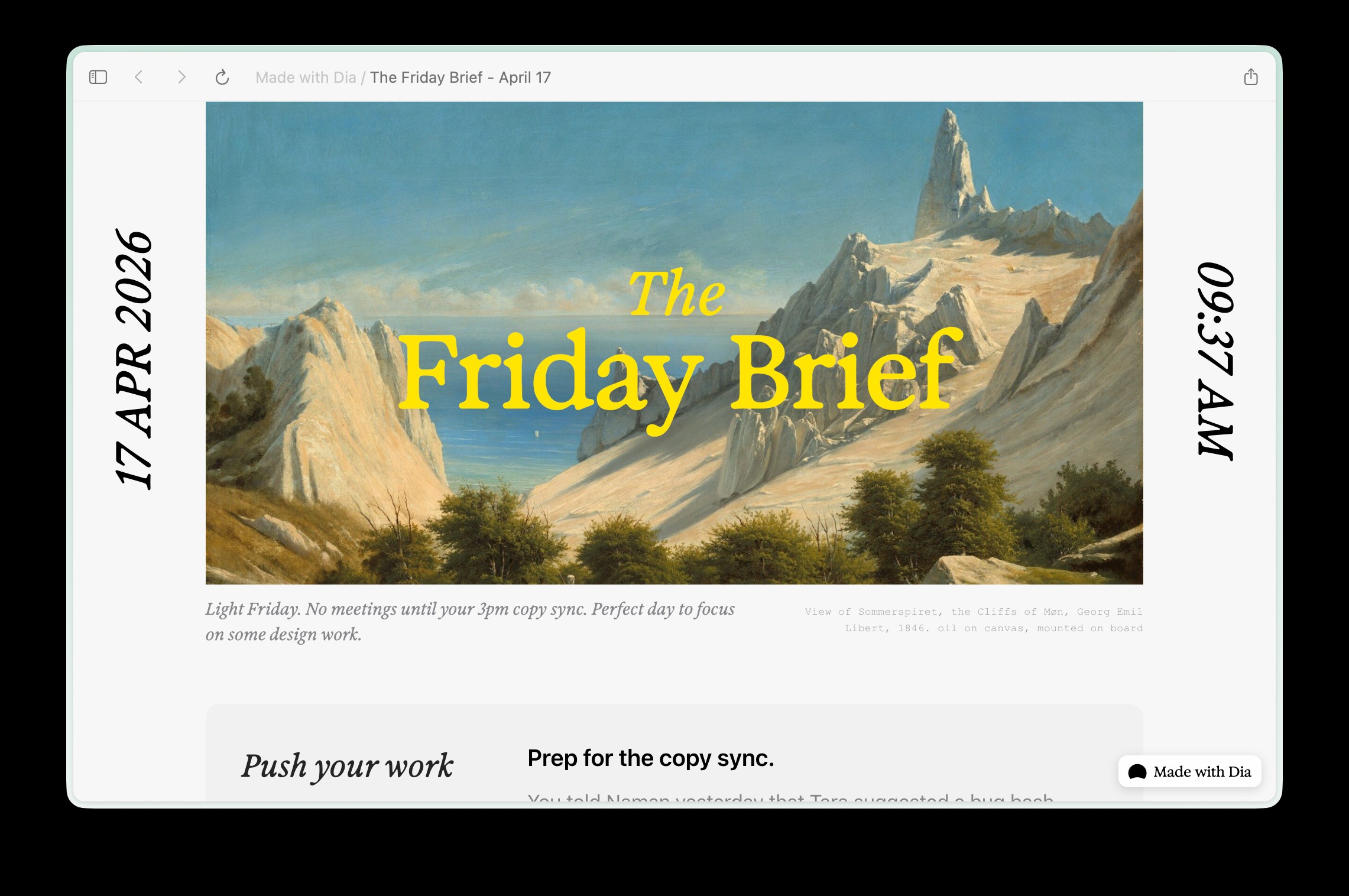
The customer is no longer merely “someone who wants a nicer browser.” Dia is aimed at the knowledge worker whose job has dissolved into SaaS tabs: the manager reconstructing a decision from Slack, the designer gathering a Figma review and meeting notes, the developer crossing GitHub and a project spec, the freelancer keeping three identities from colliding. The problem is not access to information. It is the unpaid clerical work of gathering context before useful work can begin.
This is also the competitive distinction. Chrome, Safari, Edge, Firefox, and Brave mainly compete on speed, compatibility, privacy, and ecosystem. AI browsers such as Perplexity’s Comet and OpenAI’s ChatGPT Atlas compete on answers and agents. Enterprise browsers such as Island compete on control. Dia is trying to occupy the seam: consumer-grade feel, work-tool context, and enterprise guardrails. That is an attractive position, but one with three well-funded groups approaching from three directions.
What it cost - and what it now costs
The experiment was financed like a platform bet. The Browser Company raised just over $5 million in 2020 from a group that included Ev Williams, Jeff Weiner, Dylan Field, Jason Warner, and Slack Fund. By March 2024 it had raised a reported $128 million in total. That month’s $50 million Series B, led by Pace Capital, valued the company at $550 million. Arc was free, and the company had not explained a durable business model. Venture capital paid for the learning curve.
Small checks built a very expensive browser decision
The bars compare disclosed dollar figures, not equivalent accounting measures. Atlassian later reported a $488.3 million purchase price in its fiscal 2026 filing.
On October 20, 2025, Atlassian acquired the company. The deal had been announced at approximately $610 million, including The Browser Company’s cash balance and subject to adjustments. Atlassian later recorded a $488.3 million purchase price for accounting purposes. It was not simply buying Arc’s interface. It bought a browser team, an internal development kit, a base of millions across Arc and Dia, and the chance to place AI inside the workflows of more than 300,000 Atlassian customers.
Dia now has the business model Arc lacked. Better Browser is free, with profiles, tab groups, splits, picture-in-picture, ad blocking, and sync but no AI. Better Answers costs $20 a month for contextual chat. Better Days costs $100 a month for six times more usage, Morning Brief, reports, decks, recaps, and meeting help. Extra capacity comes in $20 blocks. Most new Mac users receive a 14-day Better Days trial; paid plans began rolling out to them on August 17, 2026. Dia for Work adds SSO, management, and organization-level controls.
The trust product hiding inside the productivity product
An AI browser grows more useful as it sees more. That is exactly why the security question cannot be postponed. Dia says conversations, history, bookmarks, and files are encrypted and stored locally by default. Sync is end-to-end encrypted. When an AI request needs context, relevant data passes through The Browser Company’s servers to providers including Anthropic, OpenAI, Google, Azure, and AWS, which the company says are contractually barred from retaining it or training on it. Content sharing can be disabled by users and across an organization.
The limits are equally important. Prompt injection remains a risk for every AI browser. Dia makes a best-effort attempt to exclude sensitive sites from passive features, not a guarantee. It is not HIPAA-compliant and should not be used by clinicians for protected health information. The company completed a SOC 2 Type II examination covering security, confidentiality, and privacy for 2025, but a report is evidence of controls, not permission to stop thinking.
When the Dia bet does not work
Skip it when regulated data cannot leave the page, when your company forbids third-party model processing, when you need mature cross-platform parity, or when an answer without traceable verification could create real damage. Context is the feature and the liability.
What another company can steal
The copyable part is not “build a browser.” Browser infrastructure is punishing, distribution is entrenched, and default habits are hard to change. The transferable lesson is how The Browser Company turned a painful diagnosis into product rules.
If the capability is unfamiliar, keep the surrounding interface recognizable. Every new gesture spends user patience.
Small cross-functional pods shipped working ideas weekly. Real behavior answered questions that presentation decks could not.
Admiration is a signal, not retention. Watch what ordinary users repeat after the first delighted session.
The Arc letter named complexity, bloat, and weak retention. Candor did not erase anger, but it made the decision legible.
This playbook needs conditions many teams do not have. The Browser Company had patient investors, founders with a prior exit, a talent-dense team, years of accumulated browser infrastructure, and enough cultural permission to discard a celebrated roadmap. A company with six months of cash should not interpret “start clean” as wisdom. A team without technical leverage should not confuse reinvention with differentiation. And a product whose users cannot tolerate disruption may need migration, not rupture.
The company’s own culture made the pivot more likely. Its values are written as “Notes on Roadtrips,” a playful document about heartfelt intensity, asking what could be, assuming you do not know, being on the hook for the team, and making people feel something. Teams form small pods, prototypes outrank turf, and Thursday shipping became ritual. Roughly 60 percent of employees work outside New York across six time zones, with a small daily overlap. It is a culture engineered for turning. The cost is that users strapped into the previous vehicle feel every swerve.
A browser company, after all
Arc did not replace Chrome. It still moved the category. Vertical tabs, spaces, split views, automatic organization, and browser-level AI now feel less like eccentricities. Arc remains downloadable and receives Chromium updates, though its core experience is no longer actively developed. It is both finished product and public prototype - the beautifully upholstered first draft of Dia’s more conventional machine.
The Browser Company fits between consumer software, enterprise SaaS, and AI infrastructure. Its expertise is interaction design plus browser engineering: making Chromium feel personal, then wiring the browser’s context into models and work systems. Atlassian supplies what the startup lacked - enterprise reach, security machinery, and monetization muscle. The Browser Company supplies what Atlassian could not buy from a normal SaaS vendor - a credible claim on the window containing everybody else’s software.
The $610 million question is whether people want that window to think. Dia must prove that its briefs, reports, and cross-tool answers save more attention than they consume; that its privacy controls earn access to meaningful work; and that $20 or $100 a month feels cheaper than the daily scavenger hunt across tabs. Arc taught the team how to make a browser memorable. Dia has to make one necessary.