The first version worked. That was the awkward part. Tetrix had built an AI-assisted diligence tool that summarized investment documents, allowing people to read the essentials faster. Yet the productivity gain soon flattened. A quicker account of a fund manager’s pitch could not tell an investor how that pitch compared with three funds ago, or where the proposed investments overlapped with holdings already in the portfolio.
- Tetrix collects fund documents, turns them into structured data, and connects them to investment analysis.
- Its buyers are institutional allocators and family offices, rather than individual stock pickers.
- The company’s revealing lesson: faster summaries need a better-connected workflow to improve diligence.
In a May 2026 essay, co-founder and CTO Naunidh Singh Bhalla described what changed. Tetrix rebuilt diligence around comparison matrices, inconsistencies and investor-defined criteria. That meant reconstructing data links, identifying the same entities across records, and changing the analytics interface. The useful gain arrived when those pieces worked together. The PDF had looked like the obstacle. The missing context proved more troublesome.
The summarizer’s ceiling
This is an unusually instructive admission from a company selling AI. The early feature delivered its narrow promise. It made the available slice easier to digest. Investors, however, needed a wider slice: earlier promises, comparable managers, underlying companies and existing exposures. Reading speed could improve while the important question remained unanswered.
“A summarizer didn’t change that”
Naunidh Singh Bhalla, on the missing context in diligence
Tetrix’s response suggests a practical test for any business considering AI. Choose a decision, then map every input needed to make it responsibly. Measure the time to a checked answer. If the tool accelerates one step while leaving the other inputs scattered, its apparent efficiency may evaporate before anybody acts.
Two graduates, hundreds of conversations
Babin and Bhalla met at Stanford Graduate School of Business. Babin had worked at Goldman Sachs and SoftBank’s Vision Fund; Bhalla had been a software engineer and technology lead at JPMorgan. Their experience put investing and engineering at the same table. It did not hand them a finished business idea.
Innovation Endeavors, which incubated the company, describes a structured search after graduation. The founders investigated dozens of ideas in financial services and supply chain, conducting hundreds of interviews. They settled on investment-data collection and analysis because the pain, willingness to pay and technical opportunity lined up. Among the problems the investor heard: teams waiting more than a month for processing, and financial statements assembled using older reporting periods.

There is a charming footnote: their Stanford classmates voted them most likely to build a unicorn. Classmates are rarely investment committees. The more useful endorsement was the tedious research that followed the applause.
The distance between a report and a decision
Tetrix serves the people who allocate money to private funds: foundations, pensions, endowments, family offices and other institutional investors. Their capital may sit behind several managers, each reporting differently. A balanced list of fund names can conceal repeated investments in the same companies. Counting the envelopes does not reveal what is inside them.
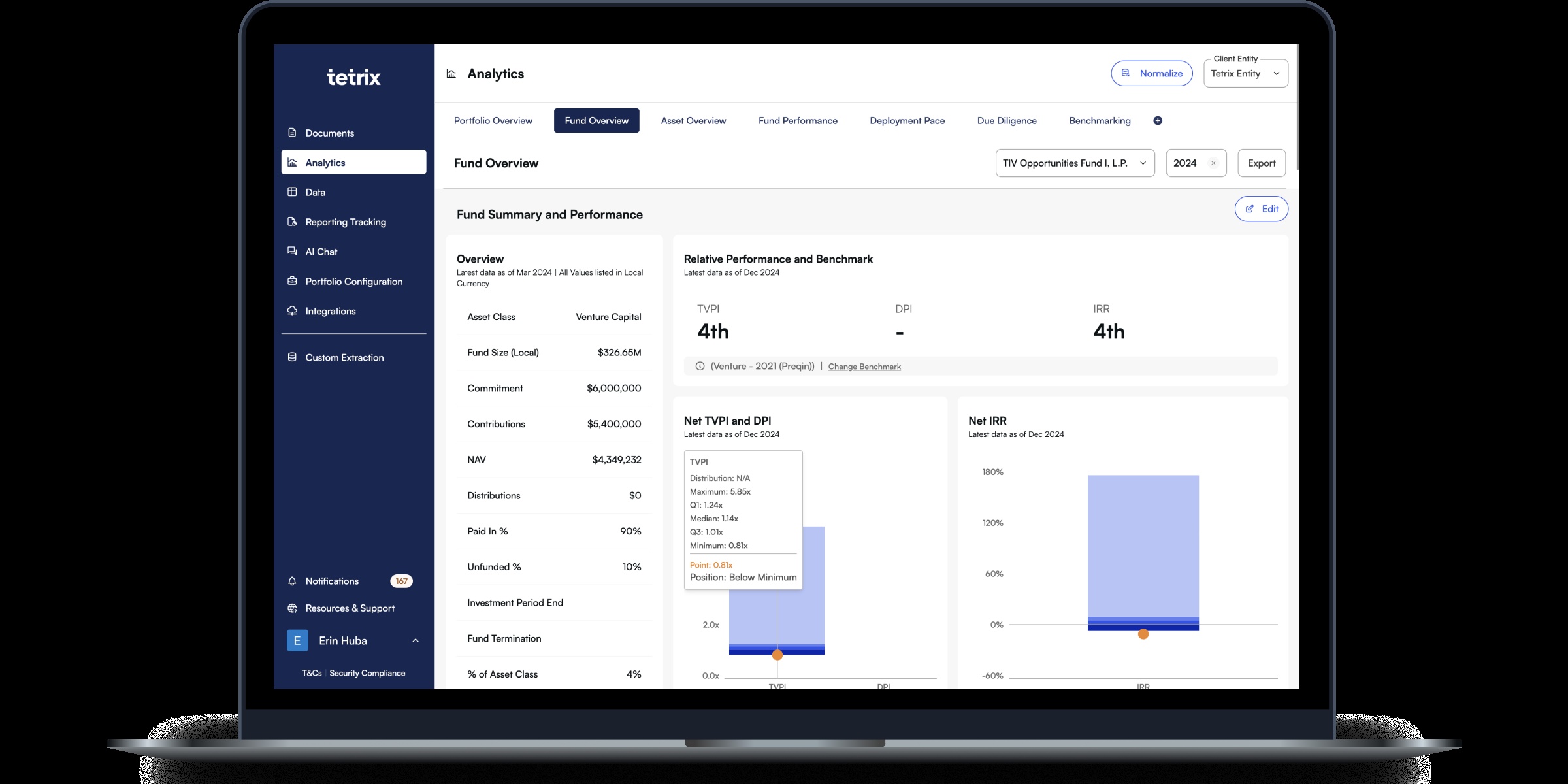
The platform follows that information through three stages. Agents retrieve documents from connected portals and inboxes. Extraction turns PDFs and spreadsheets into normalized records. Analytics lets investment teams examine exposures, compare funds and investigate opportunities. Its AI chat supplies source-linked answers; custom extractions can follow a buyer’s internal taxonomy.
That places Tetrix between document processing and portfolio decision support. Its own product writing distinguishes investment intelligence from fund operations software: accounting and recordkeeping remain necessary, but they answer different questions. A general financial assistant can help with a draft or an ad hoc query. A persistent portfolio dataset must also survive successive quarters, permissions and corrections.
A number needs a return address
The distinguishing claim is the connection between automation and verification. Tetrix describes source traceability, financial checks and human review. Those details matter because a confidently written answer can still contain an incorrect number. An investor needs to inspect where the value came from and understand how it was handled.
On Talk Python To Me, Bhalla and founding engineer Grant Gittes explained the engineering underneath. The backend uses Python, including FastAPI and Pydantic, with pandas and NumPy for analysis. Bhalla described investment in evaluation datasets, financial validation rules and feedback from human corrections. Gittes, a former investment banker, brought firsthand experience of the transcription work being automated.
Named customer testimonials give the proposition some texture. Solamere Capital describes easier manager analysis. Next Legacy Capital discusses analytics across funds and underlying companies. W3 Family Office points to cash-flow planning, while Point Olema Capital Partners highlights cited AI chat. These are customer accounts published by Tetrix, useful descriptions of applications rather than a controlled performance study.
The money, and the two clocks
The company announced a $5 million seed round in September 2024, led by Innovation Endeavors. A $15 million Series A followed on June 23, 2026, co-led by White Star Capital and Innovation Endeavors. The announced funding totals $20 million, intended to support product development, hiring and international expansion.
Its commercial ladder is explicit: Core handles collection and high-level extraction; Edge adds deeper portfolio oversight; Alpha combines diligence with portfolio data. Buyers request pricing. The business is enterprise SaaS, with a sales conversation between interest and purchase.
Tetrix advertises a reduction in time to insight from 45 days to one day. Treat that as the company’s reported result, rather than a timetable for every installation. A buyer’s useful trial would involve its own reports, its own reconciliation checks and one concrete investment question.
There are still two clocks. Tetrix can shorten the time between receiving a document and using it. The manager controls when the underlying information is reported. Faster processing cannot make an old valuation current, and a connected platform needs documents and review to work well. That distinction is the sensible place to judge the product: fewer hours reconstructing the evidence, more opportunity to question it.