Imagine a semiconductor chip with impeccable paperwork. It has been tested. Its measurements fall inside the permitted limits. It is ready to leave the factory. Then an engineer looks at the other chips on the wafer and notices something awkward: this one behaves differently. Its certificate of good conduct has acquired a footnote.
That little gap between passing a test and looking convincingly ordinary is where Test Acuity Solutions built its software proposition. The Scottsdale company, previously known as Test Advantage Software, works on manufacturing quality and test efficiency. Its subject is the individual semiconductor device; its raw material is the evidence accumulated while that device is made and tested.
- The job: identify marginal devices using manufacturing and test data.
- The product: Streetwise, a statistical analysis platform.
- The connection: a historical Kinesys partnership links analysis with individual chip tracking.
- The lesson: a useful screening rule must earn its place in production.
A factory with a memory problem
Semiconductor testing produces an abundance of measurements. Abundance, however, is a poor substitute for an explanation. A result can tell an engineer that a device lies within specification without saying whether its behaviour fits the surrounding population. Test Acuity’s local outlier-detection patent describes comparing a component’s data with a selected local group. The comparison supplies context that a broad limit alone can miss.
Consider an illustrative wafer, with chips arranged across its surface. A gradual change from centre to edge may be part of a manufacturing pattern. A lone departure from its neighbours poses a different question. Geography gives the engineer another way to interpret the same electrical measurement. The outlier is a candidate for attention, not a diagnosis delivered by colour coding.
The company’s hybrid outlier-detection patent adds another wrinkle: different analytical approaches can be combined. In its account of the testing problem, one component may produce thousands of results. Finding a suspicious device in that material requires a method for organising comparisons. A person cannot usefully stare harder at a growing pile of numbers forever.
Streetwise earns its name
Streetwise is the central product in that proposition. The historical product description sets out a statistical post-processing platform spanning single-variable, multivariate, regression and spatial analysis. Multiple data flows can be considered together. The name sounds like an urban survival manual; the neighbourhood happens to be a wafer.
There is a practical distinction here. A test machine measures a device. Analytical software examines the measurements and helps determine what should happen next. Test Acuity operates in that layer of the semiconductor market, where production engineering, quality control and data analysis meet. Its software is meant to influence device grading and disposition, equipment use and manufacturing decisions.
The documented users belong to the industrial side of computing: device manufacturers, fabless businesses and outsourced assembly and test operations. Engineers need workable screening methods. Quality teams need consistent decisions. Production teams need a flow that can move. These interests can collide whenever an additional precaution consumes time or removes otherwise saleable devices.
Twenty-four lots, and a clock
In December 2009, Freescale’s Toulouse operation and Kinesys Test Advantage announced a Streetwise deployment for automotive semiconductor quality. It connected wafer-sort electrical tests, outgoing inspection and in-process wafer-fabrication measurements. The neglected evidence was already being collected; the project gave it another job.
The partners said comparable comprehensive analysis could previously take up to two weeks. Their approach used smoothing algorithms to translate sampled fabrication measurements into die-level information without adding fabrication controls. This was a particular deployment, reported by its participants in 2009, rather than a universal speed promise.
The useful change was conceptual as well as computational: process data could participate in decisions about individual devices. For another manufacturer, the copyable idea is to inspect where existing measurements stop travelling. Useful evidence may be separated by a database boundary long before it is exhausted as evidence.
The chip needs its own passport
Analysis becomes more useful when the factory can preserve the identity of the device being analysed. The December 2009 Kinesys partnership announcement paired Test Advantage’s performance-variability technology with Kinesys’ single-device traceability. It addressed integrated device manufacturers, assembly and test contractors, and fabless companies.
“look beyond the test cell”Fabrice Dechoux · partnership announcement, 2009
The stated ambition was an integrated production solution, with open data standards and feed-forward adaptive testing. In plain language, an earlier observation could help guide a later manufacturing or testing step. Keeping the observation attached to the right device is the essential administrative trick.
There is an unglamorous dependency beneath that promise. If a device’s identity and records cannot be joined reliably across operations, the downstream decision lacks its intended context. An elegant analytical rule still needs usable inputs and a dependable route into production. The partnership’s logic was to provide both the analytical judgement and the continuity needed to act on it.
The orange spike is an invitation
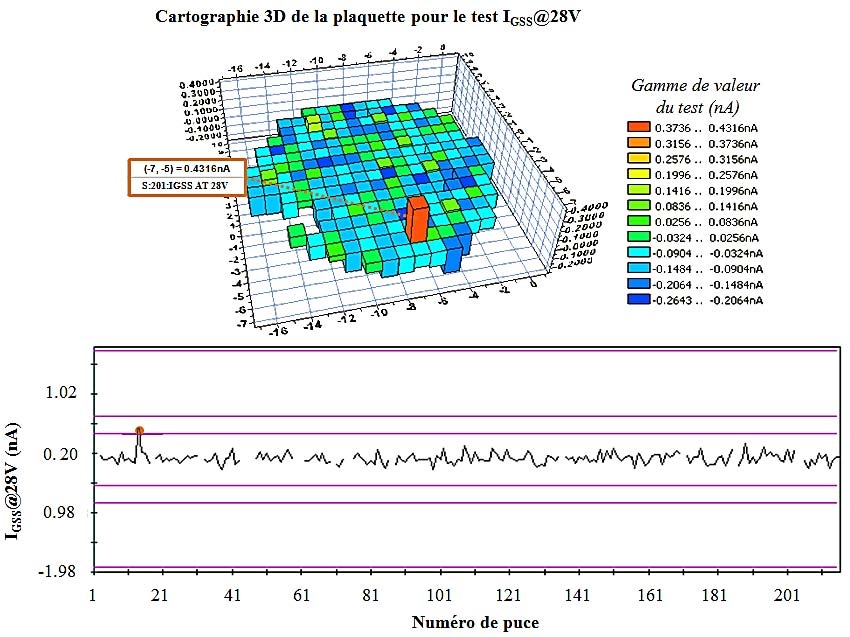
That thesis documented Streetwise Engineering in automotive power-MOSFET research. Engineers could write analysis recipes to examine parametric outliers, regression relationships and changes between tests. It also supplied an essential restraint: marginality needed validation against the application, because stricter screening could reduce yield.
In a related traceability study, module testing revealed a problem with a chip-level leakage limit. Following the devices back to their wafer records helped justify halving that limit from 50 to 25 nanoamps. Two studies involving more than 60,000 chips found an average yield reduction of 0.18 percent. The limit was implemented. This was a specific engineering result, not a published price or a company-wide return on investment.
Two ways to pay for better testing
The company’s history helps explain its interest in manufacturing economics. Test Advantage began in 1997. By the 2009 partnership announcement, the wider business included refurbished test equipment, leasing and rental capacity, and proprietary software. Capacity and information were two routes to addressing the expense of semiconductor test.
In 2010, Boston Semi Equipment Group announced its acquisition of the hardware operation. The announcement said the software business would continue separately. Alongside Streetwise, it described Express, a standalone rules-based engine intended to support product transfers across test platforms and improve test quality and efficiency.
For the software operation, the commercial proposition is business-to-business: deploy proprietary analysis in a manufacturing environment and support its use. A reviewed Streetwise reseller listing invites a quotation. That fits the practical character of the sale: a buyer has to establish how the software will work with its data and production decisions before the purchase becomes meaningful.
Founder Fabrice Dechoux’s own biography reports a software-division sale in 2022. It also credits the broader Test Advantage business with earlier equipment placements and entrepreneurial recognition. Those historical achievements belong to the business’s evolution; they should not be mistaken for a present-day software revenue figure.
What a buyer should recognise
Test Acuity’s documented distinction is the combination of device variability analysis, multiple manufacturing data flows and a traceability partnership. Those functions now sit in a wider competitive field. PDF Solutions’ Exensio Test Operations, for example, offers outlier detection, adaptive testing and automated test-data collection. A buyer can compare approaches without assuming that an old deployment establishes a permanent performance lead.
The decision turns on the factory’s actual problem. Is useful process evidence stranded upstream? Are devices being compared with the right population? Can the organisation follow an individual chip into the next operation? What happens to yield when a new screening rule is introduced? These questions turn a software demonstration into an engineering evaluation.
Test Acuity Solutions makes an unusually concrete case for contextual judgement. The pass-or-fail result remains useful. Beside it belongs a second inquiry: whether the device’s history, relationships and surroundings give engineers a reason to look again.