Ryan Peddycord remembers being asked to leave. At UC Santa Barbara, where he played water polo, older teammates walked out on their coach and wanted him to join them. He kept attending practice. In his telling, nearly the entire team departed; the following season ended 2-22. Eventually, the team worked its way back into the national top seven. There are more glamorous ways to begin a business biography than a season spent losing almost every match. This one has the advantage of explaining something.
Years later, Peddycord would build a holding company around the freedom to stay: with a business, with its managers, with an investment whose useful work might outlast a conventional fund’s schedule. That does not make a college pool a business school. It does suggest why the unpleasant part of a commitment interests him. A principle is easy to admire before it sends you the bill.
A useful education in other people’s businesses
Peddycord was born and raised in San Diego. He studied at UC Santa Barbara and later attended Harvard Business School’s Executive Education program. His working education came through B2B companies: the largely unglamorous businesses that sell information, services and supplies to other businesses. These are markets where a returning customer can matter rather more than an admiring audience.
At ARS, a data analytics and competitive intelligence business, he helped lead a turnaround before its sale to Current Analysis. Mike Hagan, the owner he worked for, later credited Peddycord with helping shape the company and managing the practical work of integration. Sales compensation, overlapping clients, technology and products all had to fit together. An acquisition announcement is a remarkably short document compared with the work it sets loose.
Then came Resource Nation, founded in 2006. Its proposition was practical: help companies find vendors. In 2010, it launched EverythingBusiness.com, a directory spanning more than 125 categories. Peddycord described two sorts of buyers: those who wanted assistance and those who preferred to search independently. He was building for both. The distinction is modest, observant and useful - the sort of thing a business can actually sell.
Buying a very large front door
On February 16, 2011, Resource Nation announced its acquisition of the Business.com brand and associated assets. JMI Equity provided funding, and Peddycord would lead the combined operation. More than 10,000 advertising customers were part of the combined proposition. Business.com would retain its name while being integrated into Resource Nation. It was a recognizable address attached to a business with considerable work ahead.
By August, Business.com Media was reporting its fifteenth consecutive quarter of revenue growth, continuing the earlier Resource Nation run. The company had recruited executives with experience at eBay and Experian and reported 96 percent renewal rates among its largest customers over the preceding two years. These were company-reported figures, tied to that period. They show the measures occupying Peddycord’s attention: customers staying, customers spending, and the people required to support them.
That history helps explain his later appetite for manufacturers and distributors. Digital marketing and metal fabrication look distant from one another. Each still needs a way to find customers, a reason those customers return and an organization capable of delivering what was promised. Peddycord’s career has moved between sectors while returning to those operational questions.

The clock he wanted to remove
Peddycord founded Tide Rock in 2013, using his own capital and support from investors who had backed him as an operator. He had experienced different investors and boards and had become dissatisfied with interests that failed to line up. His answer was a holding company able to own businesses without a predetermined fund termination date.
The other central choice was to avoid bank debt when buying companies. Tide Rock raises equity and makes quarterly distributions to investors from operating profits. It can therefore provide cash returns while continuing to own a business. The arrangement gives Peddycord room to talk about an acquisition as the beginning of an operating relationship, rather than the start of a countdown.
There is a seller’s problem inside this financial design. A founder may want to retire while still caring very much about the staff, the name above the door and the customers who have called for twenty years. Price matters. So does what happens on Monday after completion. Peddycord’s proposition is built to address both conversations.
- Equity capitalFunds the acquisition
- Operating businessesEarn profits; receive growth support
- Quarterly distributionsReturn cash to investors
Removing acquisition debt does not make a business immune to bad decisions or weak demand. It changes the obligations around it. Money that would service a bank acquisition loan can support other uses. A longer holding horizon also changes the questions a manager can ask about hiring, machinery or a sales team whose work takes time to pay off.
What he sees in a founder’s workshop
Peddycord gravitates toward established businesses with products customers need repeatedly and relationships that have survived for years. In manufacturing, he looks for something differentiated. A founder may be exceptionally good at making the product and less practiced at building the sales organization around it. The gap is commercially interesting precisely because the product already has a reason to exist.
That is a revealing preference. The dramatic entrepreneur starts with a blank page. Peddycord often starts with a page somebody has been writing for decades. The assignment is to understand the handwriting before adding a paragraph. His operating background becomes part of the pitch: he has been responsible for the work behind the numbers.
Tide Rock’s support has included a library of more than 100 operating modules, covering subjects such as account management, business development and contracts. In 2024, Peddycord described Premier LogiTech gaining the backing needed to support a larger customer relationship with Motorola. A small company can have the capability and still need a larger organization standing behind its promise. His work sits in that space between competence and capacity.
Permanent capital, with an exit door
By March 2024, Tide Rock had invested nearly $500 million across more than 30 businesses, according to Peddycord’s account at the time. By October 2025, it announced more than $1 billion in acquisition capital. Those are dated milestones with different measures. Neither is a statement about his personal wealth, and acquisition capital should not be mistaken for annual sales.
Freedom to hold also leaves freedom to sell. Accu-Fab, assembled from two separate metal fabrication businesses, passed from Tide Rock to Mayville Engineering Company in July 2025. Tide Rock described the next owner’s scale as a way to support another stage of growth. The transaction gives the philosophy a useful boundary: permanent capital permits patience; it does not require permanent possession.
Peddycord’s ambitions at the billion-dollar milestone were strikingly procedural. He wanted to keep improving consistent execution and supporting the people doing it. He described the scale as something that had accumulated while the team worked on the model. It is an ambition with fewer fireworks than another arbitrary target, and rather more meetings.
Give the software a sales assignment
His approach to AI follows the same commercial instinct. In 2025, Tide Rock described using its own development resources to identify acquisitions and prospective customers. At Airsupply Tools, the focus included supporting sales and marketing alongside founder Sean Hutchens. The people who understood the products remained central to the growth plan.
“We use AI to make great people more effective.”Ryan Peddycord · 2025
That is a choice about where to put scarce engineering attention. Third-party software can supply routine efficiency tools. His team’s distinctive effort can go toward finding demand that a portfolio business has not yet reached.
By December 2025, he was explaining how research could identify potential component and service requirements arising from large aerospace and defense contracts. The purpose was to help suppliers approach opportunities earlier. For someone who once ran a business connecting buyers with vendors, the continuity is almost comic. The software has changed considerably. He is still trying to introduce the right businesses to each other.
The difficult conversation comes along too
A photograph Peddycord shared from an executive retreat shows a group gathered among red rocks. His accompanying account was less concerned with scenery. The team had put away phones and examined its playbook, its blind spots and how candidly people could speak to one another. He acknowledged that he, too, had become more able to have those conversations.
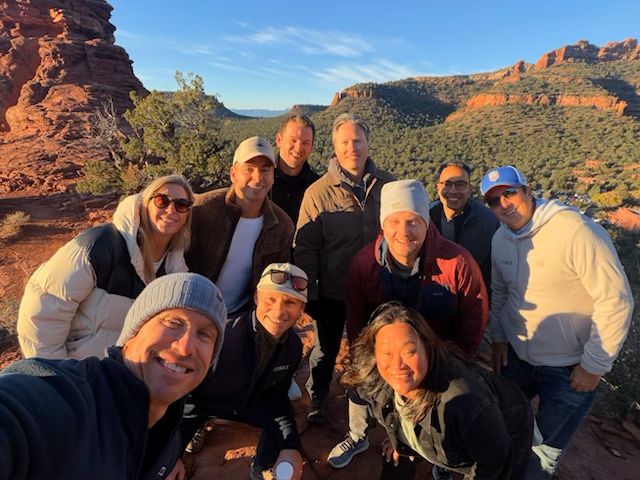
Outside work, his interests include surfing, snowboarding and triathlons. He has three children and remains connected to YPO, the Young Presidents’ Organization. The water polo player is still visible in that collection of pursuits, but the business lesson he draws is less about winning than maintaining standards when doing so becomes inconvenient.
In discussing hiring, he describes the temptation to accept a merely adequate candidate after a long search. Waiting has a cost; colleagues absorb the unfinished work. His response is to keep searching. That is the less photogenic side of patience. Someone has to live through it before it becomes a virtue in a presentation.
His October 2026 Grit Rising conversation with old college friend Trent Bryson returned to leadership and principles. The pool story still belongs in the discussion. Staying can mean a miserable season, another difficult meeting or an investment allowed to develop on its own timetable. Peddycord has built a career around giving that decision room to work. Then comes the part no structure can automate: showing up again.