Before Tessa Barron was an executive paid to think about transformation, she was a Rice University student trying to understand a marketing plan. The setting was the Houston Symphony in 2005. Barron had arrived from a political science program with no marketing or communications coursework. Then a mentor handed her the sort of assignment that makes an internship suddenly feel less like supervised tourism: build a subscription campaign plan.
Her first response was not the polished confidence that executive biographies retroactively apply to their subjects. She was lost. She tried to reason her way through the assignment alone, discovered that solitude was not a strategy, and began asking her mentor and his assistant for daily suggestions. She revised. She learned. Eventually she produced a plan that met the brief. In the essay she wrote afterward, Barron borrowed Plato's cave to describe the experience. The metaphor was ambitious; the lesson was plain. Expertise begins when embarrassment stops preventing a good question.
That small origin story gives her later career an unusually clean spine. Barron did not fall in love with a marketing channel. She learned to look for the institution around the channel: what it values, how it works, whom it serves and which people know what she does not. Twenty-one years later, Lumivero lists her as Chief Transformation Officer. The title has widened since she joined the software company as Chief Marketing Officer in 2024, but the original habit is intact. Understand the business. Find the guides. Then make the plan.
With a guide, navigating through darkness is much easier.Tessa Barron, reflecting on her 2005 internship
Political science, public affairs and the long way into marketing
Barron graduated from Rice in 2007 with a degree in political science and government. It was not a detour from her eventual work so much as early training in power, persuasion and institutions. Her first professional chapters ran through California Strategies and Marvell Semiconductor, where public affairs, policy and corporate reputation met. A former Marvell colleague later praised her strategic intuition, writing and ability to build the company's standing in its community.
Agency roles followed at PPR Worldwide and SutherlandGold Group. Then came work with Apigee and a product marketing stint at Google. The logos make a tidy progression, but the useful accumulation was perspective. Public affairs taught her that organizations speak to more than buyers. Agency life exposed her to different problems and operating speeds. Enterprise technology forced her to translate complex products. Startups required thrift. Each environment added another window onto the same building.
A General Assembly profile from her ON24 years captured the range neatly: Barron helped enterprises and startups build brands and animate them through content experiences, on both the agency and in-house sides. It also noted that the California native split her time between San Francisco and New York. Her center of gravity would become New York, but her working vocabulary remained comfortably bicoastal: Silicon Valley product logic with East Coast impatience for ornamental language.
The enjoyable nuisance of marketing to marketers
Barron joined ON24 in 2016 and stayed for nearly eight years, eventually becoming Senior Vice President of Marketing. The company sells digital engagement software, including the webinars its own marketers used. This created a professional hall of mirrors. She understood the customer because she was the customer. She also knew the danger of an industry becoming fascinated by its own vocabulary.
In a 2019 interview, she described the assignment as both rewarding and maddening. Marketing to marketers made empathy easy and novelty difficult. Everyone in the room already knew the playbook. Her answer was to begin outside the room: read trade newsletters, scan the news and collect the odd data point or perspective capable of breaking the internal spell. It was a wonderfully analog prescription for a digital profession. Read widely before you send anything.
She was equally blunt about attribution theater. A vendor claiming that one tactic produced an entire pipeline invited skepticism, not applause. Marketing systems are messier than conference slides suggest. Buyers meet brands through multiple moments; sales, product and marketing all alter the outcome. Barron preferred an integrated campaign held together by a distinctive story, with webinars, email, advertising, direct mail, video and ebooks doing their particular jobs.
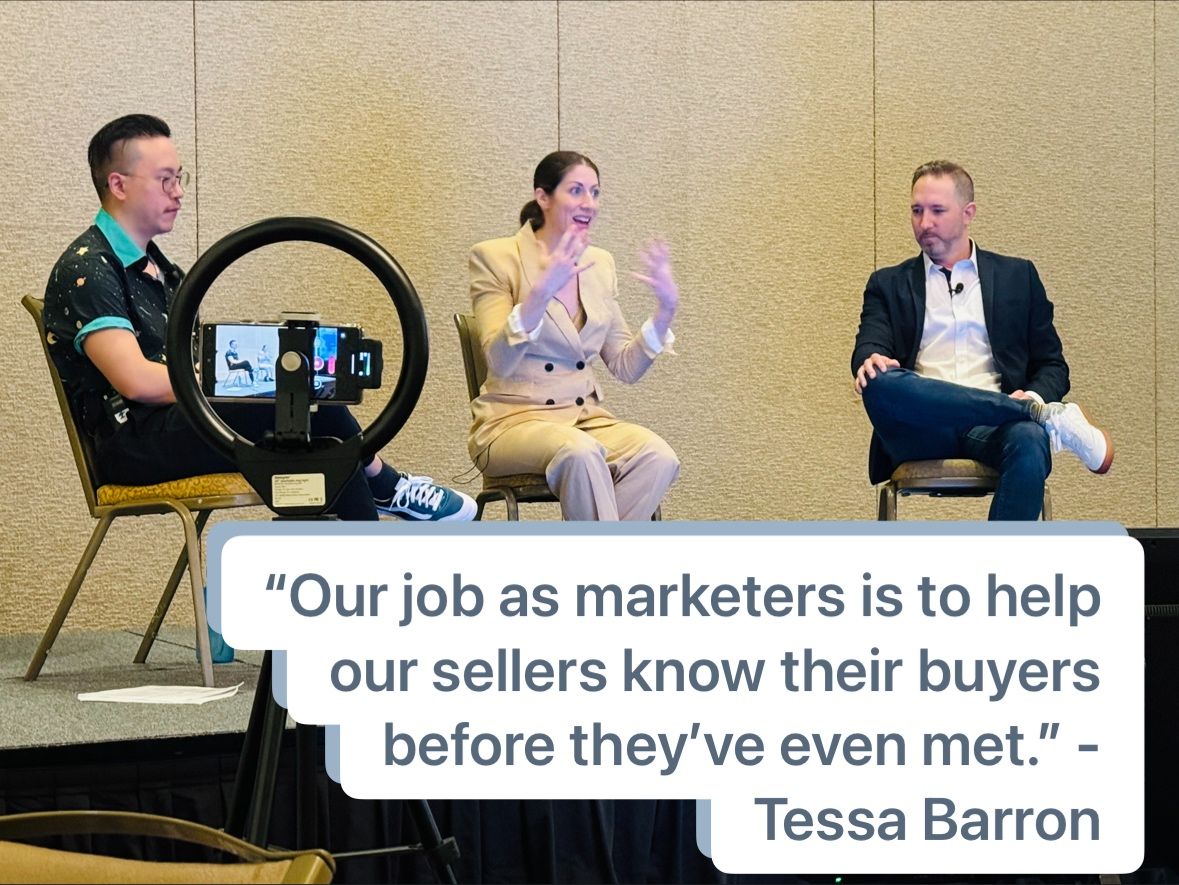
It's the story that you're telling through the tactics that matters most.Tessa Barron on cutting through B2B noise
Her campaigns could still be playful. The ON24 team developed a “Scrappy Marketing” idea around the familiar panic of too much work and too little time. Graffiti-like creative turned the disorder of a marketer's day into the aesthetic rather than concealing it behind smooth corporate gradients. The campaign said “get it done,” but its production model was more interesting than its slogan: Barron's team scaled design through an outside partner while keeping the ideas and operational knowledge close.
Scrappy, with standards
“Scrappy” can be a flattering name for understaffed. Barron's version carried a higher demand. Everyone should understand some execution. The content creator might help distribute the work; the event marketer might write promotional copy. This was not a plea for specialists to dissolve into a cheerful generalist soup. It was a belief that strategy becomes brittle when its author has forgotten how delivery works.
That conviction also explains her interest in flexible teams. The marketing organization she later described at Lumivero combined internal leaders, specialists and freelance capacity. The point was not merely cheaper labor or a fashionable org chart. It was to match stable ownership with variable expertise. Audiences remained somebody's responsibility even as the mix of people and tools changed around them.
Know the business
Understand value creation, growth sources and changing customer behavior before prescribing a channel.
Own an audience
Organize around the people the company serves, rather than the media used to reach them.
Plan on purpose
Use a rigorous cadence to turn strategy into choices and cross-functional commitments.
Stay near the work
Execution knowledge keeps strategy practical and makes handoffs between specialists more intelligent.
The same pragmatism shaped her view of digital experience. During ON24's virtual-event years, Barron argued for personalized, human-to-human encounters woven into existing marketing motions. The phrase mattered because digital marketing had grown fond of treating scale as a synonym for distance. Her preferred model used first-party engagement signals to make the next interaction more relevant, not merely to make the dashboard busier.
When the CMO starts redrawing the org chart
Lumivero hired Barron as Chief Marketing Officer in 2024. The company assembles software for qualitative analysis, statistics, research, experiential learning and decision support. Its portfolio includes names such as NVivo and XLSTAT, tools often used by researchers who care less about marketing taxonomy than whether their evidence can survive scrutiny. Barron's remit covered brand, go-to-market strategy and profitable growth. It was an assignment full of seams: distinct products, distinct audiences and a shared company story still being made.
On the Executive Guidance podcast in early 2026, she described the operating philosophy behind that work. Marketing leaders needed business acumen more than narrow technical mastery. They had to know where value came from, where growth might come from next and how customer behavior was changing. A marketing department that simply accepted requests would remain a service function. One that understood the audience and economics could help shape the company.
This is the unglamorous route to influence. No dramatic manifesto is required. The instruments are planning cadences, clear owners and difficult conversations across product, sales and finance. In Barron's model, audience ownership outranks channel ownership because a customer does not experience the company as a collection of departmental specialties. People see one company, even when the company sees six software products and a spreadsheet of internal accountabilities.
Lumivero's current leadership page now names Barron Chief Transformation Officer. Recent company event pages put her beside topics such as AI-assisted research, decision visualization and project risk. The shift looks less like a departure from marketing than the consequence of taking her argument seriously. If a marketing executive is responsible for understanding the whole value system and aligning the people inside it, the job has already crossed the department's border.
The beginner's mind, promoted
There is an appealing symmetry between the student who did not know how to make a subscription plan and the executive charged with transformation. Both assignments begin with incomplete information. Both punish the person who performs certainty instead of building understanding. Both depend on asking better questions of people who see a different part of the system.
Barron's public personality is clearest in the friction between seriousness and skepticism. She believes stories matter, but distrusts fluff. She values data, but rolls her eyes at vanity metrics. She likes technology, but keeps returning to human-to-human experience. She once picked Dolly Parton as a model of an original, self-made brand and praised The New York Times' “The Truth Is Worth It” campaign for standing for something larger than its product. These choices suggest a marketer drawn to identities that feel inhabited rather than assembled.
They also explain why her career has expanded beyond communications. Transformation is partly a contest over what an organization believes itself to be. A brand can describe that belief, but an operator has to make the processes and incentives agree with it. Barron's route through policy, agencies, products, events and executive planning gave her practice on both sides of the sentence.
The student essay ended with illumination. The grown-up version is less final. Companies keep changing, customers keep moving and every planning cycle produces another dim room. Barron's advantage may be that she never made certainty the price of admission. She learned early that the map can be drawn while walking, provided somebody is willing to ask where the walls are.