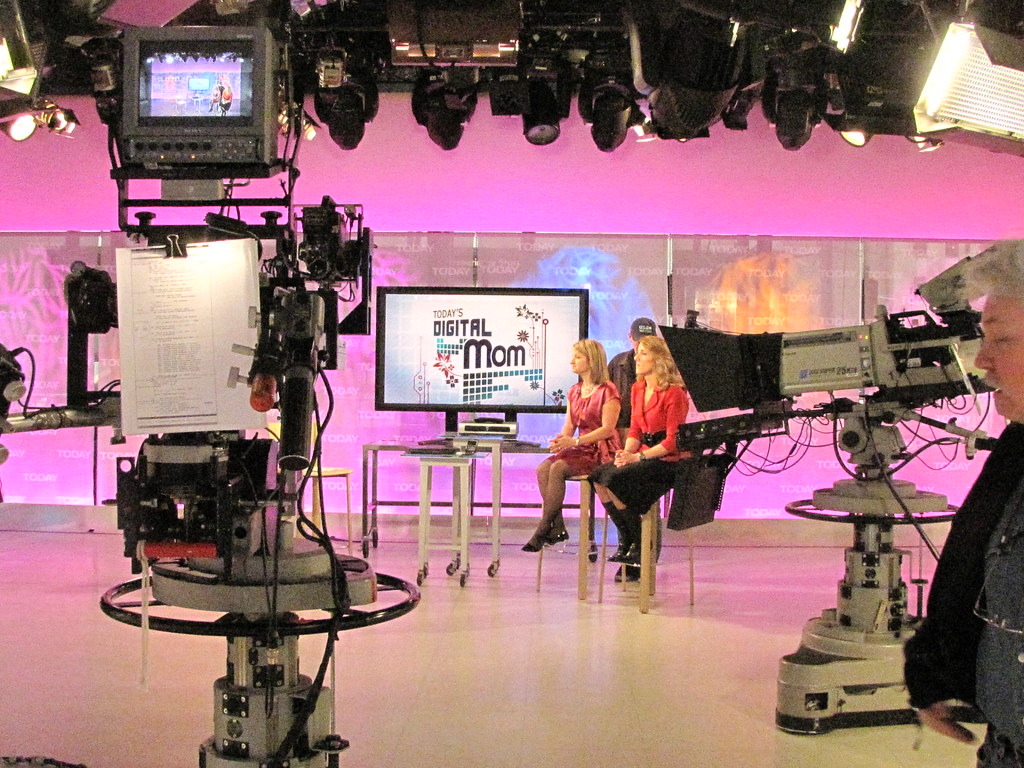
There is a photograph from a television studio in 2009 that doubles as a portrait of an industry catching itself in the act of changing. Cameras crowd the foreground. Two women sit beneath a monitor that reads “Today’s Digital Mom.” The phrase now sounds almost quaint, a little relic from the years when digital life could still be treated as a separate province. Terri Walter was there because she had helped prove it was already ordinary.
At Razorfish, where she was vice president of emerging media, Walter authored research with CafeMom based on 1,500 digitally active mothers. The findings resisted the lazy habit of describing mothers as a single demographic block. Behavior changed with the age of a woman’s children. Social networks, text messaging, gaming and mobile browsing were already shaping how people researched and bought things. The report supplied numbers, but its sharper contribution was a change of focus: watch the behavior before inventing the marketing plan.
The work escaped the usual orbit of conference decks and trade newsletters. It inspired a two-day series on NBC’s Today show and earned a Stevie Award for Women in Business. Walter’s LinkedIn account describes the report as an early marker of the mommy-blogger movement and credits it with popularizing “Digital Mom.” However one judges the durability of that label, the episode established a pattern that would recur across her career: enter when the market’s vocabulary is inadequate, gather evidence, and give the change a name sturdy enough to travel.
A career written in new nouns
Read Walter’s résumé in sequence and it resembles a compressed history of digital advertising. There were account roles at Grey Global Group and Beyond Interactive, then marketing leadership at DoubleClick. At Razorfish she worked in “emerging media,” a useful bucket for everything the existing org chart had not yet learned to hold. At Microsoft Advertising, she led global brand marketing and a repositioning effort that covered advertising, content, sales enablement and go-to-market work.
Then came programmatic. PubMatic appointed Walter chief marketing officer in 2014, when real-time bidding was expanding quickly and its machinery still required translation outside the specialist crowd. Her remit included product marketing, corporate communications and social media. In 2015, Kargo hired her as its first CMO amid a rush toward the phone. The company spoke then of creativity, efficacy and viewability in mobile advertising. These were not merely campaign themes. They were attempts to decide which qualities should define a young category.
The category builder’s loop
The industry has never suffered a shortage of names. It produces acronyms with the cheerful abundance of a government department. Walter’s particular craft is more useful: connect a technical capability to a recognizable human or commercial problem. A category earns attention when it explains experience better than the old language did.
“Many of the marketers I talk to are still looking to prove the value of their brand and connect it to growth.”Terri Walter, announcing her move to DISQO
Attention, trust and the parts between
At Chartbeat, where Walter served as CMO, the central subject shifted from ad delivery to reader attention. She wrote about subscription status not as a finish line but as another lens on behavior: what subscribers read, how they return, and how editorial strategy changes when publishers look beyond conversion. In an interview with a CNN writer about breaking news, Walter asked how teamwork, platforms and metrics could help a newsroom deliver an accurate, authentic story. The questions carried an implicit warning. A metric is not neutral merely because it arrives in a neat column.
Her later work at TRUSTX added trust and supply-chain quality to the equation. By 2023, she had served as the company’s chief growth officer and joined MadTech as an executive marketing consultant and product marketing practice lead. The assignment there was to help brands, publishers and agencies define products, position them and bring them to market while the foundations of digital media shifted beneath all three groups. She also spent several years working with AI startups, gaining direct exposure to the way artificial intelligence was changing marketing before taking her current post.
Digital behavior gets a mainstream stage
The Razorfish and CafeMom study maps how mothers use social, mobile, messaging and games.
Programmatic and mobile seek a voice
Walter becomes CMO at PubMatic, then the first CMO at Kargo.
Attention and trust enter the frame
Leadership roles at Chartbeat, TRUSTX and MadTech put publishing quality and market infrastructure at the center.
Measurement meets the AI era
Walter joins DISQO to lead marketing, communications and go-to-market strategy.
That range matters. Walter has viewed advertising from the agency, ad platform, publisher analytics, marketplace, consulting and measurement sides. Each has its own preferred truth. The agency prizes the idea. The platform sees delivery. The publisher sees attention. The marketer sees brand and sales. The consumer, sensibly, sees none of these organizational boundaries. She simply moves.
The funnel becomes a subway map
In April 2026, DISQO named Walter chief marketing officer, reporting to CEO and co-founder Armen Adjemian. Her responsibilities span brand, communications and go-to-market strategy. Her arrival placed her inside another vocabulary fight, this time around advertising intelligence, full-funnel measurement and AI. The tidy consumer journey has been fraying for years. Social, television, connected television, programmatic media, search, ecommerce and now language models can all participate in discovery and decision-making. The funnel now looks less like kitchenware and more like a subway map designed during a committee argument.
Walter’s public framing is direct. Marketers want to prove brand value and connect it to growth. To do that, she argues, they need to close blind spots across channels, including walled gardens and LLMs. DISQO’s pitch is to connect campaign exposure with both attitudinal measures, such as awareness, consideration and purchase intent, and behavioral outcomes, such as search and site visits. The ambition is not another count of impressions. It is a more complete account of what changed after the impression.
One campaign, several kinds of evidence
Conceptual signal map - this explains the model and does not represent campaign results.
“These are the signals the next era of advertising will run on.”Terri Walter on brand and behavioral outcomes
The statement fits her career because it treats measurement as language. Signals only become useful when teams agree on what they mean and what action follows. A brand-lift result that cannot change a media plan is decoration. A behavioral signal stripped of context may be precise and still mislead. Walter’s work has repeatedly occupied this junction between product truth and market meaning.
Thirteen trips to the Croisette
A small detail from Walter’s summer offers another angle on how such a career compounds. In June, she attended her thirteenth Cannes Lions and her first with DISQO. Her reflection emphasized breakfasts, dinners, conversations with clients and fellow CMOs, and the strange industry village that temporarily assembles along the Mediterranean. She described advertising as standing at a crux of changes in discovery, technology, sports, shopping, music and social influence.
Thirteen visits are not a credential in themselves. They are a measure of repeated exposure to the same market as its fashions, fears and favored nouns rotate. The long view makes patterns easier to spot. Mobile moves from “emerging” to ambient. Programmatic travels from specialist jargon to infrastructure. Attention challenges the click. Privacy reshapes the supply chain. AI enters first as a tool, then as a channel through which people discover and decide.
Walter’s public profile also lists working knowledge of Japanese, graduate study at Columbia’s School of International and Public Affairs, and recent credentials in go-to-market strategy and P&L fluency. Those facts point toward the breadth beneath the marketing titles: language, institutions, operating mechanics. Category creation requires all three. Someone must understand the system, read the people inside it and make the economics believable.
The useful thing to steal
The practical lesson from Walter’s path is not “be early.” Early is often another word for wrong in an empty room. Her better habit is to locate the gap between lived behavior and the story an industry tells about it. In 2009, mothers were already socially networked, mobile and gaming while marketing plans lagged behind. In publishing, a conversion alone could not explain durable reader engagement. In today’s advertising market, a campaign can touch a person across systems that refuse to share a common window.
Find that gap, then do three things. Describe the behavior without flattening it. Build evidence that can survive outside the sales deck. Give the market a phrase that helps people decide what to do next. The order matters. Begin with the phrase and one gets fashionable fog. Begin with the behavior and the language has a chance to last.
Walter has said it is time for brand measurement to match the pace of AI innovation. The sentence is an aspiration, but also a summary of the work still ahead. Technology changes quickly; organizations change reluctantly; measurement arrives somewhere in between, carrying a clipboard and asking everyone to hold still. They never do. Terri Walter’s career has been built on noticing the motion anyway.